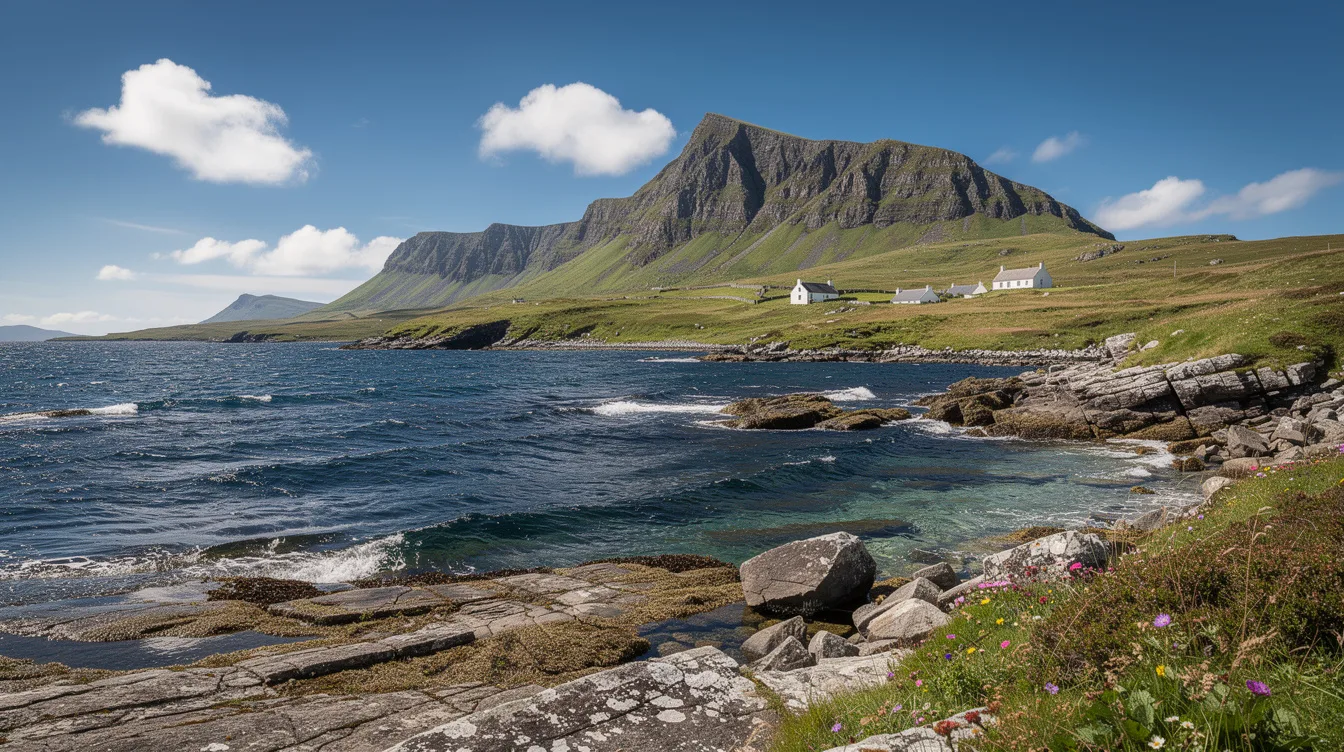
Eigg rises 1,289 feet above a community that took charge of its future in 1997. On this Small Isle off Scotland’s west coast, the summit of An Sgùrr looks down on a place that now produces virtually all its electricity from renewable energy.
That contrast is Eigg’s pull. The island feels spare and weather-led, yet its roughly 100 residents run a locally managed power system. And if you come expecting a museum piece, you’ll find something more useful: a lived-in community with clear ideas about how an island can work.
It’s south of Skye and north of the Ardnamurchan peninsula, reached from Mallaig by ferry. The crossing is close enough to plan but far enough to make the mainland feel suddenly irrelevant.
A 1997 buyout changed the island’s direction
In 1997, the Isle of Eigg Heritage Trust bought the island for community ownership. That fact matters because Eigg’s renewable system isn’t a decorative environmental claim. It comes from residents having a direct stake in what powers their homes and businesses.
You’ll notice the scale quickly, so the big story is never far from the everyday one: a ferry arrival at Galmisdale, a bike leaning outside a house, electricity made locally rather than simply arriving by cable.
But community ownership doesn’t make Eigg frictionless. Visitor accommodation and camping capacity are limited, so an overnight stay needs advance planning. That limitation is part of the deal, and it keeps the island from becoming a place you merely consume between ferry times.
The renewable system draws on local wind, hydro, and solar resources. You don’t need technical knowledge to appreciate its meaning. You only need to stand on an island surrounded by sea and understand why local control carries real weight here.
An Sgùrr gives Eigg its hard edge
An Sgùrr is Eigg’s highest point, a dramatic ridge of pitchstone rising to 1,289 feet. It gives the island a sharper profile than its modest size suggests, and it’s the feature that turns a ferry approach into a proper arrival.
The climb is worth considering only with suitable weather and a clear sense of your own footing. But reach the top in good conditions, and views can extend toward Mull, Coll, Muck, the Outer Hebrides, Rùm, Skye, and mainland mountains.
You’ll be looking across a lot of water, but Eigg itself stays under your feet. The central plateau, valley, and coast make the island feel compact rather than empty. And that compactness means the summit is never just scenery, it’s a reference point.
There’s a geological story beneath the shape. The ridge formed from pitchstone that erupted into a valley of older lava during the Eocene epoch, then cooled into visible columnar joints. Its volcanic form explains why the island’s skyline feels so unexpectedly severe.
At Laig, the beach answers back
Beyond the harbor, Bay of Laig has a quartz beach called the Singing Sands. When the surface is dry and conditions cooperate, sand underfoot can make a squeaking sound. It’s a small effect, but it changes the way you walk.
Camas Sgiotaig is not a guaranteed performance. Wet sand won’t deliver the same noise, so go with curiosity rather than entitlement. But when it does speak, the sound is oddly intimate, a dry little chirp beneath each angled step.
You can explore Eigg mainly on foot or by bicycle, which suits a place this size. Cars don’t set the rhythm for visitors here. And because movement is slower, you notice the practical details: the slope ahead, the wind at your back, the ferry’s distant presence.
The island is lively in its own quiet way, but never built for rushing. If you need constant options, Eigg will feel constrained. Its small scale is exactly why a short walk can hold your attention longer than expected.
The ferry is part of the trip, not an afterthought
The usual route is the CalMac Small Isles service from Mallaig to Galmisdale. Ferry schedules vary, and not every sailing makes a practical same-day return. Check the exact pattern and weather before you commit to a plan.
Galmisdale is the island’s main port, at the southeastern end of the central valley. From there, Eigg unfolds at human pace. You’ll understand fast why an overnight stay can be more rewarding than trying to force the island into one hurried afternoon.
Bring patience with the logistics. The weather has a say, and the ferry does too. But the payoff comes late in the day, when fewer people are moving and the island’s renewable-powered homes sit beneath the dark rise of An Sgùrr.
By the time the ferry pulls away, the water closes over the route back to Mallaig. Eigg’s 1,289-foot ridge remains above the harbor, black against the last light.