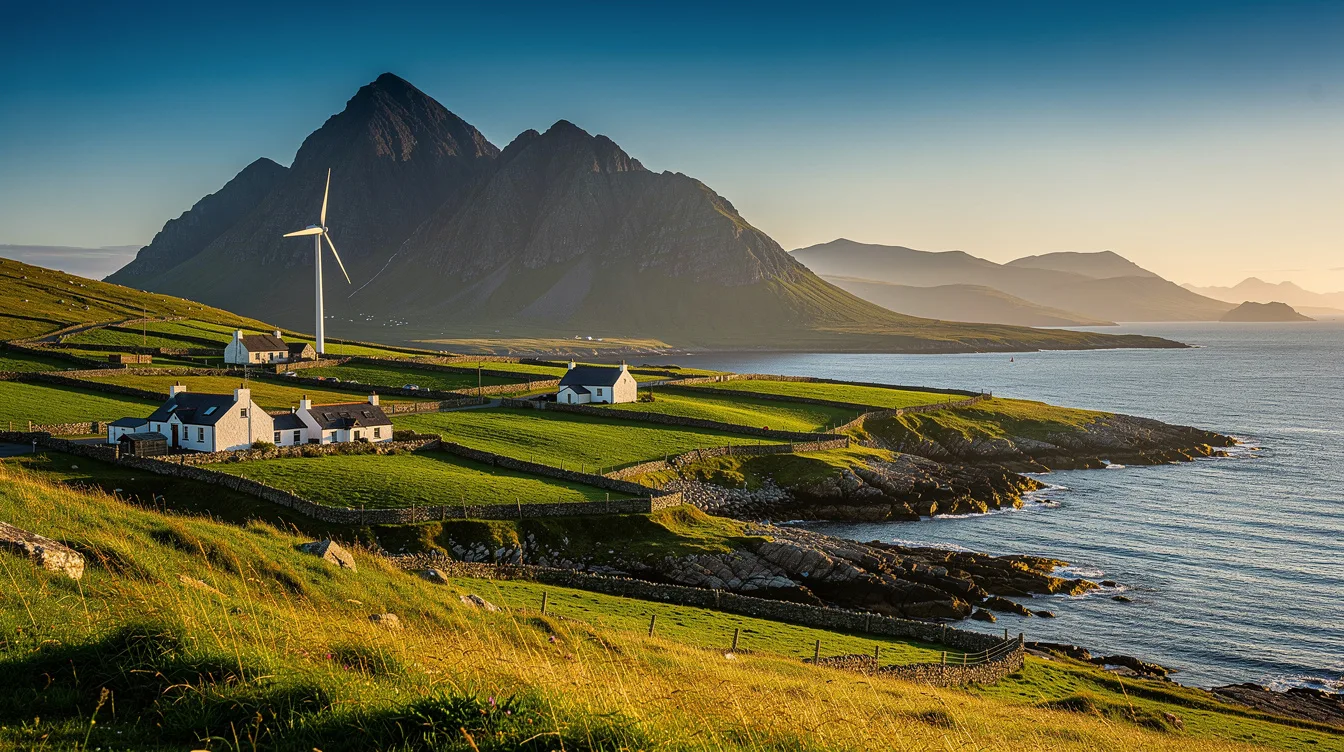
Eigg makes nearly all its electricity from sun, wind, and water through a local off-grid system commissioned in 2008. On a small Scottish island, that fact feels less like branding and more like the practical rhythm of daily life.
You reach Eigg by CalMac ferry from Mallaig, across water in Scotland’s Inner Hebrides. The crossing is part of the point. It leaves mainland plans behind and puts you on an island where visitors cannot bring cars without special permission.
A power system that changed island life
Eigg’s renewable grid combines solar power, wind, and hydropower, so the island no longer depends heavily on diesel. And because the system is local and off-grid, electricity here has a visible connection to weather, water, and the community using it.
The island has been community-owned since 1997, when the Isle of Eigg Heritage Trust bought it. That ownership matters because the power system was not dropped onto a blank map. It grew from an island trying to hold onto homes, local work, and year-round life.
You won’t find a visitor center turning the grid into a theme park. That restraint is refreshing. Eigg’s achievement is strongest precisely because it is ordinary infrastructure, keeping lights on in a place reached by ferry.
But don’t come expecting a frictionless resort break. Eigg has roughly 105 to 110 residents, limited accommodation, and weather that can disrupt ferry plans. Book early for stays from May through September, then check the CalMac timetable again before committing to connections.
An Sgùrr gives the island its hard edge
The island’s defining climb is An Sgùrr, a volcanic pitchstone formation rising to 1,289 feet. It looks almost too abrupt for an island this compact, which is why it pulls your eye long before you begin walking.
Reach the top in clear conditions and you can look toward Rùm, Skye, Muck, Ardnamurchan, and the Outer Hebrides. And the view earns its reputation through contrast: dark rock underfoot, open sea on every side, and an island community suddenly reduced below.
You should treat the walk as a real hill outing, not a casual harbor stroll. Conditions change, and the reward depends on visibility. When cloud closes in, the volcanic ridge still has presence, but the long-distance views disappear.
Eigg runs about 5.6 miles north to south and 3.1 miles east to west, so you can understand its shape quickly. But its scale is deceptive. A day can fill up fast once you are walking, waiting for weather, and letting the ferry schedule set the boundary.
Singing sand and the slower western shore
At Singing Sands, dry sand can squeak beneath your feet when conditions cooperate. It is a small, odd pleasure, and much better than it sounds on paper. You hear the scrape under a boot and suddenly everyone starts testing another step.
Laig Bay offers a broader stretch of pale sand facing Rùm, with room for walking and watching the light shift over the water. It is quiet, but not empty of character. The bay has enough weather in it to make a short walk feel like an event.
Beyond the beaches, Eigg’s coast can reward patient watchers with seals, porpoises, dolphins, basking sharks, and minke whales. Sightings are never guaranteed, of course. The best approach is to keep looking during the ferry crossing and accept that the sea decides.
There are coastal caves with historical weight, including Massacre Cave and Cathedral Cave. But access depends on tides and conditions, and local notices matter after rockfalls. That is a useful reminder that Eigg is generous without being arranged for your convenience.
Plan for the ferry, then leave room for the island
Most visitors arrive from Mallaig, the nearest mainland port, by ferry to the Small Isles. Schedules and stops vary with season and weather, so an apparent day trip can leave only a few hours ashore. Check the actual time on Eigg before reserving anything.
For many travelers, two or three nights make more sense than a rushed stop. You can explore on foot, by bicycle, or by local taxi when available. And without your own car, the island’s pace stops being an inconvenience and becomes the whole argument.
May through September brings the best window for hiking, beaches, and long daylight. But wind, ferry cancellations, and midges remain part of the deal. Pack for them, and don’t build an itinerary so tight that a changed sailing turns into a crisis.
National Geographic estimated about 10,000 annual visitors in 2019, which sounds substantial until you stand on Laig Bay late in the day. By the time the ferry pulls away, the water goes quiet, the sand cools underfoot, and Eigg returns to its own timetable.