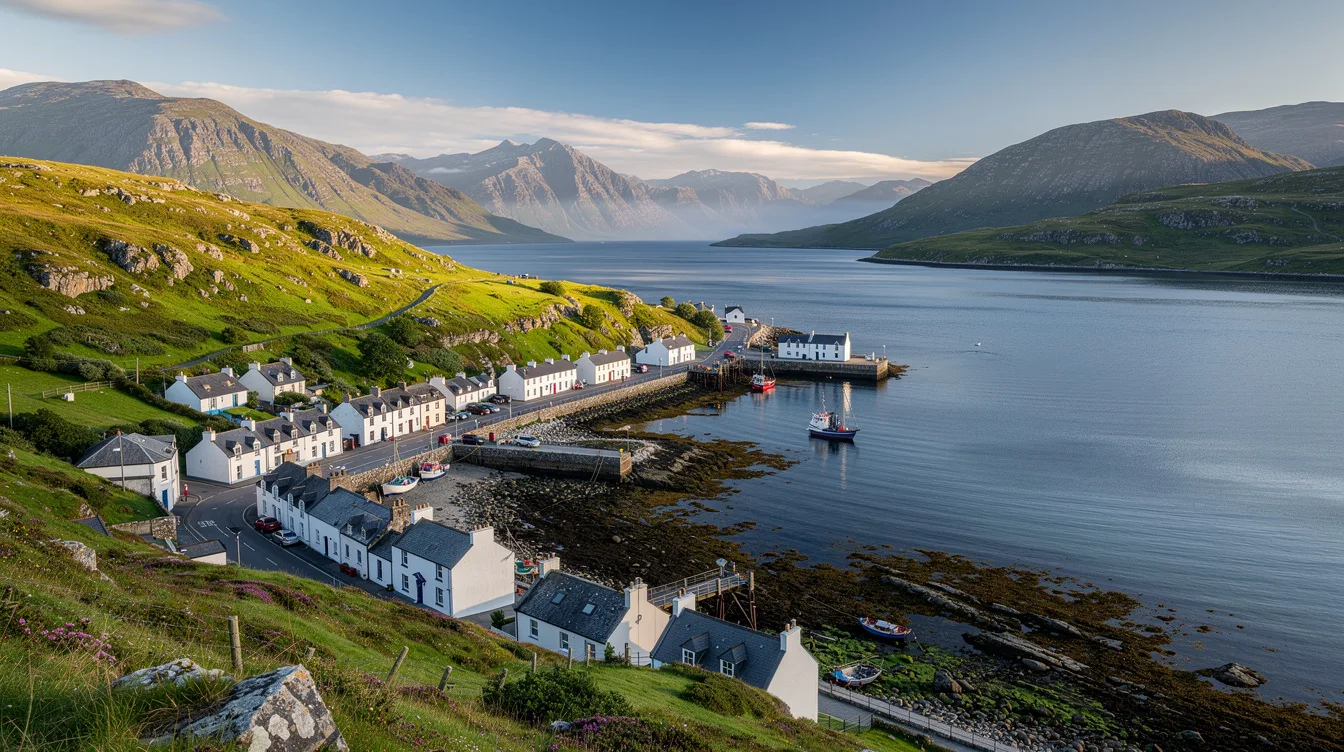
Ullapool was founded in 1788 as a herring port and designed by the engineer Telford. That history isn’t buried in a plaque. It still shapes the waterfront, where white houses face Loch Broom and ferries leave for Lewis.
With about 1,520 residents, the village is compact enough to explore on foot yet useful as a base for Wester Ross. You get a working harbor and ferry terminal. Roads lead north when you want more room, but the mood stays maritime and unhurried.
Why the harbor still explains Ullapool
And the waterfront is the village’s clearest argument. Fishing vessels, leisure craft, yachts, and the Stornoway ferry share the view, so Ullapool feels lived-in rather than arranged for photographs. Walk here first, when the light turns the loch steel gray.
But the harbor’s story reaches beyond boats. The Ullapool Museum occupies an old church designed by that engineer and traces fishing, crofting, religion, and emigration. Because those subjects share one small building, the town’s history feels close enough to touch.
And there’s a useful tension here: Ullapool is quiet, but it isn’t isolated. It remains Wester Ross’s main settlement, with pubs, restaurants, accommodations, arts spaces, and a swimming pool and fitness center. You can plan a rainy afternoon without pretending the weather will cooperate.
Loch Broom turns a small town into a base
And Loch Broom gives the village its reach. Summer Isles cruises leave in summer, with seabirds along the route and possible dolphins or porpoises depending on conditions. The water is the draw, but weather decides how generous the day feels.
But you don’t need a boat to understand the setting. Roads around Wester Ross point toward Dundonnell, Gruinard, Loch Maree, and An Teallach, giving walkers coastal routes or harder mountain days. The view can feel wild while the village remains close enough for dinner.
Can you swim there?
For a dependable swim, the village’s swimming pool and fitness center are the sensible choice. And the loch is better approached for a cruise or walk because conditions can change quickly. You can build the day around the harbor, then head indoors when rain arrives.
Assynt makes the car worthwhile
And this is where Ullapool earns more than a single night. A car lets you reach Assynt and the northwest coast, including Achmelvich, Clachtoll, Stoer, and Lochinver. These places are farther out, so plan before leaving the harbor.
But the payoff isn’t only the destination. Roads open onto changing Highland light, and mountains around Suilven and Stac Pollaidh make a short stop feel larger than the map suggests. You won’t have the freedom of a car-free day, but you’ll have far more freedom beyond town.
Two nights is enough to see the village and nearby surroundings. And three to four nights gives you time to explore Wester Ross and Assynt without rushing, with a Summer Isles cruise if weather cooperates. I think the longer stay fits Ullapool because weather deserves room to rearrange your plans.
The ferry changes the road trip
And Ullapool is more than a Highland endpoint. Caledonian MacBrayne runs the ferry to Stornoway on the Isle of Lewis, making the village a practical handoff to the Outer Hebrides. The terminal gives the harbor a steady pulse when streets feel sleepy.
But the ferry also changes Ullapool’s role in your itinerary. You can stop here before crossing west, or make it a mainland pause within a longer Highland road trip. The town feels like a departure point, not a dead end.
Can you reach Lewis without backtracking?
Yes, the ferry connects Ullapool directly with Stornoway, so you can continue across the water instead of retracing the mainland road. But if you’re taking a vehicle, reserve early for summer travel. And that planning is the trade-off for keeping the islands in your route.
May and June keep the logistics calmer
And the best compromise is May and June, when days are long and visitor numbers are more reasonable. July and August bring more visitors and midges, so the harbor feels busier. You get a better chance at breathing room earlier in the season.
But getting there takes planning. Ullapool lies about 43.5 miles northwest of Inverness, a drive of roughly one hour and 15 minutes to one hour and 30 minutes. The A835 carries you there, and changing weather can stretch the journey.
There is no rail station in the village, so Inverness is the main arrival point by train or air. A car is simplest for beaches and hiking, while bus travel can work for a local stay. Ullapool sits on or near the North Coast 500, but by evening the ferry ropes knock softly against the harbor.