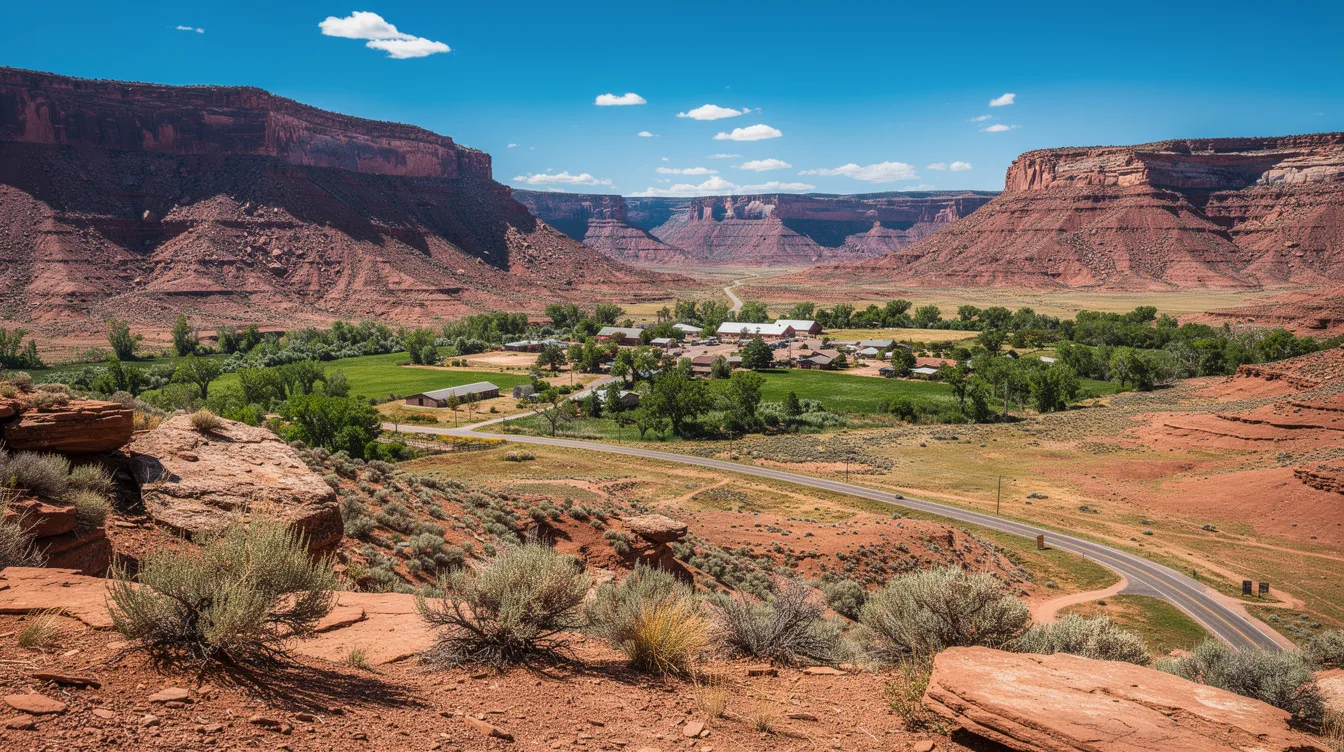
Boulder, Utah had no year-round road until 1939, and that late connection still explains its mood. The town sits in southern Utah’s Garfield County, where a drive can feel less like transit and more like a decision to leave the schedule behind.
You’ll find it 27.3 miles northeast of Escalante on Scenic Byway 12. It’s reachable, clearly, but Boulder still feels apart because the route asks you to pay attention.
A road arrived late, and Boulder kept its distance
Before 1939, Boulder lacked a road that worked year-round. That’s not a quaint footnote. It helps explain why this place of 227 residents in 2020 feels rural even by southern Utah standards.
And the north section of Highway 12 was paved only in 1985. You can feel that history in the gaps between buildings, the open sky, and the sense that nobody has rushed to make the town perform for passing traffic.
Boulder is quiet, but it isn’t a museum piece. You come here for desert country, canyons, slickrock, hiking, camping, and night skies that make a flashlight feel like a small act of defiance.
Scenic Byway 12 is the reason to slow down
Scenic Byway 12 brings Boulder within reach of Escalante, Grand Staircase-Escalante National Monument, and Capitol Reef. But the road itself deserves your attention, especially its Hogsback section, where the route carries you across exposed country with a lot of air on either side.
But don’t treat it like a corridor to somewhere better. The appeal is that Boulder interrupts the usual Utah circuit, offering a quieter pause than Zion, Bryce, or Moab can often manage.
You’ll want to arrive with fuel, water, and offline maps. That preparation isn’t drama. It’s simply the sensible way to travel when the town’s appeal is tied to country that remains wide open.
The Burr Trail leads toward rougher country
The Burr Trail meets Boulder and opens the door to more scenic driving. It’s a strong reason to use the town as a base, especially if you prefer dirt under the tires to another crowded parking lot.
And that freedom has a limit. The Burr Trail and Notom-Bullfrog route can be unpaved, and rain or snow can make secondary roads difficult, so an appropriate vehicle matters.
Don’t arrive assuming every turn is casual. Check conditions locally, keep your plan flexible, and let the weather make the final call. That’s part of Boulder’s character, not an inconvenience to outsmart.
There is history here beyond the highway
The Anasazi State Park Museum gives Boulder a useful counterweight to all that open-road drama. Its site and museum focus on the area’s prehistoric residents, grounding a visit in people rather than just views through a windshield.
But keep your expectations calibrated. Boulder is tiny, and that’s the point. It won’t fill every hour with attractions, which is why it works best for travelers who like a place with room around it.
You can spend the day hiking or camping nearby, then return to a town that still feels governed by distance. The desert light fades, the road quiets down, and the dark comes on without much competition from town lights.
How to approach Boulder without rushing it
Plan Boulder as a stop with breathing room, not a quick photo break between larger parks. The town’s real payoff is slower: a stretch of Highway 12, a turn toward the Burr Trail, and an evening when the sky seems to take over.
And if secondary roads are dry and conditions cooperate, you’ll understand why the isolation remains part of the draw. Boulder got its all-season road in 1939, but it never surrendered the feeling that the road ends somewhere close by.
By night, the pavement is dark, the desert air cools, and Boulder’s few lights sit low beneath the stars.