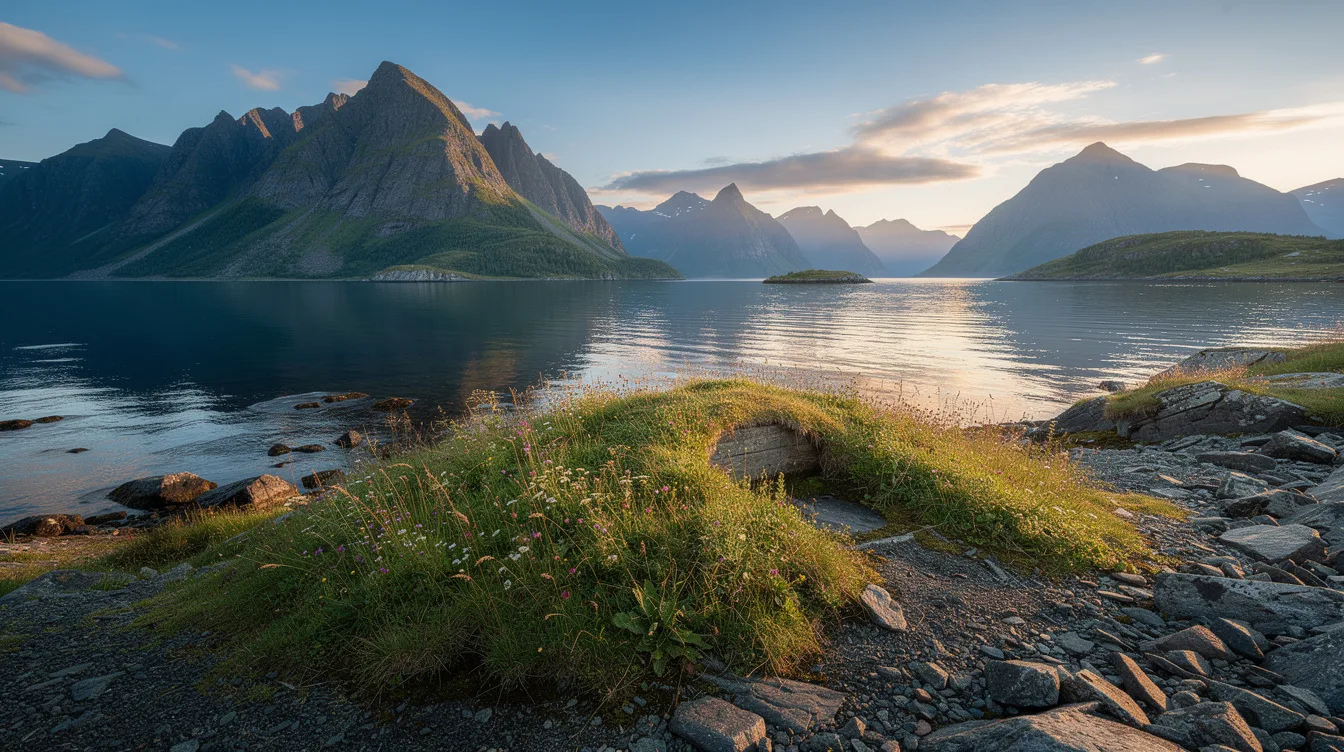
Senja has the kind of Arctic coastline that makes a road trip feel secondary. But the island’s newest draw is underground: archaeologists announced in 2025 that they had found a Viking boat burial dating to about AD 900-950.
The wooden boat measured about 18 feet long. A woman had been laid inside on her side, knees bent, with a small dog at her feet. You come for the sea and mountains, then leave thinking about that quiet, carefully arranged burial.
A Viking burial changes the way you see Senja
This isn’t a museum-piece story detached from the island. The boat was laid just below ground level, which gives Senja’s open ground a different weight. And the discovery is recent enough that it still feels like a reason to pay attention, not a plaque you pass without reading.
You won’t find a promise here that every stop explains the Viking Age. But that is part of the appeal. The burial adds a human scale to an island better known for sharp coastal mountains, deep fjords, fishing villages, forests, farmland, and pale beaches.
Norway’s second-largest island outside Svalbard has room for those contrasts. Its western side faces the Atlantic and feels wild. Its eastern side is milder and greener, so the drive changes character before you have time to settle into one version of the place.
The west coast is dramatic, but weather sets the terms
The western coast rises steeply from the sea, with Gryllefjord and Husøy tucked into the small lowland spaces between water and mountain. You can feel the Atlantic side in the wind and see it in the hard edges of the fjords.
Drive the Senja National Tourist Route for Bergsbotn, Tungeneset, Ersfjordstranda, and Husøy. The route is the practical way to connect the island’s big visual moments. But exposed weather can change quickly, so don’t treat a blue morning as a guarantee.
Ersfjord, Mefjordvær, Skaland, and the white-sand shores around Ersfjordstranda give the coast its softer counterpoint. Lively in summer, but never built up like a resort strip. That restraint is exactly why the views linger.
Can you hike Senja in summer?
Yes, and mid-June through September is the recommended window for hiking and a road trip. Segla, Hesten, Barden, and Husfjellet are among the island’s dramatic summits. But trails can hold snow well into late spring, and you should take exposed conditions seriously.
The payoff is light that refuses to quit. From about May 22 to July 21, the midnight sun gives you long evenings for hiking or kayaking. You can stand near the shore at what feels like bedtime and still see the water catching the last gold light.
Senja is quieter than Lofoten, for better and worse
Senja is less built-up and quieter than Lofoten, which is the point for travelers who want space between stops. You get fishing communities and big scenery without the feeling that every pull-off has become a production.
But quiet requires some discipline. Plan fuel, groceries, accommodation, ferry schedules, and weather-dependent activities ahead, especially outside summer. A rental car or campervan is generally the most practical choice because viewpoints, hikes, and remote villages don’t line up around one compact center.
The island’s inner side offers forests, rivers, agricultural land, and rounder mountains. That is a useful reset after the exposed coast. And it keeps Senja from becoming a one-note drive built only around cliffside photographs.
Getting there is simpler than the map suggests
Senja sits in Troms county in northern Norway and connects to the mainland near Finnsnes by the Gisund Bridge. That ferry-free road link makes overland arrival straightforward. From Tromsø, you can also drive to Brensholmen and take the Brensholmen-Botnhamn ferry.
At Lysnes, a fast boat reaches Tromsø in about 50 minutes. That is a useful connection if you want the island without committing every movement to the road. But check schedules before you build a day around it.
When should you go for northern lights?
Late September through mid-April is the window for northern lights and polar-night conditions. Winter also brings dog sledding, skiing, snow, difficult driving, and limited light. You should choose it for the season itself, not because you expect an easy version of summer travel.
Ånderdalen National Park lies in southern Senja, while the roads pull you toward villages and open water elsewhere. By the time the evening light fades or the winter dark settles in, the island’s most memorable detail may still be that small boat beneath the ground.