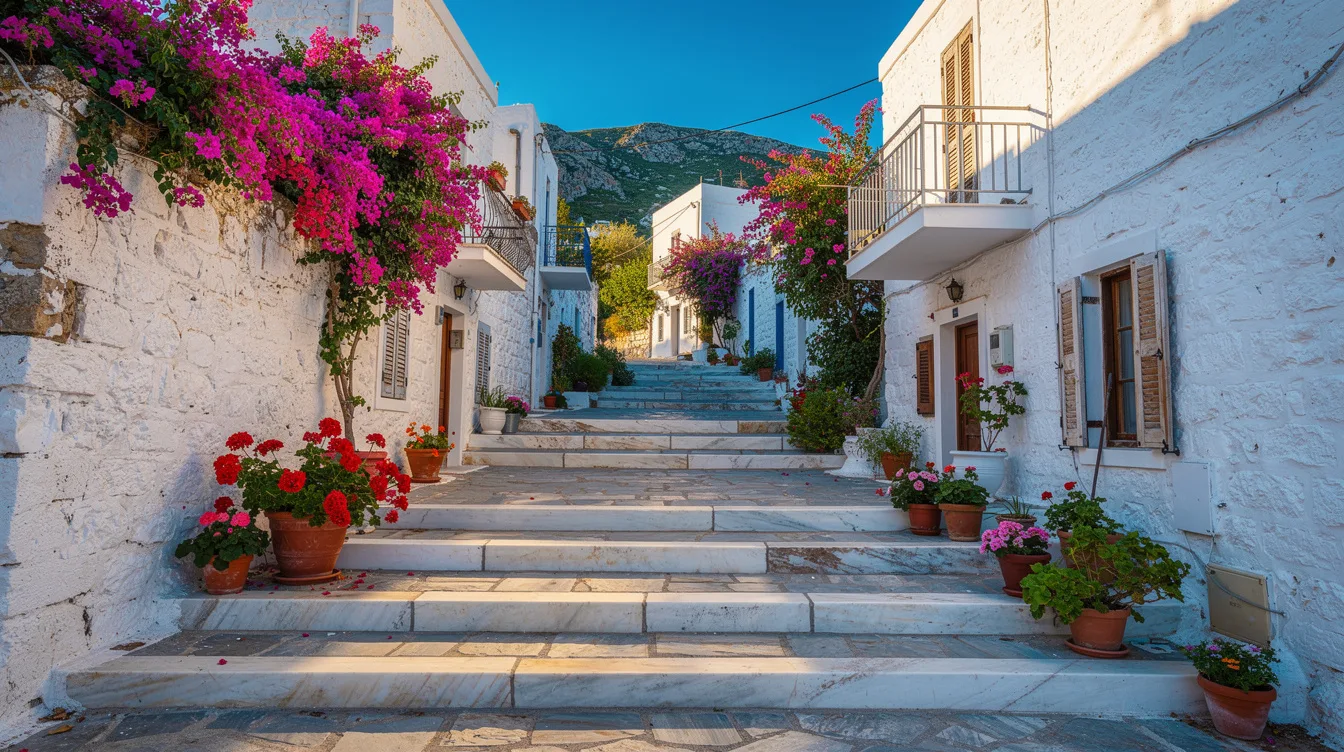
Apiranthos is the Naxos detour that changes your idea of the island. About 40 minutes from Chora, this mountain village trades beach traffic for marble lanes, stone façades, and stairways that feel cool underfoot late in the day.
But don’t come expecting the familiar white-and-blue Cycladic postcard. At roughly 1,969 feet above sea level, Apiranthos has a stonier, more inward-looking character, and that difference is exactly why the drive is worth your time.
Forty minutes from Chora, Naxos shifts gears
The village sits about 17.4 miles from Chora, on the slopes of Mount Fanari. You can drive there in around 40 minutes, though the route invites pauses at Chalki or Filoti if you have a car and aren’t in a hurry.
And the elevation changes the feel of the day. Apiranthos is generally cooler than the coast, so a summer visit makes more sense in late afternoon, when the hard light softens and the beach crowds are still elsewhere.
Spring and fall are the better seasons if you want gentler weather and quieter lanes. But summer still works, provided you treat it as an evening destination rather than a noon stop between swims.
Marble is the point, not a decorative detail
Local marble runs through the village in a way you can actually feel. Marble-paved alleys, steps, door frames, façades, and small squares give the place a pale, worn surface that doesn’t resemble the coastal towns of western Naxos.
And this is where you should resist an itinerary. The best part is walking without much of one, following narrow passages under arches, then taking whichever staircase looks more promising.
The old center is pedestrian in its most compelling stretches, so you’ll leave the car outside and continue on foot. But wear shoes with grip, because polished stone stairs can turn a casual wander into a more careful climb.
Can you drive into the old village?
No, not in any useful way once you reach its older core. Park in the outer areas identified as Panagia, near the cemetery, or Psarri Plaka, then let the marble streets do what they do best: slow you down.
Stone houses, old towers, and a different island story
Apiranthos has stone architecture and old towers linked to the island’s Venetian and Frankish past. Zevgolis Tower has been restored, while the Bardanis, or Sforza-Castri, tower adds another reminder that this village has never looked entirely coastal.
But its difference isn’t only visual. The village also carries traditions associated with communities of Cretan origin, including a local dialect with Cretan traits, which gives Apiranthos an identity that feels distinct within Naxos.
You don’t need a lecture to notice the contrast. Beyond the harbor world of Chora, the streets narrow, the stone takes over, and the island feels more mountain-bound than maritime.
Give the church and museums a little room
Panagia Apeirathitissa, an 18th-century church, is a worthwhile pause between the lanes. It gives your walk a center without turning the village into a checklist, which is the right balance for a place this compact.
And Apiranthos has an unusually dense group of small museums, with subjects including archaeology, folklore, geology, natural history, and visual arts. The choice sounds generous, but opening hours can be limited or irregular.
That said, don’t build the whole trip around a museum door being open. If one is available, step inside. If not, the village itself still gives you plenty to look at from street level.
How long should you stay?
Plan 1.5 to 2.5 hours for a walk, a coffee or lunch, the church, and perhaps a museum. You can make it a half-day from Chora, especially if you stop in Chalki or Filoti on the way.
Stay late enough for the marble to cool
If you have a car, you can continue toward eastern Naxos afterward, where the mountain terrain is tied to former emery mining and remnants remain visible. But Apiranthos doesn’t need a grand finale. Its small scale is part of the appeal.
And that’s my advice: arrive after the strongest summer heat, park at the edge, and give yourself permission to get mildly lost. By late afternoon, the marble holds the fading light, and the village sounds mostly like footsteps on stone.