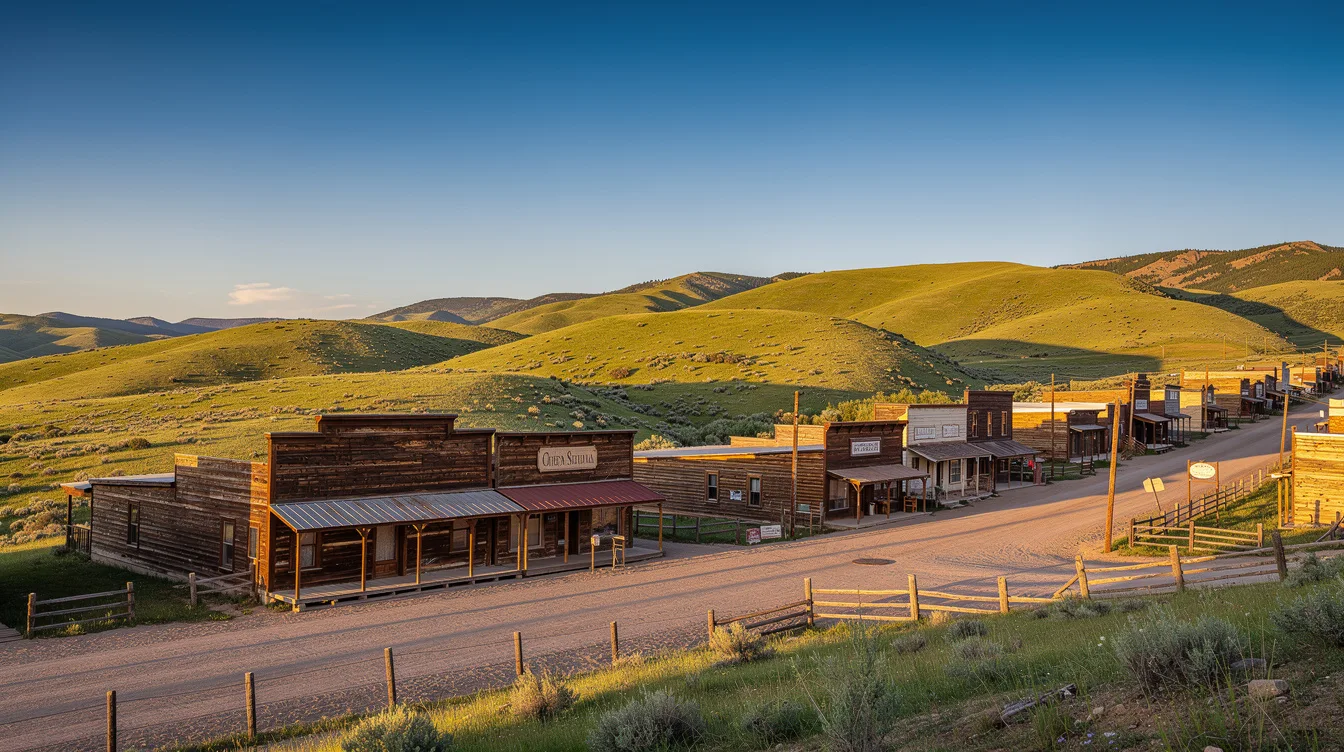
Virginia City, Montana, has only 219 residents, yet it once ran the Montana Territory. From 1865 to 1875, this compact town was its capital, a role that feels almost absurd when you stand on its wooden sidewalks today.
The reason is gold. Alder Gulch drew prospectors after a discovery in 1863, and Virginia City grew fast enough to become the territorial seat. But this isn’t an abandoned set dressed for photographs.
People still live here, and Madison County government still operates here.
You come for the strange scale of it. A town small enough to walk without a plan once carried the administrative weight of a vast territory, and that tension gives every storefront more pull than a standard historic district.
And the town doesn’t ask you to imagine its past from a plaque. Restored commercial buildings, old hotels, saloons, and homes hold the street together. The boards creak underfoot, and the dry mountain air makes the whole place feel sharply outlined.
Ten years at the center of Montana Territory
1865-1875 is the fact that changes how Virginia City reads. For a decade, territorial decisions happened here before the capital moved to Helena. You can feel the former importance in the town’s preserved core, even when the street is quiet.
Its historic district has been a National Historic Landmark since 1961. That designation matters because the town’s appeal isn’t one isolated building. It’s the continuity of a working-looking Western street, with doors, porches, signs, and false fronts close together.
But don’t expect a polished museum where every moment is solemn. Virginia City leans into theater, with historical reenactments, blacksmith demonstrations, gold panning, and melodrama and vaudeville performances at the Opera House.
That can sound touristy, and in peak season it is. Still, the entertainment fits the setting better than a hushed audio tour would. If you’re traveling with family, or simply want history that doesn’t require reading every label, it’s an easy entry point.
Alder Gulch is why the town exists
Alder Gulch made Virginia City possible, and the mining story remains the town’s main current. Local tourism information estimates historic extraction there at about $100 million in period dollars, a figure that explains why this remote-looking place became politically important so quickly.
And the town’s “living ghost town” label is fair, with one useful correction. It isn’t a ghost town in the empty sense. It’s a very small community where heritage tourism gives old structures a second life each summer.
You’ll find museums and restored buildings focused on the gold-rush era. There are shops and places to eat, plus themed lodging. But the best approach is to leave space between stops, because the town works when you notice the ordinary details as much as the staged ones.
Take the Alder Gulch Short Line to nearby Nevada City if the train is running. It’s a simple way to extend the visit without turning the day into a long drive, and it gives the historic setting a little motion.
Is Virginia City worth an overnight?
Yes, if you want an evening performance and a less rushed visit to Nevada City. The notes recommend at least half a day, but staying overnight lets you see the town after daytime visitors thin out. That slower pace is the better version of Virginia City.
But don’t build your plans around a huge choice of nightlife or dining. This is a place of limited scale. Its strength is that you can settle into the street’s old rhythm instead of racing through a checklist.
The drive is part of the point
Virginia City sits in Madison County on MT-287, about 65-66 miles from Bozeman. It also works naturally with Ennis, Twin Bridges, West Yellowstone, Yellowstone, and other former mining towns on a southwestern Montana road trip.
You’ll see it at an elevation of roughly 5,800-5,900 feet, so summer nights can turn cool. Bring an extra layer even if the afternoon feels warm. The mountain valley light fades quickly, and that’s when the wooden buildings look least like a backdrop.
And timing matters more here than in many roadside stops. Visit from late May through early September, when most seasonal attractions, lodging, restaurants, and shops are open. You can pass through year-round, but the fuller experience belongs to summer.
Virginia City is lively in season, but never big. By the time the performances end and the foot traffic fades, the wooden sidewalks are quiet again, carrying the faint sound of steps through a town that once held Montana’s capital.