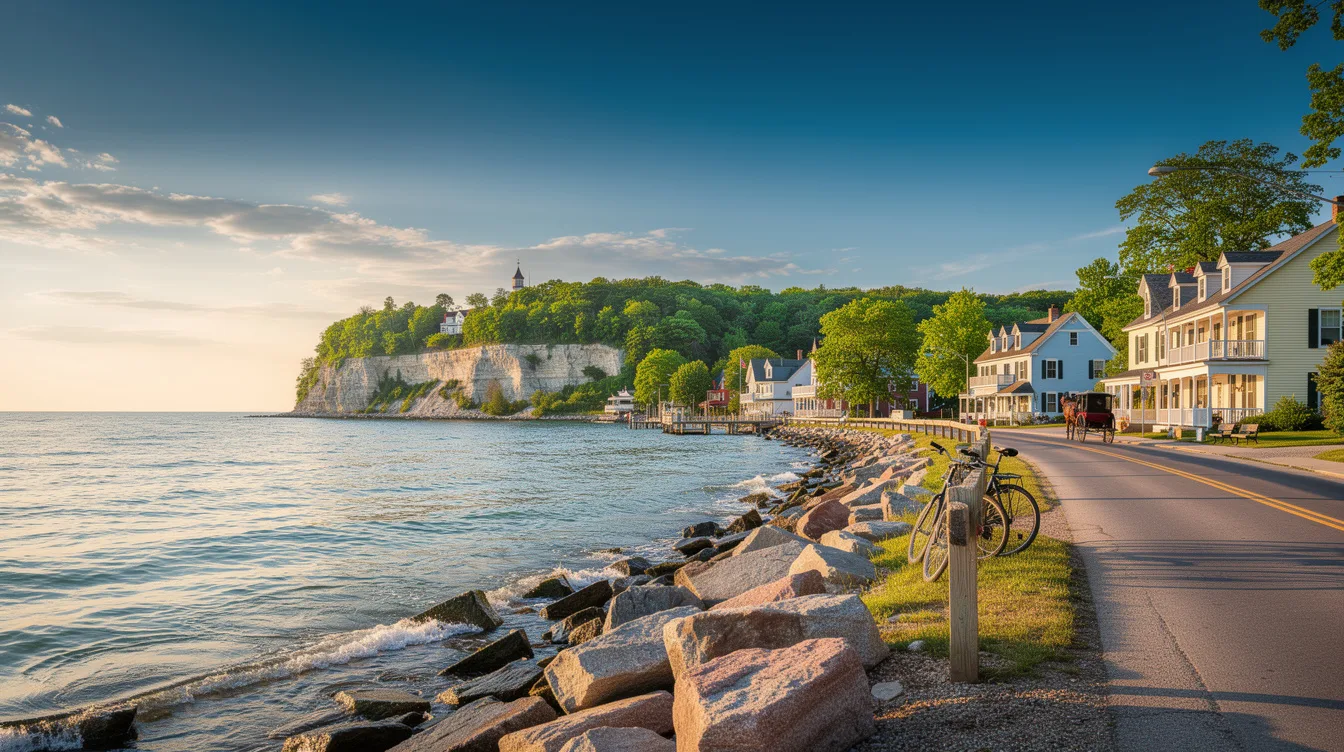
Mackinac Island makes its point before you’ve even left the dock. The ferry from Mackinaw City or St. Ignace takes about 15 minutes, then private cars disappear from the equation.
You walk, ride a bike, or take a horse-drawn carriage, and the island’s pace changes your own.
That’s the appeal, but it isn’t a theme-park trick. On this Lake Huron island between Michigan’s Upper and Lower Peninsulas, motor vehicles are almost entirely prohibited. Emergency, city service, state park vehicles, and winter snowmobiles are exceptions.
For everyone else, the hoofbeat and bicycle bell are the background noise.
Fifteen minutes from the mainland, the road feels different
Leave your car on the mainland, board the ferry, and you arrive with no temptation to drive “just one more place.” Private cars are banned, so the island’s roads belong to walkers, cyclists, and carriages. And that small restriction gives a short visit a rare feeling of being properly away.
You’ll notice it in the first block. Carriage wheels click over the street, bicycles pass quietly, and the air doesn’t carry the usual exhaust haze. It’s busy in peak season, but never car-clogged.
That said, you still need to watch where you step, because horses have the right of way in the most practical sense.
More than 80 percent is preserved as Mackinac Island State Park. That protected share keeps the built-up village from swallowing the rest of the place. Beyond town, wooded cliffs and limestone formations take over quickly.
M-185 is the ride that earns the ferry ticket
If you rent or bring a standard bicycle, ride M-185, the flat road that circles the island. It’s the clearest answer to why Mackinac works. You can keep moving without traffic noise pressing you forward, with Lake Huron beside you for long stretches.
And the route is forgiving, which matters if you haven’t spent much time on a bike lately. The water flashes through openings in the trees, then the road bends back toward the island’s greener interior. It’s easygoing, though summer crowds can make the village end feel more social than solitary.
Stop for Arch Rock, a limestone formation that earns its reputation without requiring a sales pitch. Sugar Loaf, Skull Cave, and the wooded bluffs offer more reasons to leave the main streets. But don’t expect an e-bike shortcut: Michigan tourism guidance for 2026 says e-bikes aren’t allowed except under a valid mobility or disability permit.
Can you tour the island without cycling?
Yes. You can walk or book a horse-drawn carriage, and horse-drawn taxis are also available. A carriage ride is touristy, plainly, but it fits this particular place better than it would almost anywhere else.
The sound of hooves on pavement feels less like nostalgia when no engines are competing with it.
Fort Mackinac and the Grand Hotel explain the old-world mood
Fort Mackinac was built by the British in 1780, and it remains the island’s central historic attraction. Its story reaches through the fur trade, French and British presence, Indigenous history, and the War of 1812. You don’t need to treat the island as a museum, but the fort gives the streets context.
And Mackinac’s Victorian look is real enough to be a little theatrical. Historic preservation has kept many structures intact or restored, while the entire island holds National Historic Landmark status. The result can feel polished, yet the car-free streets keep it from becoming stiff.
The Grand Hotel opened in 1887 and is known for its wide veranda. Even if you don’t stay there, it’s worth seeing how it anchors the island’s late-19th-century character. Fudge shops are another local institution, and the sweet smell near the village is hard to miss.
Late May through early September is the simple choice
Late May to early September is the easiest window because ferries, hotels, restaurants, and activities are fully operating. June brings the Lilac Festival, which gives the island a floral reason to lean into its summer-colony character. And when lilacs are in bloom, the slower pace feels especially well matched to the season.
July and August are the busiest and most expensive months. You’ll have company on the ferry, on M-185, and around the village. But the core pleasure survives the crowds: once you leave the main streets, the island still has room for a quieter stretch of road.
Pronounce it “Mackinaw,” then take the ferry with an unhurried plan. By the time you return to the mainland, the first line of parked cars feels oddly louder than it did 15 minutes earlier.