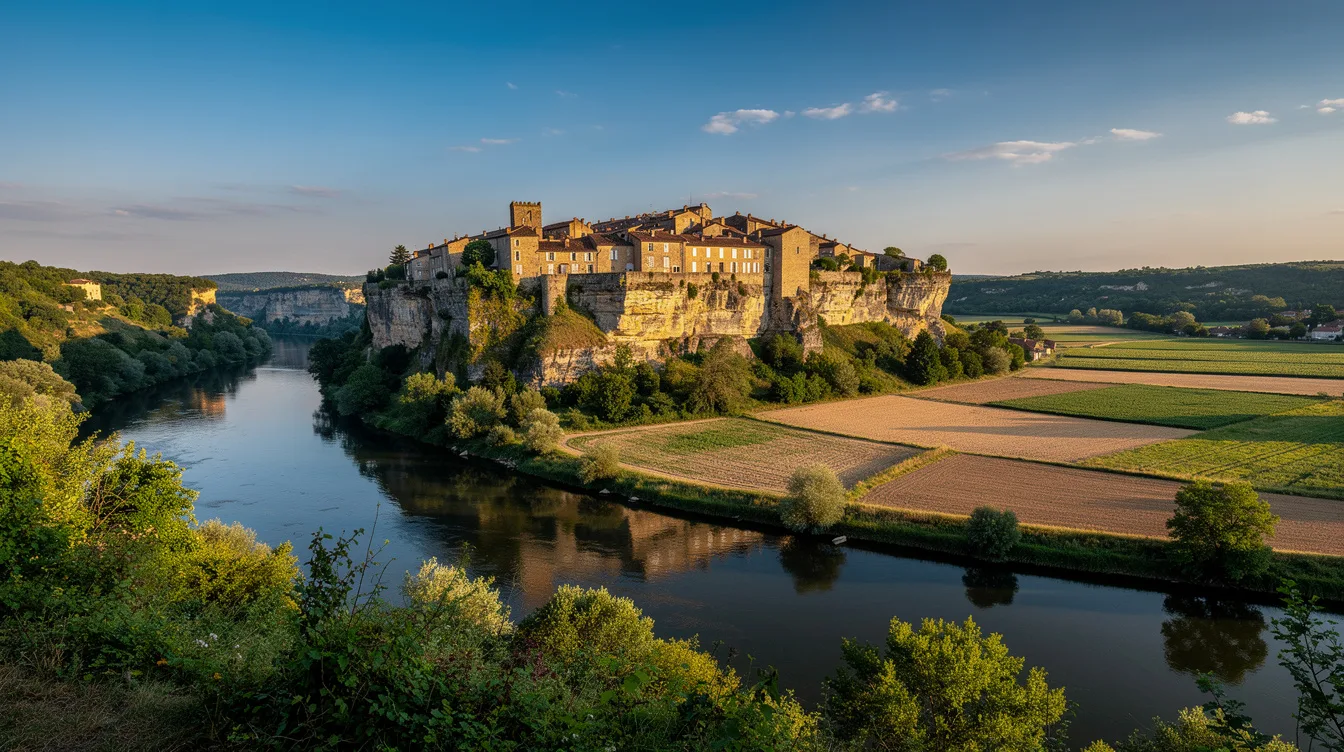
Capdenac-le-Haut sits more than 328 feet above a bend in France’s Lot River, and the height is the whole experience. You arrive in a village built to look out and hold on, where stone lanes point toward a wide sweep of water below.
It’s in the Lot department of Occitanie, about 3.7 miles from Figeac. But don’t mistake that short distance for an effortless stop. The village rises sharply from the valley, which is why the view feels earned rather than arranged.
The Lot River bend is the reason to climb
From the upper lanes, the Lot curves through the valley beneath you, with the Quercy stretching beyond it. This is the kind of overlook that makes you stop checking your phone. And because the village sits on a defensive promontory, the panorama stays open instead of framed by newer buildings.
The river view is broad, but the village itself stays compact. You can feel the slope underfoot, hear shoes tap against old paving, and catch cool air moving through a narrow passage. It’s quiet, though the uneven ground means this isn’t a place for rushing.
Capdenac-le-Haut joined Les Plus Beaux Villages de France in 2010, a designation that fits its preserved streets without making the place feel polished beyond recognition. You’ll find old façades and small details rather than a staged historic district.
Stone streets, gates, and a real sense of defense
The village’s medieval character is clearest in its cobbled lanes, corbelled houses, mullioned windows, and heavy doorways. But the architecture isn’t merely decorative. This high point was a major defensive site, so the tight passages and walls make practical sense once you walk them.
Look for the Tour de Modon, the ramparts, and fortified gateways including Porte de Gergovie. You don’t need an elaborate itinerary here. Let the streets pull you uphill and downhill, then pause whenever a gap between roofs opens toward the river.
Is the ancient history settled?
No. The promontory was occupied as far back as prehistory and is linked with an ancient fortified settlement. But its identification with the final Gaulish stronghold taken by Rome remains debated, which is more interesting than a neat label.
The visible village is chiefly a medieval fortress town.
That uncertainty keeps the history honest. You’re not being handed a simple legend. Instead, you’re standing on a place that held strategic value for a very long time, with the river bend below explaining plenty of it.
The fountain descent is worth the steps
The Fontaine des Anglais lies below the village level, reached by stairs cut into rock. It’s a memorable detour because the descent changes the scale of the place. Above, Capdenac-le-Haut feels exposed to the valley.
Below, the stone closes around you.
There are also the Gaulish fountain and César’s fountain, plus the Jardin médiéval des Cinq Sens near the tower. But the appeal is less about collecting stops than slowing down. You’ll notice worn edges on steps and the cool shade where walls stand close together.
Good shoes are essential. The irregular paving, slopes, and stairways are part of the village’s character, but they can be awkward if you’re unsteady. And there’s no reason to pretend otherwise: this is a better visit for travelers comfortable walking on uneven stone.
Getting up from the valley takes patience
Capdenac-Gare sits lower in the valley on the Aveyron side. From its train station, the walk to the village takes about 30 to 40 minutes, and it includes an uphill climb. You can do it, but arrive ready for a proper ascent rather than a flat station stroll.
Figeac is nearby, so Capdenac-le-Haut works well as a focused detour when you want a smaller place after a town day. But give it time. The lanes reward wandering, and the outlook asks you to linger longer than the map suggests.
By the time you return to the edge of the promontory, the Lot is still bending below the walls, and the old stone under your feet feels warm from the day.