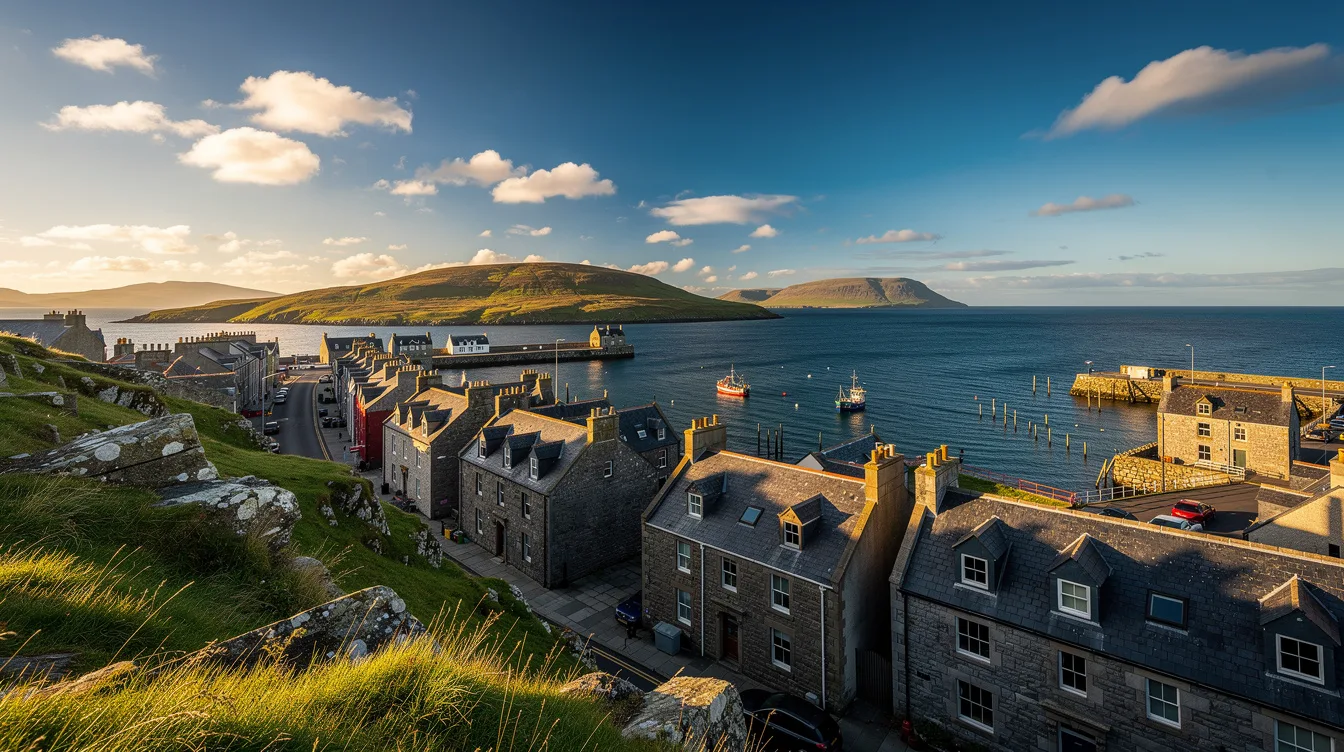
In 1980, this Orkney harbor town nearly became a uranium mine. The composer who lived through that fight sat down at the Stromness Hotel on 21 June 1980 and premiered a piano piece to protest it. The mine plans were cancelled later that year.
The piece was called “Farewell to Stromness,” a short interlude from The Yellow Cake Revue. Yellowcake is the powder you get in early uranium ore processing. The title wasn’t poetic.
It was a warning.
A town of 1,700 that fought off a mine and won
Stromness sits on the southwestern edge of Orkney Mainland, with 1,700 residents as of 2022. That makes it the second-biggest settlement in the archipelago, behind Kirkwall. It doesn’t feel like a runner-up.
The premiere happened during the St Magnus Festival, with the composer at the keyboard. And the mine never opened. You can still walk into the hotel where it happened.
Why the old town looks the way it does
The main street winds. It’s flagged, narrow, and lined with houses and shops built from local stone, with lanes and alleys peeling off toward the water. Some of those houses have their own private piers.
The name comes from Old Norse. Straumr for the strong tides ripping past the Point of Ness through Hoy Sound, nes for headland. A headland sticking into the tidal stream, which is exactly what you’re standing on.
Captain Cook’s ships stopped here in 1780
The Discovery and the Resolution called at Stromness in 1780, on the way home from the Hawaiian Islands where Cook had been killed. That’s the caliber of traffic this harbor used to see.
It happened because of war. With Britain fighting France, shipping avoided the English Channel and came north instead. Hudson’s Bay Company ships were regulars, and so were the whaling fleets.
Orkneymen signed on with both. Many came from around Stromness, working as traders, explorers, and seamen. The museum still holds the whaling relics and the Inuit artefacts those men carried home from Greenland and Arctic Canada.
The statue at the Pierhead honors a man who solved the Northwest Passage
A statue of John Rae stands at the Pierhead, unveiled in 2013. The inscription calls him the discoverer of the final link in the first navigable Northwest Passage. He’s standing upright, facing out.
The harbor also keeps a lifeboat station, one of three in Orkney. The RNLI first stationed a boat here in 1867. On a coast with tides like these, that’s not decoration.
Can you get there without a car?
Yes. The X1 bus runs from Kirkwall in 25 to 30 minutes depending on the service. The MV Hamnavoe brings you in from Scrabster, near Thurso, on the NorthLink route.
From the pier, the MV Graemsay runs passenger ferries to Graemsay and Hoy. Buses also connect to Skara Brae, St Margaret’s Hope, and Houton. Without a car you’ll be slower, but you won’t be stuck.
Cliffs up to 492 feet on the Atlantic side
Stromness turns two faces to the sea. On the Atlantic side, a range of cliffs between 100 and 492 feet high. On the Hoy Sound side, a band of fertile lowland.
Those rocks drew geologists early. The interest was never just scenic.
What’s worth your time in a single day?
Walk first, plan later. The Pier Arts Centre sits on the waterfront and holds a collection of twentieth-century British art, given to the people of Orkney by the artists themselves. The Stromness Museum is small and dense.
Then there’s the memorial garden for the poet who was born here and lived most of his life in the town. He’s buried in the cemetery above Hoy Sound. His poem “Hamnavoe” takes its name from the old Viking anchorage, which is what this harbor was called before it was Stromness.
May and July are the loud months
The Orkney Folk Festival usually lands in May and fills the town. Shopping Week comes in July. Book your bed and your table early, because Stromness is genuinely small and it fills up.
Pack a windproof and waterproof layer whatever the month. The wind gets strong year-round and the weather turns fast, even in summer. That’s the trade for light that stretches most of the way through a June night.
Stand at the Point of Ness and you can hear the tide moving through Hoy Sound, the same current that named the town a thousand years ago. It’s still running.