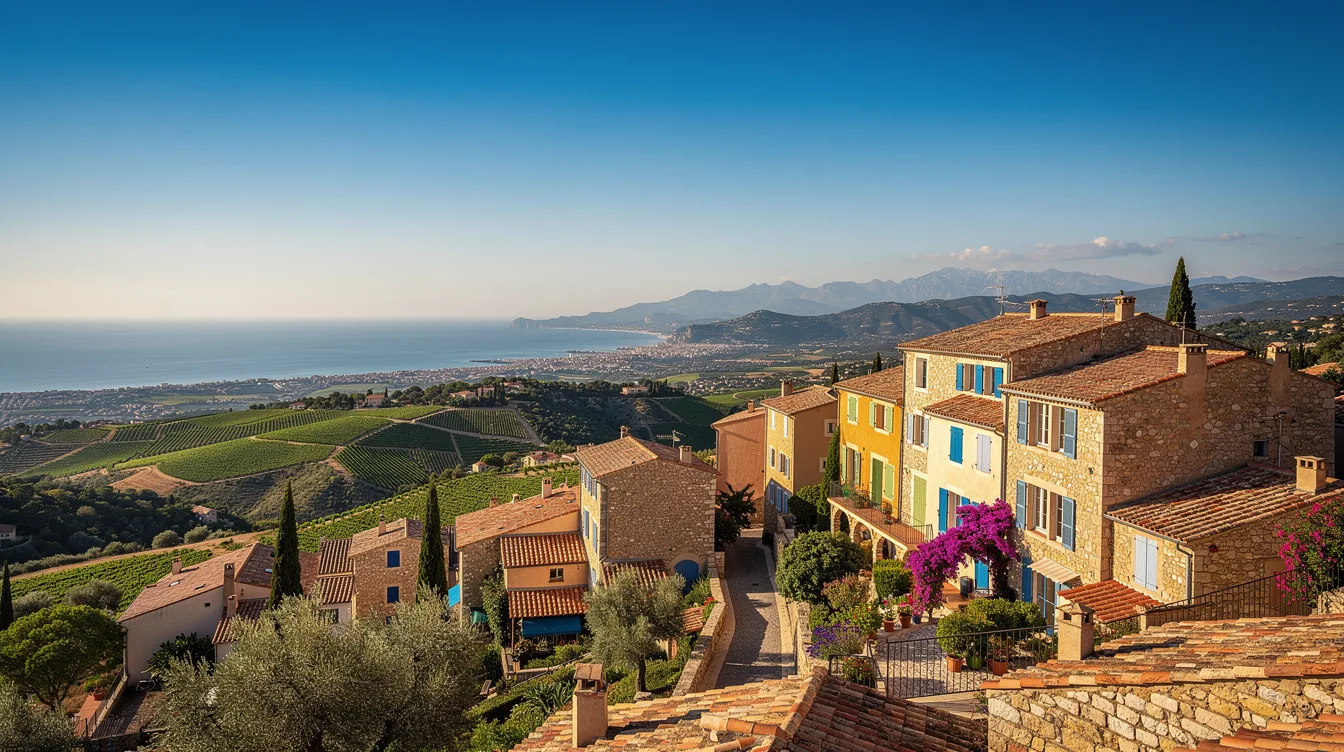
Gassin sits less than 2.5 miles from the sea, yet the old village feels deliberately removed from the Côte d’Azur rush. It rises above the Gulf of Saint-Tropez on a rocky perch, where stone lanes pull you away from the busy coast and toward a quieter kind of afternoon.
The reason to come is very specific: L’Androuno, in Gassin’s medieval center, is described as one of the world’s narrowest streets. It is a small claim with a big effect. You’ll find yourself slowing down, turning sideways, and noticing every old doorway around you.
A tiny street, then the Mediterranean
L’Androuno is not an attraction that needs a long explanation. It is a passage within a village of narrow lanes, stone houses, old doors, and vaulted sections. And because the streets compress the view, the bright Mediterranean light feels sharper when it returns at an opening.
You should make this your first stop, then let the old village take over. The reward is not a checklist. It is the odd pleasure of walking through a place where the route itself keeps changing scale, from a close stone corridor to an open square.
Place Deï Barri provides that release. Its panorama reaches across the Mediterranean toward the Îles d’Or and the Massif des Maures, so the village’s high position finally makes sense. But the views are part of a lived-in village, not a hilltop stage set.
656 feet above the Gulf of Saint-Tropez
Gassin stands at about 656 feet above sea level, overlooking the Gulf of Saint-Tropez from the Var department. That elevation gives the old center a different rhythm from the coast below. The harbor energy is nearby, but up here the stone walls and narrow passages set the pace.
And that contrast is the village’s best argument. Saint-Tropez is close, while Gassin gives you a place to pause above it. The gulf spreads outward beyond the rooftops, and the old village holds your attention at shoe level.
The village belongs to Les Plus Beaux Villages de France, an association for French villages recognized for their heritage. That designation does not mean the center is empty or private. It does mean there is real texture here: ramparts, a rectory, chapels, former mills, and lanes that have not been widened for convenience.
Can you see more than L’Androuno in two hours?
Yes. Two hours is enough to wander the center and find its principal lanes, old features, and views. But give it at least half a day if you want the village to feel less like a stop between bigger destinations.
Notre-Dame-de-l’Assomption, chapels, and the village’s older built details offer reasons to linger. The botanical garden L’Hardy-Denonain lies below the village, too. And if you prefer a slower detour, Gassin has nine vineyards within the Côtes-de-Provence area.
The coast is close, but the car matters
Gassin is in the Var, on the Saint-Tropez peninsula and near Ramatuelle. It lies 1.2 miles from the D559, the road linking Hyères and Sainte-Maxime. Hyères is 25.5 miles away by that route, while Sainte-Maxime is 7.5 miles away.
A car is the most practical way to reach Gassin and explore the gulf. That convenience comes with a limit: the village gets busy in high season. But its position above the coast still makes it a more measured base than staying directly in the dense activity around the port.
You can pair a walk through the center with time at a vineyard, a hike, or the coast. Don’t expect the village to reveal itself through one grand avenue. It works in fragments: a vaulted passage, a worn doorway, a glimpse of pale water past the stone.
Why Gassin earns the detour
Gassin’s population was 2,687 residents in 2023, which helps explain why it feels like a village rather than a resort district. It is close to the sea, yet its old core is built around enclosure, height, and narrow routes. That tension gives the visit its shape.
And L’Androuno is more than a quick photograph. It makes the village’s scale physical. After the tight passage, the open air at Place Deï Barri and the broad gulf beyond it feel earned, with salt-colored light resting over the distant water.