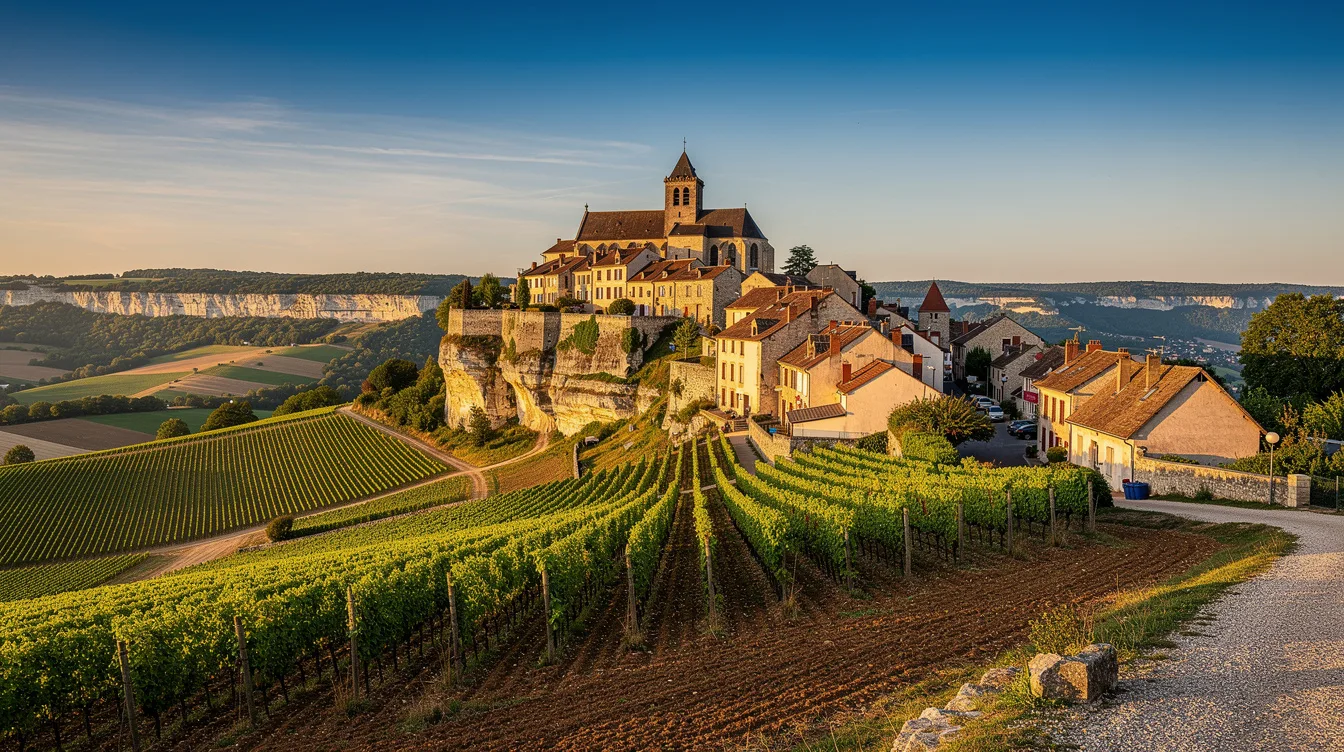
Château-Chalon gives its name to a French wine that waits under a veil for six years and three months. The village sits on a cliff in France’s Jura, above vineyards and the Seille plain, and the wine’s long aging is the reason this small place feels larger than its streets.
Why this Jura village waits six years and three months
And that waiting changes everything in the glass. The AOC Château-Chalon is reserved exclusively for vin jaune, made from the Savagnin grape and aged under a veil in oak barrels for at least six years and three months.
But this isn’t a soft, easy white wine. Expect dry intensity, walnut, mild curry, dried fruit, ripe apple, and a salty finish that lingers long after the sip. You may love it immediately, or you may need a second taste.
The traditional bottle holds 62 centiliters, a shape known as the clavelin. That smaller bottle reflects the long process and the wine’s distinctive character.
You can taste the difference most clearly with food. Comté, chicken with morels, creamy mushroom dishes, and gently spiced plates give the wine somewhere to go.
Four viewpoints make the village worth slowing down for
And the wine isn’t the only reason to come. The village has four belvederes looking across the vineyards, the Jura countryside, and the plain below, so your walk keeps opening into another wide view.
But Château-Chalon is compact, and that’s part of its appeal. You can explore the narrow lanes on foot, pass stone winemakers’ houses, and pause whenever the light catches the rows of vines.
The best time is late afternoon or sunset, when the low light settles across the Revermont. The air cools, the stone turns warm in color, and the village becomes quiet enough for footsteps to carry.
Start near the church and let the streets guide you toward the viewpoints. For more context about the area, continue with Baume-les-Messieurs, a natural companion for a day in the Jura.
What to see beyond the vineyards
And the Roman church of Saint-Pierre gives the village a strong historical center. Nearby, traces of the Benedictine past and remnants of the old keep add weight to a place that might otherwise take only an hour to cross.
But you shouldn’t rush through the houses and lanes. Their plain stone fronts, narrow passages, and wine-growing history reward a slower walk more than a checklist of sights.
The Maison de la Haute Seille, at 26 place de l’Église, provides tourist information and an interactive introduction to the Jura vineyards. You can use it to understand the wine before tasting it, which makes the unusual style easier to read.
Château-Chalon is also close to the wider wine country around Domblans, Ménétru-le-Vignoble, and Nevy-sur-Seille. The AOC covers about 124 acres across those communities, keeping the wine closely tied to this particular corner of the Jura.
How to plan a visit without hurrying
Can you visit Château-Chalon without a full day?
Yes, you can see the village and its viewpoints in a couple of hours, but a half-day feels better. And you should arrive in the middle or late afternoon, when the light improves and the walk naturally leads toward a tasting.
But don’t build the whole outing around simply checking off a famous village. The site is small, and its real pleasure comes from combining a walk with wine, food, or a second stop nearby.
The village is in the Jura near Lons-le-Saunier, though the available information doesn’t specify an exact distance. You can also connect the visit with Poligny or Arbois, both noted for their food and wine traditions.
For a fuller day, head toward Baume-les-Messieurs after Château-Chalon. Its retreat, abbey, waterfall, and caves change the pace, while the Jura Lakes offer another natural extension.
Château-Chalon is remote in feeling, but not difficult to place on a Jura itinerary. By sunset, the vineyards below turn copper-colored, and the last taste of vin jaune stays on the tongue.