Amelia Island flew eight different flags, and that odd record is the reason for its Isle of Eight Flags name. On Florida’s northeast Atlantic coast, the island changed hands under French, Spanish, British, Patriot, Green Cross, Mexican Revolutionary, Confederate, and United States rule.
That history could feel like a museum label. Here, it feels more immediate because Fernandina Beach still has old inns, waterfront bars, and late-Victorian streets where the pace noticeably drops.
Eight flags, one unusually contested island
The island is called the Isle of Eight Flags because eight different flags flew here over time. It is the only place in the United States associated with that exact run of rule, which gives this small stretch of coast a surprisingly crowded past.
And the list is stranger than the usual French, Spanish, British sequence. It includes the Patriots of Amelia Island, the Green Cross of Florida, a Mexican Revolutionary flag, the Confederacy, and the United States.
You don’t need to memorize every transfer of power to feel the point. The island sat at a contested edge of colonial Florida, so control changed more often than the calm beaches suggest.
But this isn’t a destination built around reenactment. Its historical pull comes from the friction between a beach day and the knowledge that competing governments once claimed the same shore.
Fernandina Beach gives the story a street address
Fernandina Beach is the island’s main town, and its 50-block historic district gives the eight-flags story somewhere tangible to land. You can move from late-Victorian buildings to the waterfront without leaving town.
The live oaks carry moss, and the architecture feels closer to coastal Georgia or South Carolina than a typical Florida resort strip. That Lowcountry mood is the island’s best trick, because it softens the Florida glare with shade and old brick.
And you should allow time to wander rather than treat town as a lunch stop. The old inns and bars make Fernandina Beach feel lively, but never rushed.
There are claims here to Florida’s oldest bar, inn, lighthouse, and newspaper. Those claims add character, though the better reason to visit is simpler: the district still feels like a place where people linger after the beach.
Thirteen miles of coast, without the resort-strip mood
13 miles long and about 4 miles wide at its broadest point, Amelia Island is compact enough that you can pair town with the beach in one unhurried day. Its eastern shore has roughly 13 miles of largely uncrowded white sand.
The Atlantic is the backdrop, but the quieter rhythm is the real appeal. Because the island is small, you’re never far from a different mood, from open sand to marsh edges and shaded streets.
But don’t come expecting a giant entertainment district. The island is a better fit if you want a quieter, more upscale base than Jacksonville, with room for golf, resorts, and a slower dinner afterward.
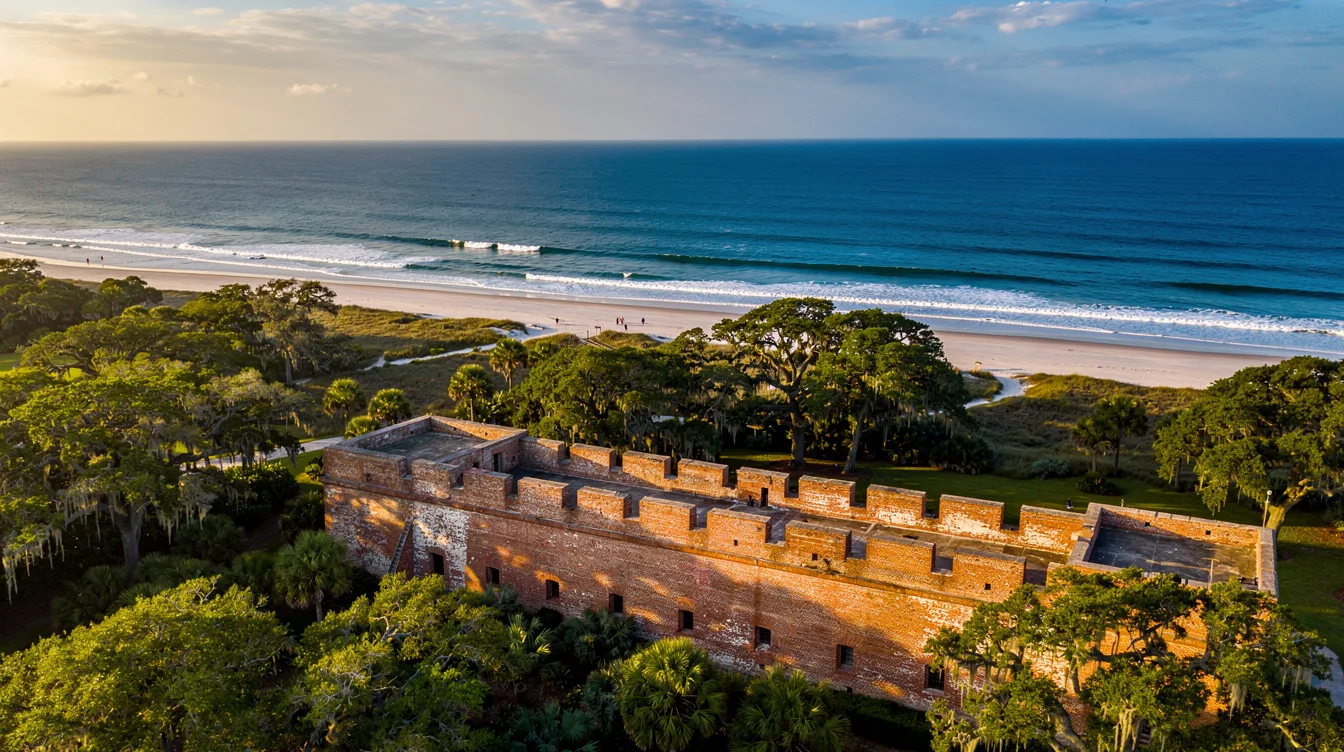
Fort Clinch State Park adds dunes, marshes, camping, and a fortress to the mix. Nearby Talbot Island state parks bring hiking, cycling, and wildlife, so you can trade beach sand for trails without making the day complicated.
Can you get there without turning it into a long trip?
Yes. Amelia Island is in Nassau County, north of Jacksonville, and the drive from Jacksonville or Jacksonville International Airport is about 30-45 minutes. That short approach is a major advantage if you want coast without a major travel day.
You’ll generally head north on I-95, take exit 373, then travel east on FL-A1A. The route is straightforward, which makes the island easy to fold into a Jacksonville stay or a longer Atlantic-coast drive.
And it also works well with a Georgia coastal loop that includes Cumberland Island or Savannah. Those pairings make sense geographically, though Amelia Island deserves more than a quick overnight if you want the town and shore to settle in.
The island has Fernandina Beach Municipal Airport for general aviation. Most visitors, though, will find JAX the practical choice, then make the short drive north.
The best reason to go is the contrast
Amelia Island Trail is part of the East Coast Greenway, a 3,000-mile trail system connecting Maine to Florida. That detail suits the island: it is part of a long coastal route, yet it still feels contained.
You get white sand and resort options, but also a historic town that doesn’t disappear behind beachfront development. You get Florida, but with moss-draped oaks and a mood that leans north.
But the island’s most memorable distinction remains its eight different flags. The name isn’t a marketing invention. It comes from a history that is genuinely unusual, then carried into an easygoing coastal place.
By the time you return from the waterfront to the quiet streets of Fernandina Beach, the old flags feel less like a list and more like a faint current under the salt air.