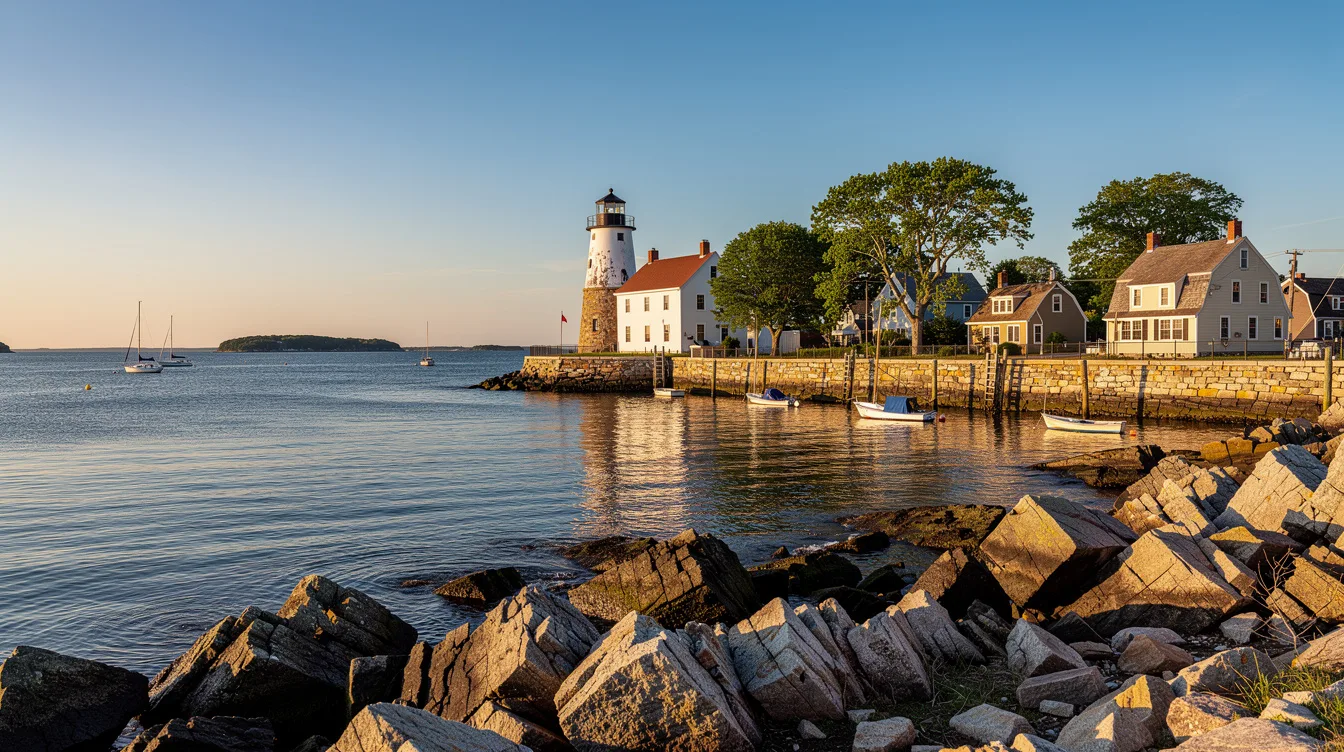
Stonington Borough has 976 residents, a working waterfront, and the sort of narrow peninsula that makes a short walk feel like an escape. A few miles from Mystic in southeastern Connecticut, it faces Fisher’s Island Sound and Little Narragansett Bay.
But the reason to come is not a packed itinerary. This is a harbor village for slowing down, watching boats work their way through protected water, and noticing how quickly the noise drops away once you leave the larger coastal stops.
The 1840 lighthouse that became a museum in 1925
At the end of Water Street, the low stone Stonington Harbor Light puts the title’s promise in plain view. Built in 1840, it became the Stonington Historical Society’s flagship museum in 1925, making it America’s oldest lighthouse museum.
You don’t need a grand tower to feel the pull of the place. The building sits close to the water, and its small scale makes the harbor feel more human than ceremonial. And that restraint is part of its appeal.
The museum belongs to a village that has kept its maritime identity. Fishing, lobstering, sailing, and the everyday movement of a working harbor give the old streets some useful friction. It feels historic, but not frozen behind glass.
That said, don’t expect a major attraction district. The lighthouse is the focal point, yet the better reward is what comes after: lingering by the water and letting the view set the pace for the rest of your afternoon.
Water Street is where the village opens up
Water Street leads toward the waterfront and makes the Borough easy to understand on foot. The peninsula is only about 0.7 square miles, with much of that area made up of water, so the shore never feels far away.
You’ll pass old New England homes and independent businesses before the street reaches the harbor. The built-up center has colonial, Federal, and Greek Revival architecture, preserved in part because modern industry and heavy traffic never took over.
But Stonington isn’t a museum set. Connecticut’s last commercial fishing fleet works from here, and that fact changes the atmosphere. You may arrive for the tidy facades, then find yourself more interested in the boats, lines, and salt-air routine of the waterfront.
There are two main streets connecting Cannon Square and Wadawanuck Square. You can cover them without effort, which is exactly why it’s worth leaving room to wander. A small place gives you permission to look longer.
Quieter than Mystic, but still easy to reach
Mystic is only a few miles away, while Stonington Borough sits near the Rhode Island border. That proximity makes it a useful change of mood if you want coastal Connecticut without the feeling that every stop requires a plan.
You can reach the area by car from I-95 via Exit 91. Rail options include Mystic, New London, and Westerly, and regional ferry connections are nearby. But once you arrive, the practical move is simple: park your schedule and walk.
The Borough has its own Board of Warden & Burgesses while remaining part of the larger Town of Stonington. That local structure fits the scale here. You’re in a defined community, not a loose collection of waterfront businesses.
And there is a real trade-off. Stonington’s draw is atmosphere rather than big-ticket spectacle, so travelers who need nonstop activities may run out of agenda quickly. For anyone who prefers a good harbor view to another timed admission, that’s the point.
History here has rougher edges than the streets suggest
The village’s calm surface carries a harder past. During the War of 1812, British vessels bombarded Stonington from August 9 to 12, 1814. The attack lasted three days, though the town did not surrender.
You can feel that history without needing a formal lesson at every corner. The compact streets, the old Customs House near Cannon Square, and the harbor all point back to a place tied to trade and the sea.
Stonington was settled in 1752 and chartered as a borough in 1801. It is Connecticut’s oldest continuously operating borough, but the statistic matters less than the result: the village still feels governed by its own small, stubborn rhythm.
By the time you return to the lighthouse, the water has done its quiet work. Boats move through the harbor, old stone catches the coastal light, and America’s oldest lighthouse museum feels less like a record than a reason to stay a little longer.