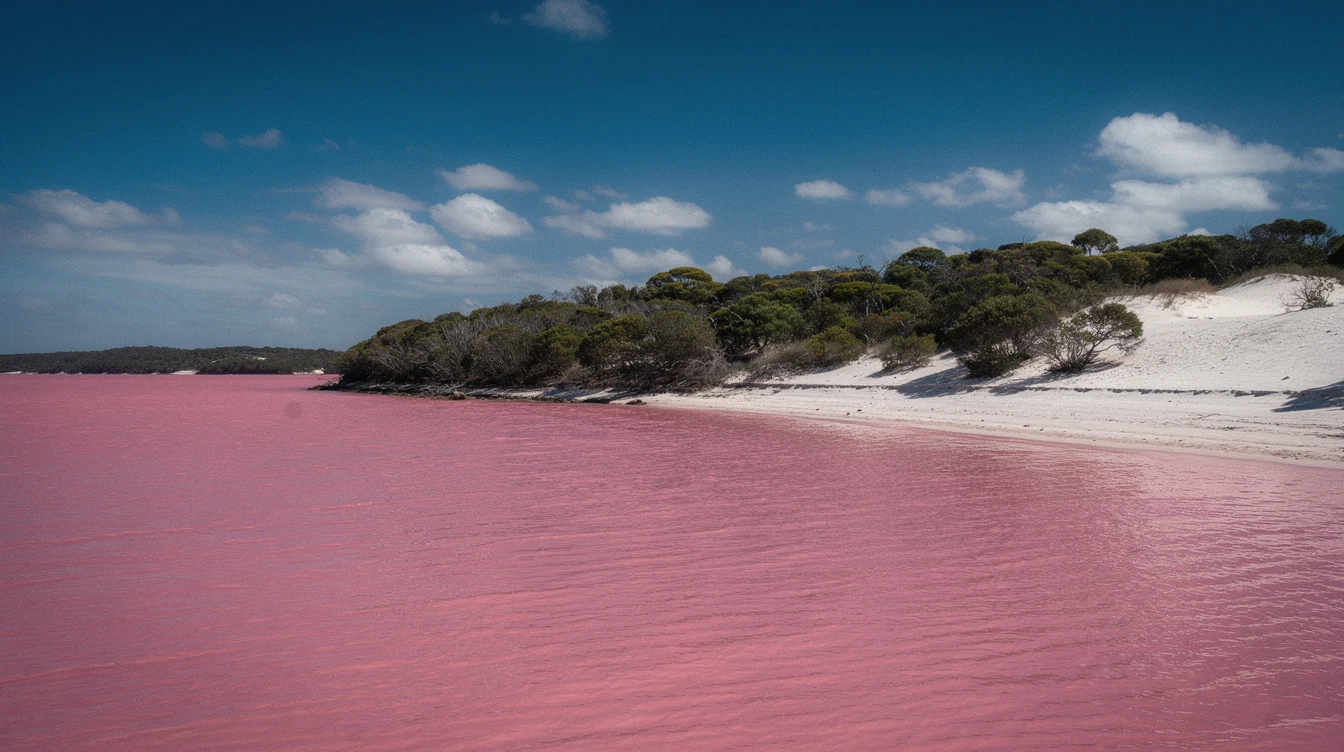
Most pink lakes blush and fade. They shift with the season, the light, or the angle of your phone. But Lake Hillier does not play by those rules. Scoop its water into a jar, and it stays pink. That permanence is what makes the place feel less like a trick of nature and more like a small miracle you can almost hold.
The lake that keeps its color in a bottle
The lake sits on the edge of Middle Island, inside the Recherche Archipelago off the south coast of Western Australia. A thin rim of sand and paperbark woodland separates it from the open ocean. From above, it looks like a pool of diluted bubble gum pressed against blue water. From the shore, the tone softens to a clear pink.
Scientists point to Dunaliella salina, a salt-loving microalga, plus red halophilic bacteria in the salt crusts. The exact recipe is still debated. What is not debated is the result: the color survives removal. That sets Lake Hillier apart from pink lakes in Spain, Senegal, or even elsewhere in Australia, where the hue can vanish with a change in salinity or sunlight.
How big is Lake Hillier?
It is small. About 600 meters long and 250 meters wide. You could walk its perimeter in under half an hour if you were allowed to land. But you are not, at least not through any regular service. The lake’s size is part of its charm. It feels like a secret, even though photographs of it have circled the globe.
Why the pink has been fading lately
Here is the nuance. In recent years, the color has noticeably faded. Heavy rainfall diluted the salt levels, so the lake looked less saturated than the postcards suggest. Scientists believe the change is temporary. As water levels drop, the salt concentration should rise again, and the pink should return.
That said, do not book a flight expecting neon. Go expecting variation. The lake is still pink, but the intensity moves with the weather and the season. A bright midday sun after a dry stretch will give you the strongest color. An overcast day after rain will give you a quieter, milkier version. Both are worth seeing, but they are not the same experience.
How to actually see it
You cannot drive to Lake Hillier. You cannot take a public ferry. The only practical options are a scenic flight from Esperance Airport or a cruise that passes nearby. Flights are the most common choice, with six departures a day during operating periods. They fly over Cape Le Grand National Park before reaching Middle Island, so you get coastline, bush, and the lake in one loop.
Cruises are slower and less predictable, but they suit travelers who dislike small planes. Most do not land on the island, so even by boat you will view the lake from a distance. Swimming is theoretically safe, the salt content is extreme. But without regular landing access, a swim is not a realistic option for most visitors.
Is Lake Hillier worth the trip?
Yes, if you accept the trade-off. You will spend more time getting to Esperance and into the air than you will hovering over the lake. The flight itself is the experience. The lake appears, shocks you with its color, and then you bank away. It is brief, expensive, and genuinely unforgettable.
What else to do in the area
Esperance is the gateway, and it rewards a longer stay. Cape Le Grand National Park sits just east of town, with granite peaks, squeaky white sand, and kangaroos that lounge near Lucky Bay. The beaches here are among the best in Western Australia, and they are far easier to reach than the lake.
From Esperance, you can also drive the Great Ocean Drive, a loop of lookouts and surf beaches. It is a useful counterbalance to the Lake Hillier flight. One day you see something surreal from above. The next you walk barefoot on sand so fine it whistles under your feet.
When to go
Lake Hillier is visible year-round, but the color shows best on a sunny midday. Summer days in Western Australia are long and bright, which helps. Winter can be moody and gray, which flatters the coastline but mutes the lake. If your main goal is the pink, aim for clear skies and dry conditions.
Esperance itself is busiest from December through February, when Australians travel. Shoulder seasons, spring and autumn, bring milder weather and fewer visitors. The flights still run, and the light can be softer and more forgiving for photographs.
The bottom line
Lake Hillier is not a place you stumble into. It takes planning, a flight or a cruise, and a tolerance for brief encounters. But the payoff is real: a lake that refuses to turn clear, even in a glass jar, sitting beside one of the loneliest coastlines on Earth. Go for the color, stay for the beaches, and do not expect to swim. That is the honest deal.