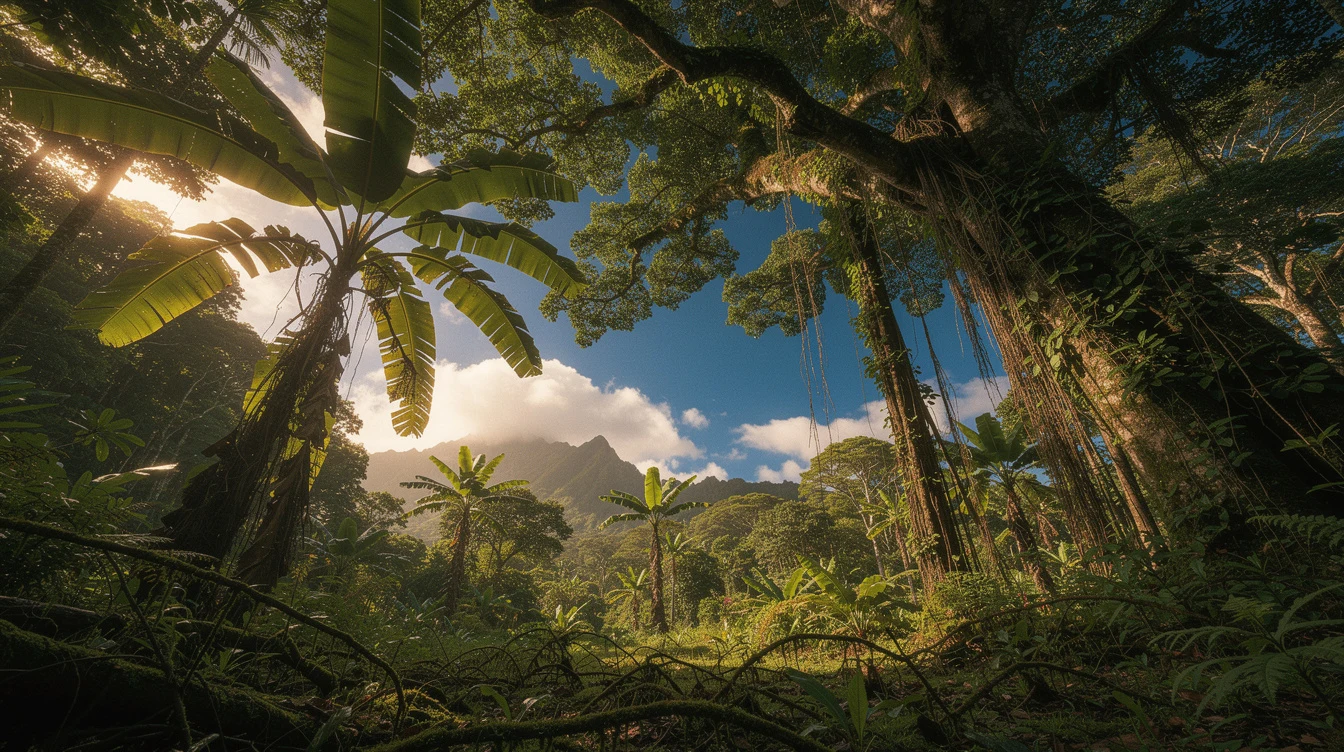
The Giant Fijian long-horned beetle lives only on Viti Levu. No other island has it. No scientist has figured out why it grew so large here, or why it never spread. The beetle can exceed the length of a human hand. That fact alone is worth the trip. But the island gives you more than a biological oddity.
How a beetle got bigger than your hand on one island
Viti Levu is volcanic rock and contradiction. A mountain range splits it north to south. The eastern side catches heavy rain. The western side sits in dry shadow. Locals call it the “burning west.” The beetle lives somewhere in this mix, and researchers still debate whether the isolation, the soil, or the forest itself made the difference.
The island’s highest point, Mount Tomanivi, rises to 4,341 feet. The terrain is rugged. Earthquakes shaped it. The Wainimala group rocks in the south date to the Eocene. The Mba group in the north is younger, basaltic, porous. None of this fully explains the beetle. That is part of the point.
What 146 miles of island actually feels like
The island stretches 146 km long and about 66 miles wide. You can drive the coastal road in a day, but you shouldn’t. The west smells of sugar cane and dry dust. The east smells of wet forest and cattle. The contrast is immediate. You cross the range and the light changes.
Nadi International Airport sits on the northwest coast. That is where most visitors land. Nausori International Airport serves Suva on the southeast side, closer to the capital. From either point, the interior pulls at you. The roads narrow. The forest thickens. The beetle’s habitat is not marked on tourist maps.
Can you actually see the beetle?
The Giant Fijian long-horned beetle is rare and tied to specific forest conditions. Your odds improve with local guides. But the search itself leads you into country most visitors skip. That is the trade-off. You come for the beetle story. You stay for the terrain it lives in.
Where the population lives, and why it matters
About 580,000 people live on Viti Levu. That is roughly 70% of Fiji’s total population. Suva, the capital, anchors the southeast. Nadi and Lautoka dominate the west. Ba, Rakiraki, Sigatoka, and Nausori fill the gaps. The coastal road links them all in a single loop.
The population split carries history. The west has a high concentration of Indo-Fijians, many descended from indentured workers who arrived between 1879 and 1916. The east is mostly indigenous Fijian, except in urban areas. The politics differ. The food differs. Even the pace differs. The west feels commercial, agricultural, hot. The east feels administrative, wet, dense with vegetation.
And the island is changing. 6.75% of the population faces exposure to sea level rise and storm surge, mostly in the north and west. The compound effects are not theoretical here. They are mapped, projected, discussed in villages where the coastal road already floods in king tides.
The ranch that dominates the interior
At Yaqara, between Tavua and Rakiraki, Fiji’s largest cattle ranch covers 70 square km with 7,000 head of cattle. The dairy industry is developing in the east because the grass grows there. The ranch in the west exists because the land is drier, more open, easier to manage at scale. You see the cattle from the road. You smell the operation before you see it. The interior is not empty. It is working country.
How do you get around without losing days?
The perimeter road is your main artery. It is paved, slow, and scenic. Ferries from Patterson Brothers Shipping Company connect Viti Levu to the outer islands. The schedules are not frequent. Plan around them, or you lose a day waiting at the dock. Domestic flights from Nausori reach smaller islands faster. The choice is time versus money versus tolerance for open water.
What to do with the beetle fact once you’re there
Use it as a lens. The beetle is large because something on this island allowed it. The same isolation that limits the beetle also limits the visitor. Viti Levu is not overdeveloped. The forested center has no major road. The peaks, Koroyanitu at 3,921 feet, Monavatu at 3,708 feet, the lower but sharp Koromba at 3,528 feet, all sit in green interruption.
The Emperor Mine near Vatukoula reminds you that extraction also shaped this place. Gold, not just cattle and cane. The mine is not pretty. It is part of the story.
And the beaches exist. Natadola Beach on the south coast has resorts. Pacific Harbour has the packaged version of Fiji. They are fine. They are not why the beetle grew large.
The real reason to book the flight
Viti Levu rewards the visitor who reads the terrain. The west is dry, the east is wet, the center is high and forested, and the only known home of one of the world’s largest insects sits somewhere in the overlap. Scientists have not solved it. You will not solve it on a two-week trip. But you can walk the same ridges, feel the same humidity, and understand why isolation matters.
The ferry from the outer islands pulls into harbor after dark. The deck lights cut through warm rain. That is when the island feels most like itself, and least like the brochure.