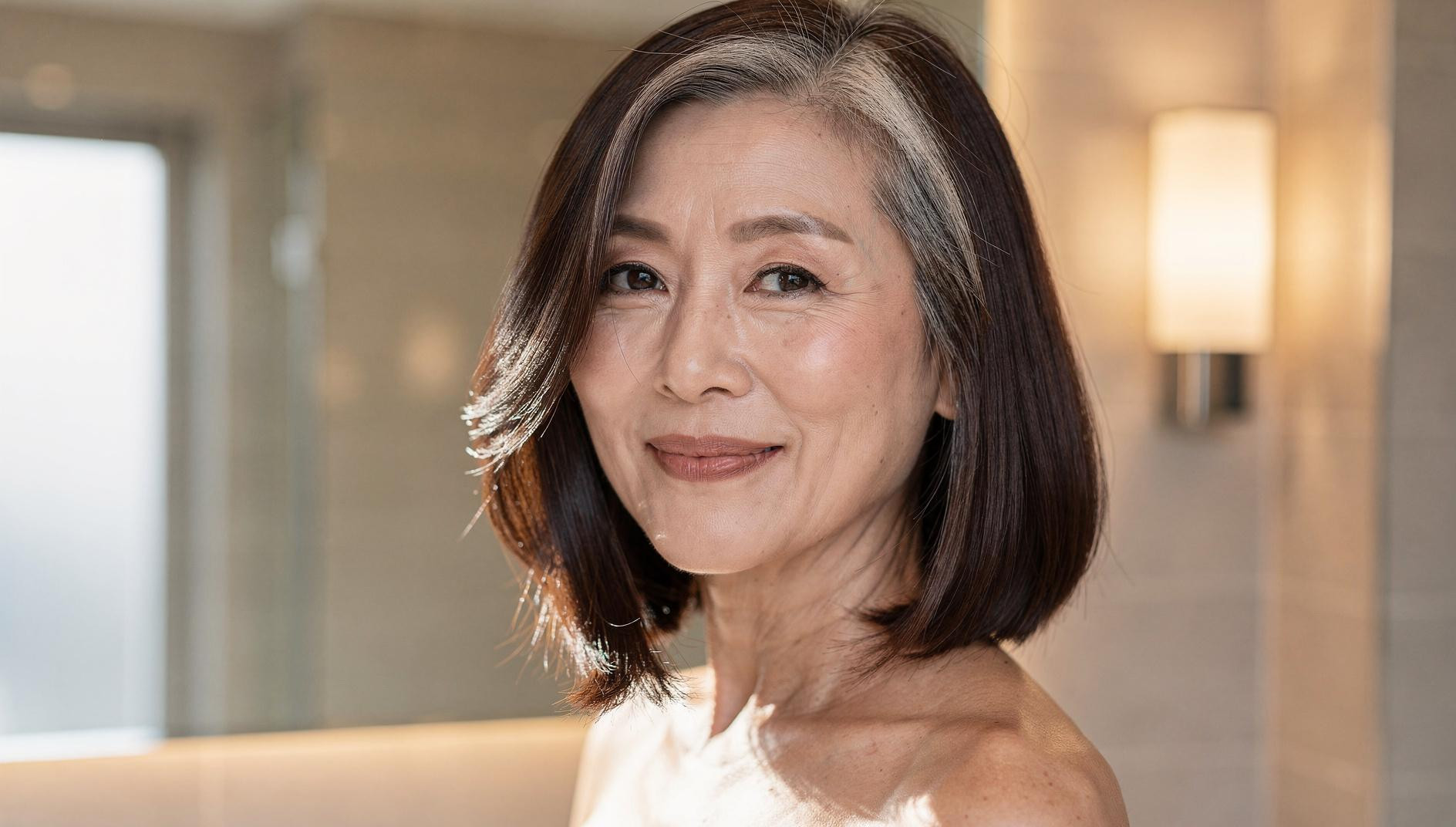
You were told to go shorter for volume. You did. The bob hits your jaw and your hair swings in one smooth, unbroken sheet that catches the light beautifully and lies completely flat by 10am. This is not a product problem. It is a weight problem. East Asian hair after 50 is fine enough to lose density but straight enough to show every gram of that loss. The cut that reads polished on thicker hair reads severe on yours. Here is what each length actually does to your specific texture, and what it costs you if you pick wrong.
Short cuts (chin and above): when the blunt bob works and when it doesn’t
A blunt chin-length bob does one thing very well on straight, fine hair: it stacks the ends into a single dense visual line that looks expensive. But above the ears, where hair thins most after 50, that same bluntness creates a flat ceiling with no movement at the crown.
The fix is a concave cut, where the back is stacked slightly shorter than the front. That angle directs the hair toward the face and lifts the crown without adding width. And it works, but only if you refresh it every six to seven weeks. At week eight, the shape collapses into a rounded bowl, which is exactly the helmet effect you were trying to avoid.
Hairstylists who specialize in mature hair point out that going shorter does not automatically solve the volume problem for fine, straight hair. The internal structure of the cut matters more than the length itself.
Medium cuts (jaw to collarbone): where this texture performs best
This is the range where straight, naturally glossy East Asian hair gets to move. A collarbone-length lob with C-shape layers lets the hair swing without hanging. The silky weight of it as it sweeps forward, catching light differently at the ends than at the root, is genuinely beautiful at this length.
C-shape layering removes weight from the interior of the hair, not the surface, so the outer perimeter stays clean while the underneath is light enough to lift. The stylist cuts a curved arc from behind the ear down to the collarbone. Ask for it by name. Many stylists default to point-cutting the surface instead, which removes density but not weight, so hair looks thinner without gaining any movement.
Stylists who work specifically with mature East Asian clients note that interior layering can lift flat hair at the crown by a measurable amount, because removing bulk from underneath lets the top layer sit away from the head rather than against it. That is the whole mechanism.
Curtain bangs work on a lob if you blow-dry them with a 1-inch round brush for about 90 seconds each morning. On straight East Asian hair, air-dried curtain bangs fall flat against the forehead within an hour. But if 90 seconds with a brush is not your routine, ask for face-framing pieces starting at the cheekbone instead. Longer, no blunt front edge, and far less upkeep.
Long cuts (below collarbone): keeping length without the curtain effect
Long hair after 50 is not the problem. Long hair hanging in a single dense sheet with no internal variation is the problem, because the eye follows the longest line and on a mature face that line ends well below the jaw, pulling everything down with it.
A single face-framing layer cut from the cheekbone to about two inches past the collarbone breaks the vertical curtain. It is long enough to blend into the rest of the hair when worn down, but it sits forward of the main mass. On glossy, straight hair this layer catches light differently from the rest and reads as dimension without any color added.
For gray blending at long lengths, a smudge or gloss technique works better than highlights on naturally dark East Asian hair. A colorist applies a toner in a shade sitting between the natural base and incoming silver, typically an ashy warm brown or soft mushroom, so the demarcation line grows in as a gradation. Budget $120 to $180 for a gloss add-on and a refresh every 10 to 12 weeks. And before you use a finishing oil on long gray hair, read about the product application mistakes that cost shine on straight silver hair, because the most common error is applying too much at the root.
What to say before the stylist starts cutting
Bring a photo and say two specific things: the length you want, and whether you want weight added or removed. “More volume” is not an instruction anyone can execute without knowing your texture. For fine, straight East Asian hair, the direction is: “remove interior weight, keep the perimeter clean.”
If you are keeping length, add “face-framing layer starting at the cheekbone.” Those two instructions, delivered before the first wet comb, change the result more than any product you put on afterward. And if the overall look also needs a lift at the eye area, low-maintenance treatments like a lash lift can shift the face read significantly without touching the hair at all.
Your questions about top 2025 looks for East Asian women answered
What is the best short haircut for East Asian women over 50?
A concave blunt bob, with the back stacked just below the occipital bone and the front pieces reaching the chin, is the most flattering short cut for fine, straight hair. It lifts the crown and keeps the perimeter dense. Expect to pay $60 to $150 at a mid-range salon, more at a senior specialist.
Does gray hair change which length looks best?
Gray hair is often slightly coarser than pigmented hair, which actually helps at medium and long lengths because the added texture creates body that straight pigmented hair lacks. But short cuts can read harsher with gray, because the contrast between silver at the temple and darker sections at the crown is more visible at that length.
Which products hold a style on straight East Asian hair after 50?
Olaplex No. 6 Bond Smoother (around $30) smooths the surface without weight. Color Wow Dream Coat ($28 to $32) seals the cuticle for even light reflection. On air-dry days, two drops of Shu Uemura Essence Absolue Hair Oil ($50 to $70) pressed through the mid-lengths is enough. Any more and fine hair goes flat at the crown within two hours.
A woman in her late 50s stands at a bathroom mirror on a Tuesday morning. The collarbone-length lob has one visible face-framing layer that swings forward as she turns. The rest of the hair, dark espresso with three inches of soft silver at the roots, moves behind it. The layer catches the light. She does not touch it again before she leaves.