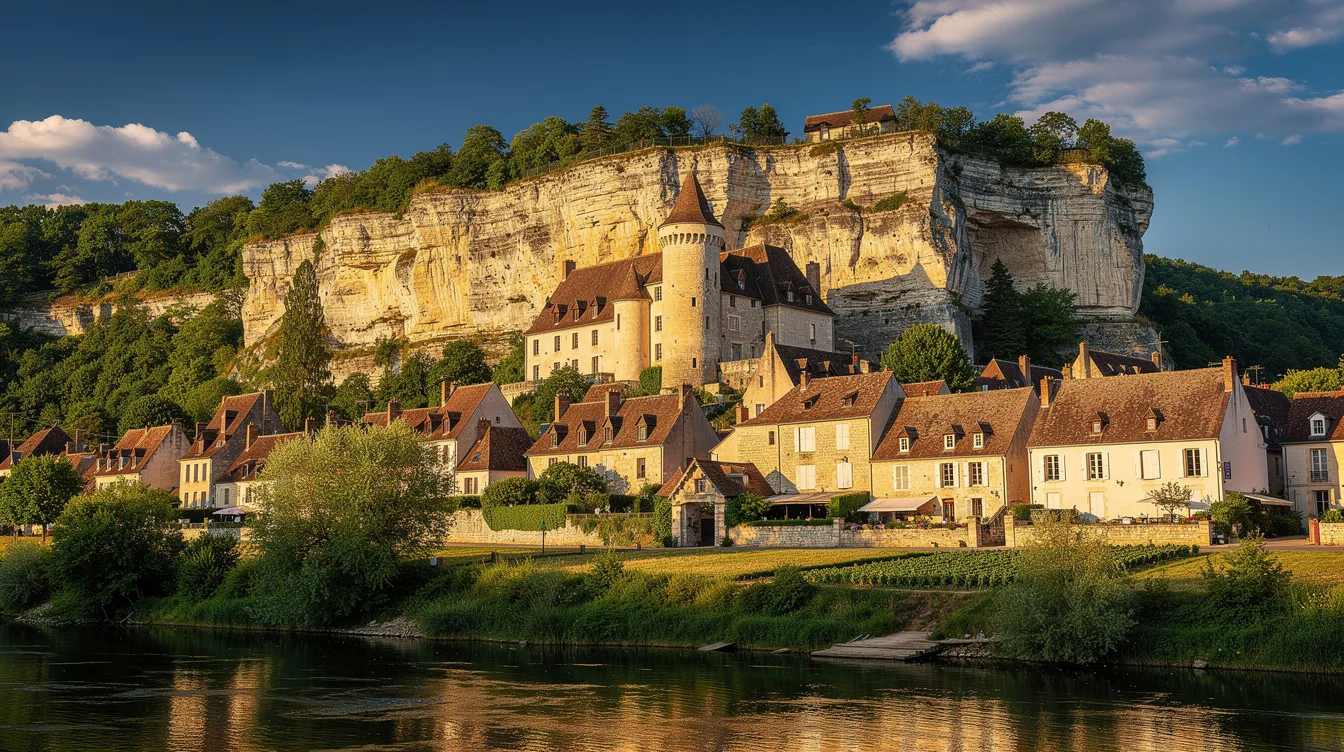
La Roche-Guyon grew around a castle hollowed into a high cliff, and that rock-bound beginning still directs the village’s every turn. The present château dates to the 12th century, when it controlled a Seine crossing on a route toward Normandy.
You feel the arrangement before you understand it. Pale chalk rises behind the houses, the river bends nearby, and the old fortress seems less placed on the cliff than absorbed by it.
The cliff made the medieval core
The château’s earliest form was cut into the high cliff, so La Roche-Guyon developed where stone, river, and passage met. This wasn’t a decorative castle added later. The village historically depended on it for its existence.
And that explains the compressed feel of the streets. Homes sit in or at the foot of the rock, while the medieval keep dominates above. You don’t come here for a broad civic square.
You come for a village shaped by a defensive problem.
A fortified manor, the château-bas, was added below in the mid-13th century. But the tension between the lower buildings and the cliff remains the point. The architecture is severe, yet the Seine softens the scene with moving water and open sky.
The keep offers views over the river, village, and Vexin plateaus. The climb has purpose because it makes the geography legible. From above, you can see why a crossing here mattered.
A Seine bend with a hard history
The Seine was both connection and threat at La Roche-Guyon. The castle controlled a crossing on one of the routes between Paris and Normandy, so it repeatedly became part of larger struggles far beyond this small commune.
But its history isn’t neatly romantic. In 1419, the fortress endured a six-month siege. Its defender left rather than accept English rule, a decision that gives the quiet stonework a sharper edge than any costumed medieval display could.
Later changes opened windows and reshaped parts of the lower château. The domain was expanded again in the 18th century, which is why the site doesn’t read as one frozen medieval artifact. It is layered, but never fussy.
The château also had a military role during World War II, when it was used as a headquarters and a bunker after D-Day. That later chapter complicates the visit. The place is old, but it was never simply preserved outside history.
Can you visit the castle?
Yes. The château is announced open daily from April 1 through November 1, from 10 a. M.
To 6 p. M. Check current hours before leaving, especially around holidays and events.
The schedule is generous, but it is seasonal.
The gardens change the mood
Below the cliff, the château gardens bring order to all that rough stone. There is a fruit and vegetable garden and a formal French garden, recognized as a Remarkable Garden. The contrast is the pleasure: chalk above, clipped structure below.
And this is where you should slow down. The gardens keep the visit from becoming an exercise in looking upward. You can move from narrow mineral streets to planted beds, then back toward the river without losing the castle from view.
The village belongs to Les Plus Beaux Villages de France, a designation that can invite crowds and expectations. Still, La Roche-Guyon feels more forthright than polished. Its appeal comes from how visibly the cliff limits every building.
There are no broad boulevards to dilute the effect. You’ll pass stone walls, low openings, and houses pressed close to the rock. The place is compact, but it rewards wandering because the castle keeps reappearing from odd angles.
Make it a Vexin day, not a rushed stop
La Roche-Guyon sits in the Vexin français regional natural park, near Giverny. That proximity makes it an easy addition to a Seine Valley drive or bicycle outing, especially if you want a smaller counterweight to busier stops.
But don’t treat it as a photo stop between destinations. The village’s story only lands when you give yourself time to walk beneath the cliff, enter the château, and watch the river bend past the old walls.
The practical limit is simple: castle access runs from April into the start of November. Outside that window, the village and its setting still exist, but the carved heart of the visit may be closed.
By late afternoon, the chalk cliff catches the quieter light, and the Seine keeps folding around the village below.