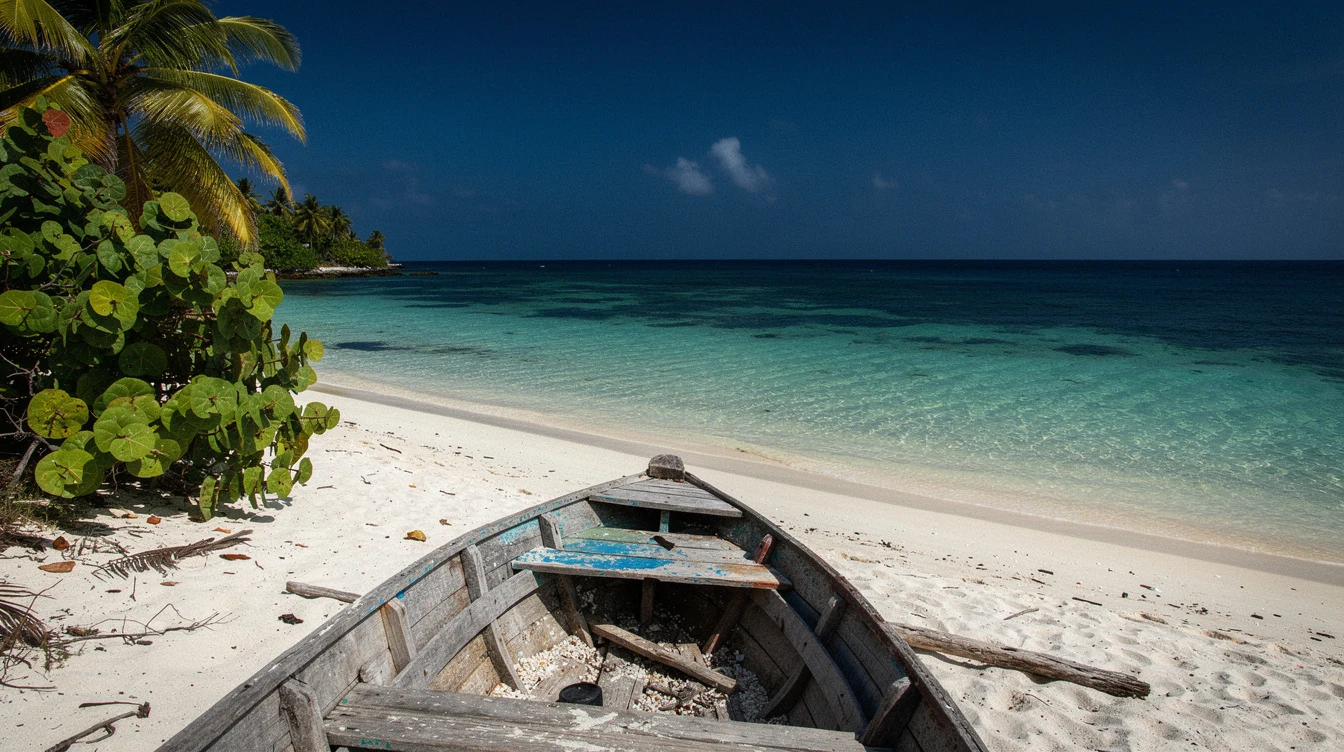
Big Corn Island is a 10 km² slab of sand and coral where every beach belongs to the public. That is the first thing that matters, and it is rare in the Caribbean. Most islands here have long sold their shorelines to resorts. But on Big Corn, you can walk from one end to the other and never hit a fence or a “guests only” sign.
The island runs on 20-cordoba taxis and one ring road
The paved road is only 12 km long. It loops the whole island, and that is the entire infrastructure. Most vehicles are taxis, and a ride costs 20 cordobas. There is also a bus that circles clockwise for 10 cordobas. You will not need a car. You might not need a map.
And that is the point. The island has roughly 7,000 to 8,000 people, mostly Creole, Spanish, and Miskito locals plus a few expats who came for the lobster and stayed for the pace. It feels more village than vacation rental. Nights are quiet unless there is a baseball game at Karen Tucker Stadium, where the island gathers.
Public sand means you choose your own spot
All beaches are public, which changes how you travel here. Picnic Center and Arenas Beach on the southwest have calm water for swimming and snorkeling. The east coast faces open Caribbean wind, so the surf is rougher and the sand emptier. You can move between them in a single afternoon.
The water is turquoise, the sand is white, and the reefs are intact enough to draw divers. Barracudas, nurse sharks, and green sea turtles are common sightings. But the island is not a dive resort. It is a place where fishing still matters, where lobster boats leave early, and where the coral is watched rather than marketed.
Mount Pleasant is only 113 m, but it earns the climb
The highest point is Mount Pleasant at 113 m. The hike is short and steep, and there is no shade for the first stretch. Start before the heat builds. From the top you see the whole island, the reef line, and the distance to Little Corn Island, 3 km² of no cars and no paved roads at all.
Little Corn is reachable by panga boat from Southwest Bay, usually three or four times daily depending on weather. Big Corn handles the logistics: the ATMs, the hospital built in 2017, the port, the flights. Most travelers use it as a base or a pass-through. That is a mistake if you skip the main island entirely.
Getting there is part of the filter
Big Corn sits 70 km off Bluefields, the Atlantic port city. The easiest route is a direct flight from Managua, twice daily on La Costeña. The harder route is the ferry from Bluefields, roughly 6 hours and about $7, leaving Wednesdays and Saturdays at 9 a.m. The ferry does not run daily, and that schedule keeps the crowds thin.
When should you go, and what will you eat?
The dry season runs December through April. May to November brings rain and real hurricane risk. December is the sweet spot: calm water, full lobster supply, and the island fresh from the wet season.
Can you work remotely from here?
3G and 4G exist, and hotels have Wi-Fi. But the connection is inconsistent, and the speeds lag behind mainland cities. This is fine for email and casual calls. It is risky for live trading or video uploads. The island is cheaper than most Caribbean destinations, though imported goods and higher-end hotels still cost. Local seafood, including lobster, is the bargain.
What is the actual nightlife?
There is none, in the conventional sense. Beach bars serve rum. Seafood shacks close by nine. Most people are in bed early unless it is a local event or a baseball game. The rhythm is morning-heavy: fish markets, early boats, afternoon siesta. That said, the lack of clubs is not a flaw. It is the trade-off for public sand and cheap taxis.
The history still shapes the present
The Afro-Caribbean culture stuck. English-based Creole is still spoken alongside Spanish. The cuisine and community traditions reflect this layered heritage. And the Creole identity that formed still runs the kitchens and the baseball leagues.
Cuisine is seafood and coconut: crab soup, rondon stew, fried fish, rice with shrimp. The dishes are not restaurant inventions. They are home cooking that happens to be served in small open kitchens.
Why this island works for travelers over 50
It is flat, small, and slow. The 12 km road means nothing is far. The 20-cordoba taxi means you never negotiate. The public beaches mean you never pay for access. And the health infrastructure, while basic, includes a real hospital built in 2017, which matters on an island 70 km from the mainland.
But the humidity is serious, and the medical evacuation option is limited. The ferry is long and weather-dependent. The island is not for travelers who need certainty or luxury branding. It is for travelers who want the Caribbean without the private beach.
Skip the resort model, keep the water
Big Corn Island is not undeveloped. It has hotels, a airport, and a growing tourism economy. But the development has not yet claimed the shoreline. That is the exception. In the Caribbean, sand is usually the first thing sold and the last thing shared.
Here, you can still walk to the water at dusk and not know which hotel you are passing. The ring road ends where it began. The last panga to Little Corn leaves by mid-afternoon. And the taxis still cost 20 cordobas, whether you are going 500 yards or all the way around.