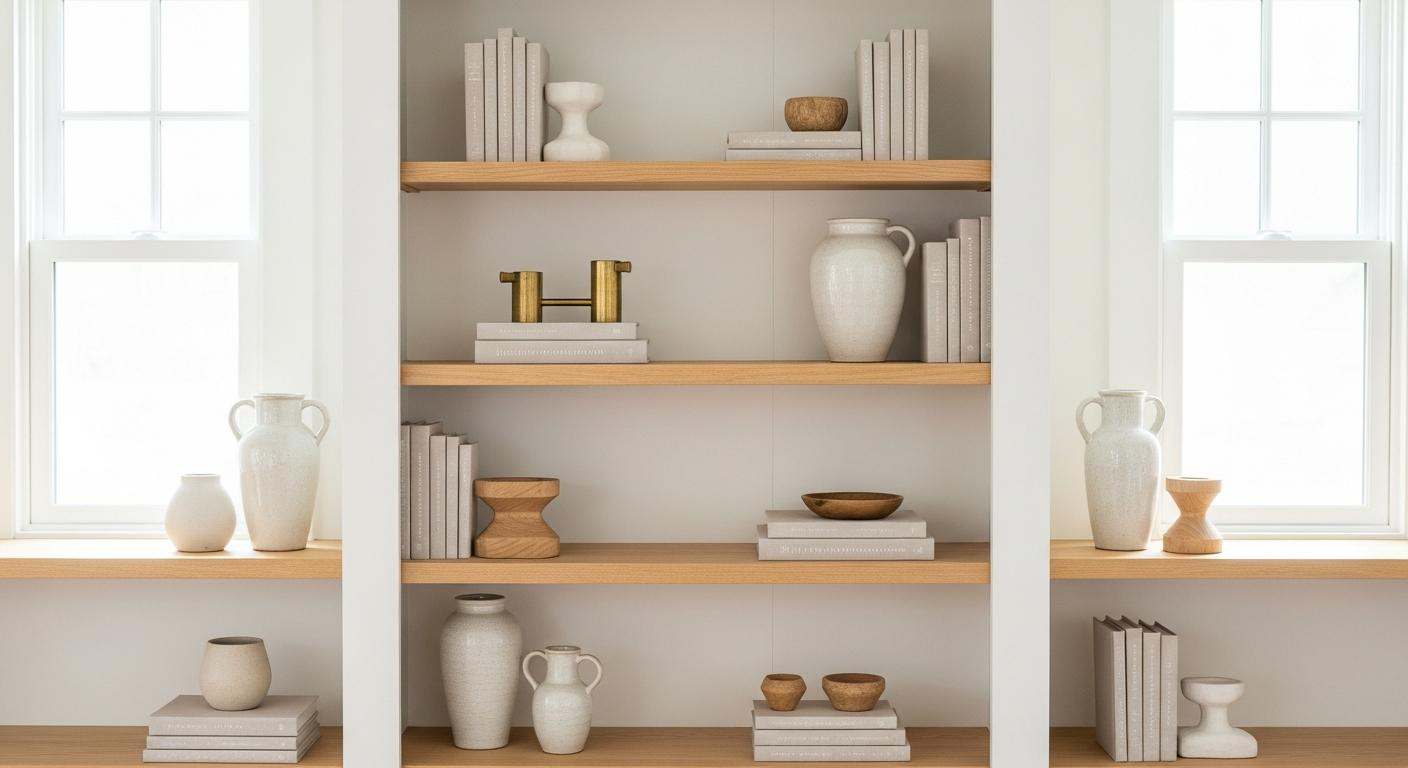
Your bookcase held $340 worth of objects on a Tuesday afternoon when you stepped back after two hours of styling and the whole thing felt like a storage locker photographed for an estate sale. Twenty-three books, four vases, eleven picture frames, two sculptural objects, and three plant pots distributed across five shelves that measured 72 inches tall by 31.5 inches wide. You’d filled 87% of available space following the internet’s advice to style in odd numbers and vary heights, but the composition felt heavy in a way you couldn’t name until a stager friend visited Thursday and said six words: you’re packing it like a moving truck.
Stylists measure shelf depth first and never exceed 60% front-to-back coverage
Professional shelf styling starts with depth measurement. Standard bookcases run 11 to 15.75 inches deep, and the 60% rule means maximum 6.6 to 9.45 inches of front-to-back object placement. Most amateurs push objects all the way back and layer forward, creating 95%+ density that makes the eye see storage, not display.
The specific professional technique places tallest items 2 to 3 inches from the back wall and leaves the front 4 inches completely empty on 40% of shelves. When I styled my bookcase at the 60% guideline, I could fit only 14 of my 23 books on the top three shelves. The remaining 9 went into closed storage, and that subtraction made the 14 visible books look intentional instead of leftover.
But here’s the hard truth this ratio forces: editing. Most people own 40% more stuff than the ratio allows, which is exactly why overfilled shelves photograph like inventory instead of interiors. Installing new shelving won’t fix the problem if you’re still working at 90% density.
The top-down sequencing that builds visual lift instead of weight
According to residential photographers featured in design publications, eye level sits at 59 to 63 inches for average heights and receives first visual attention. Professional stylists place 3 to 5 objects maximum on eye-level shelves in 8-foot bookcases, leaving 50%+ empty. This creates the gallery effect where each object gets individual attention instead of competing for space.
And the inversion works because lower shelves can handle more density. Bottom shelves below 24 inches can hit 70% coverage because the eye expects weight at the bottom, where horizontal book stacks and heavy ceramics anchor the composition naturally.
My bottom shelf held 8 books stacked horizontally plus a 10-inch ceramic bowl, filling roughly 68% of the 31-inch width. At eye level, that same density would photograph as clutter. But down low, it reads as grounded and intentional, which is exactly what keeps the whole unit from feeling like it’s floating off the wall.
Eye-level shelves stay under 50% to create breathing room where you look first
Interior designers with ASID certification recommend the lightest density at eye level because that’s where the room’s visual expectation gets set. When you walk into a space and the first shelf you see holds 12 objects crammed into 36 inches, your brain categorizes the whole unit as storage. When that same shelf holds 4 objects with visible wall behind them, the categorization shifts to display.
The texture of that breathing room matters as much as the objects themselves. White walls behind brass candlesticks or the grain of natural wood showing between ceramic vases creates visual rest that makes each piece feel more valuable.
Bottom shelves can hit 70% because visual weight anchors there naturally
Design experts featured in trade publications note that bottom-heavy compositions feel stable while top-heavy arrangements create visual tension. That’s why professional staging places heavier, denser groupings below 24 inches from the floor and keeps upper shelves sparse. The result is a space that feels balanced without requiring mathematical precision.
Why bottom-up packing creates the cargo ship effect professionals avoid
The amateur mistake starts with bottom shelves, filling them completely, then working upward until running out of space or objects. This creates visual gravity problems where the composition feels like it’s sinking through the floor. And it photographs even worse than it looks in person because cameras capture vertical compositions from center-out.
Professional stylists work top-down instead. Style the eye-level shelf first at 45 to 50% density, work upward to the lightest shelf at 35 to 40% coverage, then work downward adding progressive weight. Editorial shoots follow this sequence because when the visual center stays light, the whole unit photographs as curated display.
The psychological resistance makes sense because starting with the least-filled shelf feels backwards. But that backwards feeling is exactly why it works, keeping you from over-packing early and running out of breathing room later. Picture ledge styling follows the same principle at smaller scale.
The count-and-divide trick that translates 60-40 into actual objects
The practical measurement system works like this: count total shelf inches across all levels. Five shelves at 31 inches each equals 155 total inches. Multiply by 0.6 to get 93 inches maximum coverage. Then measure your objects end-to-end and if they exceed the threshold, edit until they don’t.
My styling used 87 inches of object coverage across 155 available inches, hitting 56% density. But it felt packed because I’d distributed it wrong, with three shelves at 85% each and two at 20%. Re-balancing to 50 to 60% per shelf made the same objects photograph professionally without buying or removing a single piece.
According to professional organizers with certification, visual weight distribution matters more than total object count. Twenty objects at even spacing read as cluttered while fifteen objects at strategic intervals read as curated, even though the difference is just 5 pieces.
Your questions about why the 60-40 shelf styling ratio works better than filling every inch answered
Does this work for kitchen open shelving where you need actual storage access?
Yes, but the ratio shifts to 65-35 for functional shelving where you grab items daily. The breathing room still applies but accounts for practical reach patterns, storing heavy-use items like dinner plates at 65% density on lower shelves. Display-only items like serving pieces stay at 50% density at eye level, creating the same visual lift without sacrificing storage capacity.
What if my shelf is only 24 inches wide—does 60% mean just 2 objects?
Short shelves can hit 70% coverage because the eye reads them as single units, not compositions. A 24-inch picture ledge can hold three 5-inch frames at 62.5% coverage and still feel balanced. The ratio matters most on shelves 36+ inches wide where empty space becomes visible structure instead of accidental gap.
Can I save money by styling with fewer objects instead of buying more decor?
That’s the entire point the retail industry doesn’t advertise. Styling at 60% with $85 worth of objects photographs better than 95% density with $340 worth because the ratio makes each piece look more valuable through isolation. Grouping items with intentional breathing room works the same way on bathroom counters and nightstands.
Your bookcase now holds fourteen objects across five shelves where twenty-three used to crowd. Morning light hits the top shelf’s single brass candlestick at 8:17am without competing for the white wall behind it. The empty 40% doesn’t read as missing, it reads as the space that makes the 60% matter.