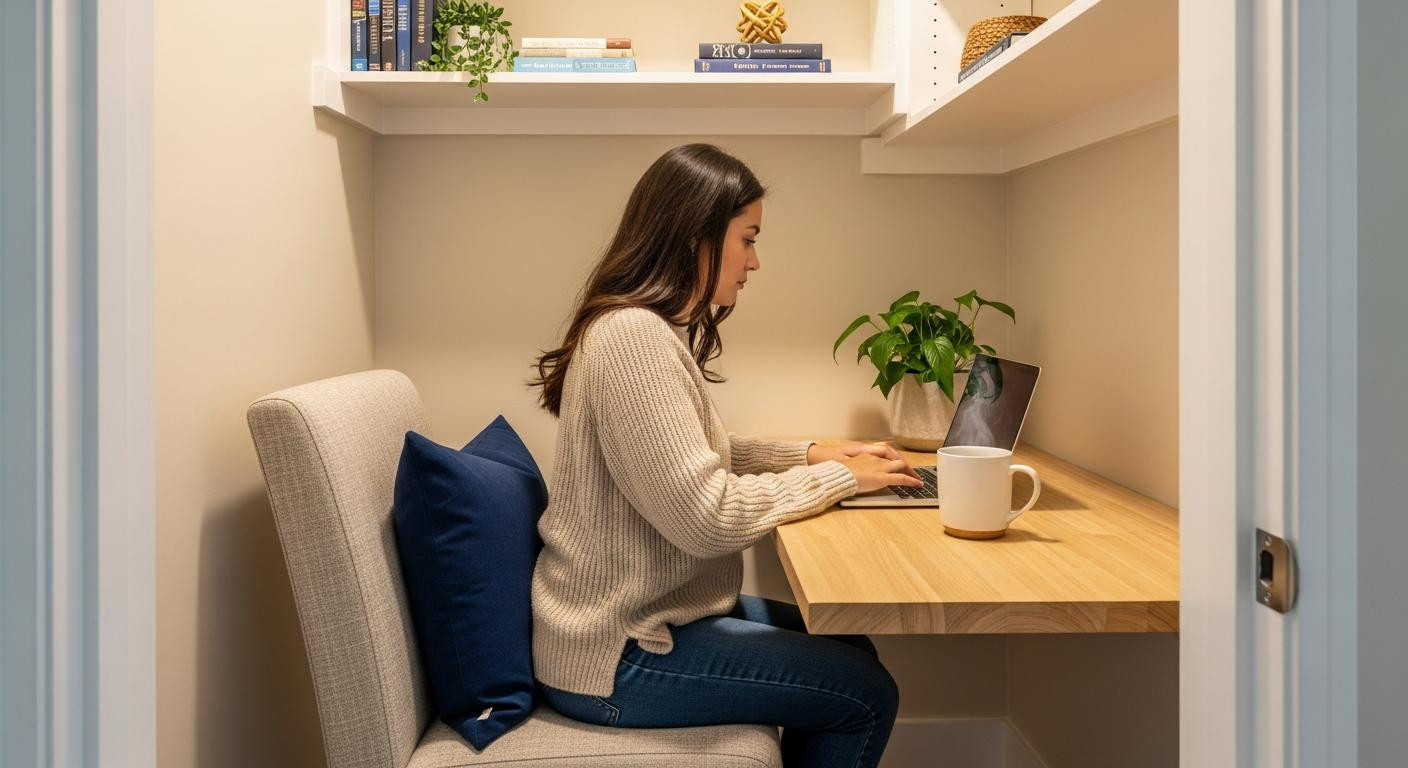
Your walk-in closet measured 4 feet deep when you positioned the $99 IKEA desk against the back wall last Tuesday, exactly where the Pinterest tutorial showed. By Thursday afternoon, you’d turned sideways to enter three times, knocked your knee on the chair arm twice, and realized the door wouldn’t fully open with the chair pulled out. The measurements technically fit. The psychology didn’t.
Closet offices fail at predictable dimensional thresholds that have nothing to do with total square footage and everything to do with three specific clearances most people measure wrong.
The 24-inch reach that makes shallow closets feel like traps
Sit in a reach-in closet that’s 22 inches deep and your knees hit the wall while your back presses against shelving. It’s not claustrophobia, it’s geometry. ASID-certified interior designers confirm that reach-in closets under 24 inches deep create physical discomfort regardless of width.
Wall-mounted desks change the ergonomic equation entirely. They fold away, eliminating the sensation of being trapped behind furniture. The IKEA Norberg at $79.99 drops to 17.7 inches deep when closed, giving you 6 inches of breathing room compared to standard desks.
And that matters because standard desk depths run 29 to 30 inches. Add a chair that needs 24 inches to pull out and you’ve consumed 54 inches of total depth in a space that might only offer 48. The result is a workspace that feels like sitting in a cardboard box.
But here’s the measurement test nobody mentions: extend your arms forward while seated. If your fingertips touch the wall, the depth fails. What you’re feeling is the absence of visual escape, and it makes concentration nearly impossible after the first hour.
Why 30 inches of door clearance matters more than desk size
Most people measure floor space but forget the vertical plane. Desk positioning affects how often you check the door, and closet offices amplify that anxiety when clearances feel tight.
The chair needs 24 inches to pull out. You need 18 inches to stand without contorting. That’s 42 inches of clearance from the desk front to any obstruction, including door swing radius. Standard 24-inch closet doors create entry friction that makes the space psychologically uninviting, even when you technically fit.
Removing doors entirely changes perceived openness by roughly 30 percent, according to residential design experts featured in Architectural Digest. If you’re renting, a linen curtain on a tension rod offers the same visual softness without the commitment. The space breathes differently when there’s no physical barrier to cross.
The doorway width that determines if this actually works
Doorways under 30 inches wide force you to angle your shoulders on entry. Do that six times a day and the closet starts feeling like a punishment instead of a retreat. Professional space planners recommend 30 to 36 inches as the comfortable minimum for daily use without spatial resentment building over weeks.
The 28-inch desk height nobody talks about
Wall-mounted desks installed at the standard 29 to 30 inches feel wrong in closets because confined space amplifies any ergonomic mismatch. Cable management becomes critical when visual chaos has nowhere to hide, and so does precision with desk height.
Lighting designers with residential portfolios note that users under 5’4″ need desks installed at 26 to 27 inches in tight quarters where feet can’t extend forward comfortably. That’s 3 inches lower than standard, and it’s the difference between working pain-free and developing shoulder tension by noon.
The $179.99 Target Project 62 Nora Task Chair serves as the diagnostic tool. Adjustable height reveals whether desk positioning causes discomfort or if the space itself fails your proportions. Admittedly, if adjusting the chair to minimum height still leaves your thighs hitting the desk underside, the installation height is wrong for your body.
Standard desks sit at 29 to 30 inches but wall-mounted changes the math
Fixed-height desks offer no flexibility once installed. And that’s the hidden cost of wall-mounting: you get one chance to position it correctly. Measure from floor to elbow while seated, then subtract 2 inches. That’s your target desk height, not the number on the installation manual.
The lighting mistake that makes 4×4 closets feel like cells
Overhead lighting alone casts shadows on desk surfaces and turns functional closets into depressive caves. Multi-source lighting changes spatial perception entirely. One overhead fixture, one task lamp, one accent light. That’s the minimum configuration that makes walls recede instead of close in.
Closets designed for clothing storage typically feature one dim overhead fixture at 40 to 60 watts equivalent. Video call backgrounds need deliberate styling, and lighting determines whether you look professional or exhausted on camera. The $25 Lepro LED desk lamp at 2700K warm white and the IKEA BARLAST wall lamp at $39.99 solve both problems for under $65 total.
Warm white at 2700K makes walls recede. Cool white at 5000K turns them into a fluorescent box. And that color temperature difference creates entirely different emotional responses to the same physical space.
Your questions about closet offices that actually work answered
Can a reach-in closet work as an office?
Yes, if it’s at least 24 inches deep and you use a wall-mounted desk that folds away. A documented case study from a home design blog showed a 24-inch by 6-foot reach-in supporting full-time remote work, but only with proper lighting and a chair under 20 inches wide. Desk depth affects natural light access, which matters more in windowless closets.
Will a closet office look professional enough for video calls?
It depends on what’s behind you, not the size of the space. Style the back wall with floating shelves at 12 to 15 inches apart, one framed print, and one plant to create visual interest without clutter. The background reads as intentional when objects are spaced deliberately instead of scattered randomly.
What’s the actual budget for a closet office that doesn’t feel temporary?
$430 to $860 for budget builds using IKEA desks, Amazon chairs, and DIY shelving. $1,250 to $2,600 for mid-range setups with West Elm desks and ergonomic task chairs that include proper lumbar support. The expensive-looking factor comes from restraint, not price. One quality item plus simple everything else reads as more intentional than five mediocre pieces competing for attention.
The closet door opens at 7:42am on a Tuesday in May and the space holds a desk, a chair, and 14 inches of clearance that finally feels like enough room to think. Warm light from the wall-mounted lamp hits the corner where your coffee sits. You’re working, not coping.