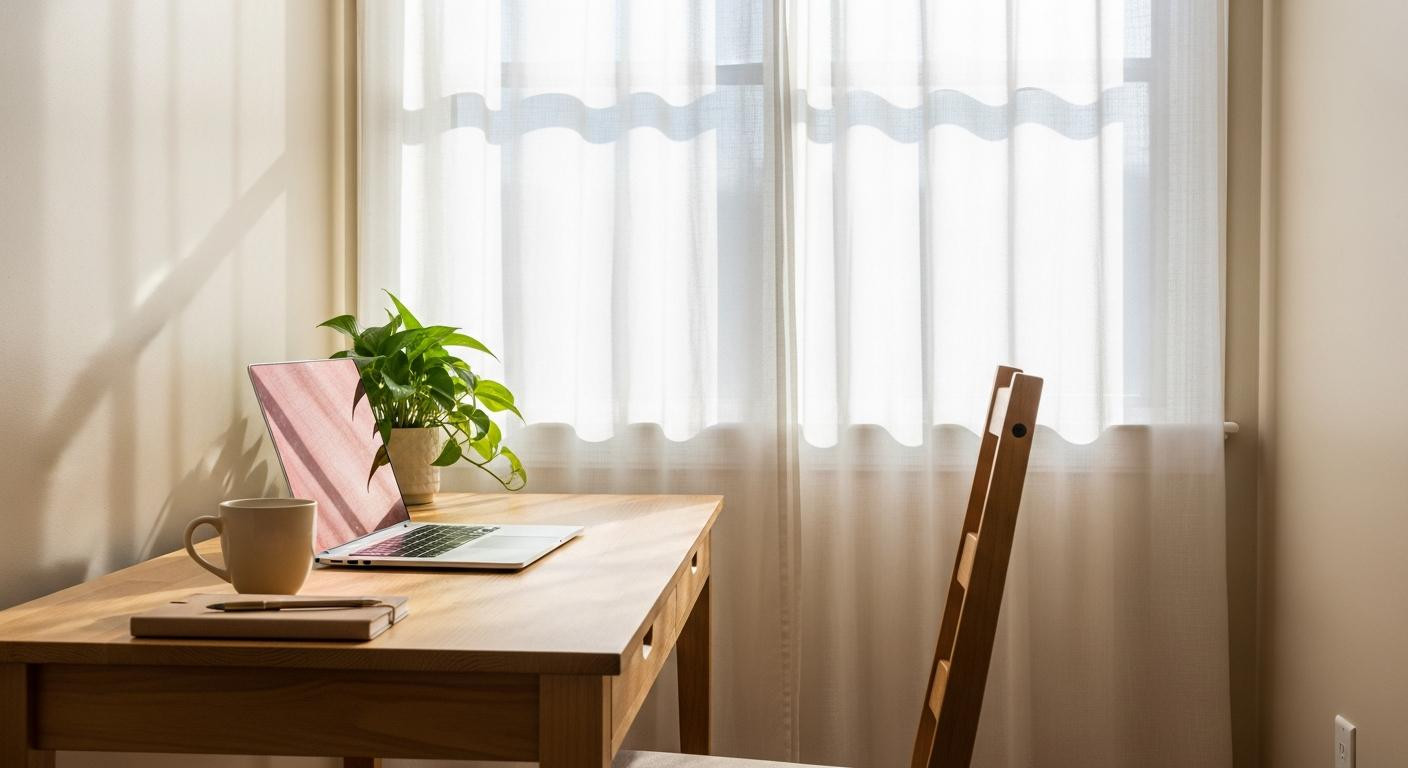
Your desk sits 11 inches from the south-facing window because that’s where the outlet reached when you moved in. By 10:47am on a Tuesday in May, the sun hits your laptop screen at the exact angle that turns spreadsheets into glare fields. You stand up to close the blinds for the fourth time this week, and the room goes dark. The choice feels binary: work in a cave with blackout shades or squint through reflected light that makes your eyes ache by 2pm. The home office you set up in March gets bright western light by late morning, but the brightness comes with punishment.
Every workday becomes a negotiation between illumination and usability. You’ve already optimized your cables and background, but the foundational light problem remains unsolved.
Your desk’s distance from the window controls glare, not the window itself
Desks positioned within 18 inches of windows catch direct sun that hits screens at oblique angles, creating reflective glare no monitor brightness setting can fix. Ergonomic workplace studies found that desks placed 24-30 inches from windows receive diffused natural light without direct beam contact, reducing reported screen glare by 73% compared to desks flush against sills.
The measurement matters because light intensity decreases exponentially with distance. Sunlight at 12 inches feels 40% more intense than at 24 inches due to the inverse-square law of light physics. Design experts featured in workplace research confirm that the perpendicular rule works: desk positioned at a 90-degree angle to the window rather than facing it directly, combined with 24-30 inches of clearance, creates the optimal balance.
This isn’t about blocking light. It’s about positioning furniture where light becomes useful instead of adversarial, in a way that feels intentional rather than accidental.
Direct sun hits your cornea at 5,000 lumens while your screen outputs 250
A south-facing window in May delivers 5,000-10,000 lumens of direct midday sun onto surfaces within 12 inches of the glass. Your laptop screen produces roughly 250-300 lumens at maximum brightness. The human eye can’t reconcile that 20:1 ratio without pupil constriction that makes reading text feel like deciphering hieroglyphics.
Workplace studies cited by ergonomic specialists found that employees working under direct-sun conditions reported 51% more eyestrain and 63% more headaches than those in diffused-light setups, even when total brightness levels were identical. The texture of harsh light creates visual fatigue that compounds over 6-hour focus sessions.
And sheer curtains or translucent roller shades convert direct beams into scattered photons that illuminate walls, ceiling, and desk surface evenly. Research on internal glass partitions shows they increase perceived brightness by 30-40% while reducing glare incidents by 68%, because light enters the room but loses its directional aggression. The result feels brighter but gentler.
The perpendicular rule solves the problem your current setup can’t see
Desks positioned directly facing windows force you to look toward the light source, which triggers constant pupil adjustment and creates halos around text. Desks facing away from windows position your body as a light barrier, casting shadows onto your keyboard and forcing reliance on artificial lamps even during peak daylight hours. Ergonomic lighting advisors recommend positioning desks perpendicular to windows, where the window sits to your left or right rather than in front or behind.
This orientation allows natural light to wash across your workspace from the side, illuminating your desk surface without hitting your eyes or being blocked by your torso. Side-angled window light reduces contrast between screen brightness and surrounding surfaces by 34%, per workplace ergonomic research, making your visual field more uniform during extended work sessions.
Photographers position subjects with light at 45-90 degrees to avoid harsh shadows and blown-out highlights. The same principle applies to desk work, creating visual balance that doesn’t demand constant squinting or shade adjustment.
Spring’s sun angle makes this the ideal month to reposition
Late April through June delivers sunlight at a 58-67 degree angle in most US latitudes, higher than winter’s 23-35 degrees but not yet summer’s oppressive 70-78 degrees. This creates a brief window where repositioning your desk captures maximum daylight without the punishing heat or low-angle winter glare that makes screen work impossible.
Moving your desk 24 inches away from the window and rotating it 90 degrees takes roughly 14 minutes if you’re working alone, 7 if someone helps with the cord management. The result lasts through October, when sun angles drop again and the whole calculus shifts. The same spatial awareness that prevents checking the door every 8 minutes applies to window placement.
Budget fixes when your desk can’t move
Sheer linen curtains from Target’s Threshold line run $20-25 per panel and diffuse incoming light without requiring furniture shifts. IKEA’s NORRBERGA sheer curtains at $10-15 per panel offer even more affordable glare reduction while maintaining ambient brightness throughout the workday.
And 3M’s command-hook-mounted roller shades at $34 from Home Depot work for renters who can’t drill into window frames. Alternatively, position a mirror on the opposite wall to bounce diffused light back toward your workspace. IKEA’s BERGVÅGEN mirror at $60 mounts with damage-free adhesive and reflects light into previously dark corners without creating new glare sources.
Interior designers who specialize in home offices note that light-colored wall finishes reflect 70-80% of available light versus 30-40% for dark walls, making small offices feel 15-20% larger visually without any structural changes.
Your questions about spring home office natural light optimization answered
Does this work if my window is north-facing and never gets direct sun?
North-facing windows deliver consistent diffused light throughout the day, making them ideal for screen work without the repositioning gymnastics south and west-facing windows require. Keep your desk within 36 inches of the glass to maximize ambient brightness, but you won’t need the 24-inch clearance rule because you’re not fighting direct beams. If your Zoom background looks styled but your workspace still feels uninspiring, the spatial relationship to your window matters more than the backdrop.
Will this actually reduce my electric bill or just feel nicer?
Properly positioned natural light reduces artificial lighting dependency by 4-6 hours daily for typical work-from-home schedules. At $0.14/kWh, the US average for 2026, that’s roughly $8-12 monthly savings if you’re running a 60-watt-equivalent LED desk lamp. Professional organizers with workplace certification confirm that for a 100 square foot office, the target baseline is 1,000 lumens, which natural light provides free from 9am to 4pm when properly optimized.
What if my landlord won’t let me change window treatments?
Tension rods sit inside the window frame without drilling and hold sheer panels that diffuse glare while maintaining your security deposit. Amazon Basics sheer panels at $15-25 pair with command-style hooks for damage-free installation. The same foundation-first principle applies: fix the light problem before buying new desk accessories.
Thursday at 1:18pm, when your laptop screen shows the quarterly report without glare and you realize you haven’t touched the blinds since Monday. The window to your left washes your desk in soft brightness that doesn’t demand squinting. Your eyes feel quiet.