Tempur-Pedic is the brand most people picture when they hear “memory foam.” Its mattresses are built around TEMPUR material, a viscoelastic polyurethane foam engineered to respond to the body’s weight, shape and temperature, and the current lineup runs from the entry Tempur-Adapt through the Tempur-PRO series and the TEMPUR-Breeze collection. The reason to consider the brand is pressure relief: the material conforms closely, cradling shoulders and hips rather than pushing back, which is what side sleepers and anyone waking with aches tends to want. The reason to pause is heat, since dense memory foam holds warmth against the body, and that tradeoff sits at the center of every buying decision here.
Our pick
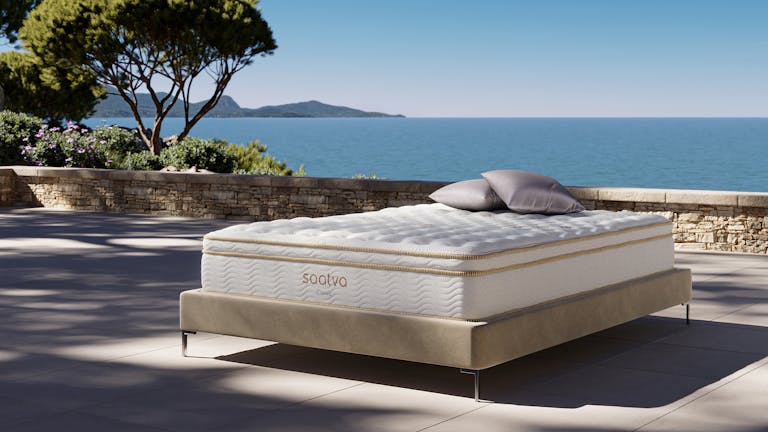
Saatva Classicthe innerspring alternative if you want contouring without a foam feel
- 365-night home trial
- Free white-glove delivery and old-mattress removal
- Lifetime warranty
- Three comfort levels including Plush Soft (3/10) for side sleepers
Who is Tempur-Pedic for?
Tempur-Pedic suits sleepers who want a close-conforming foam feel and are willing to manage heat in exchange. The TEMPUR material responds to the body’s weight, shape and temperature, so it settles around pressure points instead of resisting them, which suits side sleepers, lighter sleepers and anyone who changes position at night and dislikes a firm pushback. It also suits shoppers who value a long ownership horizon: current Tempur-Pedic mattresses carry a 10-year non-prorated warranty for manufacturing defects, and mattresses purchased after March 2014 fall under that coverage.
The brand is less suited to hot sleepers, to people who dislike sinking into a surface, and to anyone who wants a mattress they can flip or rotate on a schedule. Tempur-Pedic states that its mattresses are not designed to be flipped, and the Help Center confirms the brand does not recommend flipping. If you sleep warm, weigh the TEMPUR-Breeze line carefully against a coil-based option, because airflow through coils moves heat away from the body more readily than a solid foam block does.
What does the Tempur-Pedic lineup actually include?
The brand organizes its mattresses into a few clear families. The Tempur-Adapt series is the entry point, the Tempur-PRO series steps up in construction, and the TEMPUR-Breeze collection is built around cooling. The current lineup consists entirely of single-sided mattresses, meaning each model has a specific top and bottom and is engineered for one orientation. Modern models manufactured after 2018 incorporate five distinct support zones with varying Indentation Load Deflection ratings, tuned for different areas of the body.
| Model family | Position in the lineup | Feel | Best suited to |
|---|---|---|---|
| Tempur-Adapt | Entry level | Close-conforming memory foam | Shoppers buying their first Tempur-Pedic |
| Tempur-PRO series | Mid to upper | Conforming with firmer support zones | Back sleepers wanting zoned support |
| TEMPUR-Breeze | Cooling tier | Conforming with cooling materials | Hot sleepers who still want foam |
| Tempur hybrid collection | Hybrid | Foam comfort over coil support | Shoppers wanting airflow under the foam |
Each model in the current lineup, including TEMPUR-Breeze, TEMPUR-Adapt, Tempur-PRO and the hybrid collection, is engineered as a single-sided mattress. Mattress thickness across the brand ranges from 8 inches to 13 inches, which matters when you are matching a mattress to an adjustable base or a frame with limited clearance.
Which Tempur-Pedic model should you buy?
Pick the Tempur-Adapt if you are buying your first Tempur-Pedic and want the brand’s conforming feel at the lowest entry point. Choose a Tempur-PRO model if you want the five-zone support layout to keep your spine aligned while the surface still cradles your shoulders and hips. Choose TEMPUR-Breeze if sleeping warm is your main complaint and you accept that cooling materials cost more than the standard foam build. Choose the hybrid collection if you want the TEMPUR material on top with coils underneath for airflow and a more responsive base.
For a closer look at the upper tier, read our Tempur-Pedic ProAdapt review, which covers that model on its own terms.
How does the TEMPUR material feel in practice?
The TEMPUR material responds to weight, shape and temperature, so the surface warms slightly where your body contacts it and softens to take your shape. The result is a cradling feel rather than a floating one: you settle in, pressure points at the shoulders and hips ease, and the material pushes back only where the support zones are tuned to do so. Sleepers coming from an innerspring mattress usually notice the difference most at the edges of the body, where foam wraps around rather than letting you hang off.
Because the material is viscoelastic, it recovers slowly when you move. That slow recovery is what gives memory foam its reputation for isolating motion, and it is also why the mattress feels different the first week than it does after the surface has settled. Tempur-Pedic publishes a break-in process for new owners, and following it helps the material reach its intended feel.
For care details specific to this brand, see our guides on breaking in a Tempur-Pedic mattress and cleaning a Tempur-Pedic mattress.
Does Tempur-Pedic make a cooling mattress?
Yes, the TEMPUR-Breeze collection is the brand’s cooling line, built for sleepers who want the conforming foam feel without the heat buildup that dense memory foam can cause. The search term “tempur pedic cooling mattress” points directly at this tier, and it is the family to shop if you wake up warm. Beyond the Breeze models, the hybrid collection adds coil airflow beneath the TEMPUR material, which also moves heat away from the sleeping surface more effectively than a solid foam build.
Cooling is a materials question, not a firmness question. A firm Tempur-Pedic will still hold warmth against the body if the comfort layer is dense foam, so choose on cooling construction first and firmness second. If heat is your primary complaint and you are not attached to memory foam, a coil-based mattress is the simpler answer.
See the Saatva Classic price in your size →
What are the trial, warranty and shipping terms?
Tempur-Pedic mattresses purchased after March 2014 carry a 10-year non-prorated warranty covering manufacturing defects, not normal wear. Warranty claims on current mattresses are processed in roughly 2 to 4 weeks, and approved claims receive a replacement mattress rather than a repair. Mattresses bought before 2014 may still fall under extended prorated coverage, which requires individual verification against the original purchase.
On support, platform beds and solid foundations are the recommended base for Tempur-Pedic mattresses, and foundation choice affects how the foam performs over time. The brand’s mattresses work with most adjustable bases provided the base has adequate weight capacity, a frame design without center-bar interference, and a motor rated for memory foam density. For the full compatibility picture, read our adjustable base compatibility guide.
How long does a Tempur-Pedic mattress last?
Longevity depends on the support you give it and on how the foam is cared for, and Tempur-Pedic does not require rotation: the brand states its mattresses are not designed to be flipped, and the directional support zones are engineered for one orientation. What you can control is the base. Platform beds and solid foundations keep the surface flat, while a sagging or slatted base accelerates compression in the foam.
The 10-year non-prorated warranty covers manufacturing defects for mattresses purchased after March 2014, which gives a clear floor for the ownership window. Beyond that, foam condition is judged by how it recovers: healthy foam compresses minimally and returns to shape quickly, while worn foam shows deep compression and slow recovery. Our lifespan guide walks through the signs to watch, and our rotation guide explains why the usual rotation advice does not apply here.
Who should NOT buy a Tempur-Pedic?
Skip the brand if you sleep hot and do not want to pay for the Breeze tier, because standard dense foam holds warmth against the body. Skip it if you dislike a cradling, sinking feel, since the TEMPUR material is designed to take your shape rather than hold you on top. Skip it if you want a mattress you can flip or rotate on a maintenance schedule, because these are single-sided mattresses engineered for one orientation. Skip it if you need a very firm, floating-on-top surface, since the brand’s identity is contouring pressure relief.
Also skip it if you are shopping on a tight budget and want the shortest path to a decent night’s sleep. Tempur-Pedic sits in the premium tier, and the cooling and zoned-support features push the price higher again. If you want a firm, hotel-style feel with a coil support core instead, the Saatva Classic is the alternative worth pricing out.
How does Saatva compare as an alternative?
The Saatva Classic is an innerspring mattress with a 3-inch Euro pillow top, a dual-coil design using triple-tempered recycled carbon steel coils, and patented Lumbar Zone Technology for spinal alignment. It comes in three comfort levels: Plush Soft at 3/10 for side and lighter sleepers, Luxury Firm at 5-7/10 as the most popular option for all positions, and Firm at 8/10 for stomach and back sleepers. The cover is a breathable organic cotton blend treated with Guardin botanical antimicrobial treatment, and the dual-coil design allows airflow through the mattress to help disperse body heat.
The ownership terms differ in ways that matter. Saatva includes a 365-night home trial and free white-glove delivery with in-room setup and old-mattress removal at no additional cost, backed by a lifetime warranty for the original purchaser. For a direct brand-versus-brand read, see our Saatva vs Tempur-Pedic comparison.
World Sleep Almanac score: 8.1/10 for Tempur-Pedic as a brand. The score is editorial and built from five criteria: materials and construction (the TEMPUR material and five-zone support layout), warranty (10-year non-prorated on post-2014 purchases), lineup breadth (Adapt, PRO, Breeze and hybrid families), cooling options (a dedicated Breeze tier plus hybrid airflow), and buyer guidance (clear single-sided design and published care process). The brand loses points on the standard foam’s heat retention and on the premium pricing that puts the cooling tier out of reach for budget shoppers.
Frequently asked questions
Tempur pedic cooling mattress: which model should I choose?
The TEMPUR-Breeze collection is the brand’s dedicated cooling line, built for sleepers who want the conforming TEMPUR material without the heat buildup of standard dense foam. The hybrid collection is the other route, since coils under the comfort layer add airflow that a solid foam build does not have. Choose Breeze if you want to stay with all-foam, choose the hybrid if you want airflow and a more responsive support core.
Does Tempur-Pedic require rotating the mattress?
No. Tempur-Pedic states its mattresses are not designed to be flipped, and the Help Center confirms the brand does not recommend flipping. The current lineup is entirely single-sided, with directional support zones engineered for one orientation, so the usual rotation schedule does not apply.
Can I use any adjustable base with a Tempur-Pedic mattress?
Most Tempur-Pedic mattresses work with universal adjustable bases, provided the base meets three requirements: weight capacity matched to the mattress model, a frame design without center-bar interference, and a motor system rated for memory foam density. Mattress thickness across the brand ranges from 8 to 13 inches, which affects how the mattress interfaces with base retention systems.
What does the Tempur-Pedic warranty cover?
Current mattresses purchased after March 2014 carry a 10-year non-prorated warranty for manufacturing defects, not normal wear. Claims are processed in roughly 2 to 4 weeks, and approved claims receive a replacement mattress rather than a repair.
Is Tempur-Pedic good for side sleepers?
The TEMPUR material responds to weight, shape and temperature, so it cradles the shoulders and hips rather than pushing back, which is what side sleepers generally want from a pressure-relief surface. The five support zones in models manufactured after 2018 are tuned to different body areas, which helps keep the spine aligned while the surface conforms.
Verdict: Tempur-Pedic is the right brand if you want close-conforming pressure relief and will pay for the Breeze tier to manage heat. Look elsewhere if you sleep hot on a budget, prefer a firm floating feel, or want a mattress you can flip and rotate.
Reviewed by the World Sleep Almanac editorial team. Updated 2026.