
You can build a playroom kids obsess over with hidden storage, soft layers, and a weekend budget between $150 and $600 if you keep the millwork you already have. IKEA KALLAX covers more ground than custom millwork at half the price.
- ✓ Start behind a skirted storage ottoman
- ✓ Anchor the hideout with a paneled play wall
- ✓ Layer floor cushions inside a curtain corner
I learned this after trying to cram toys into our living room in plain sight. It never looked calm for more than ten minutes.
Once the play zone had a hidden entry, the room started working for adults too. That is the whole win.
- Start behind a skirted storage ottoman
- Anchor the hideout with a paneled play wall
- Layer floor cushions inside a curtain corner
- Hang a canopy under the stair landing (does it actually work?)
- Build a crawl-through arch beside the sofa
- Hide toy bins inside window-seat drawers
- What if you want the play door to read as art first?
- Farrow & Ball Stiffkey Blue inside the nook
- Install touch-latch cabinets for the supply wall
- Why a tiny desk behind bookcase doors beats a homework nook
- Frame the entrance with scalloped trim
- Add battery sconces inside the hidden corner
- Should you actually slide a barn door across the play zone?
- Finish with labeled baskets behind the panels
1Start behind a skirted storage ottoman
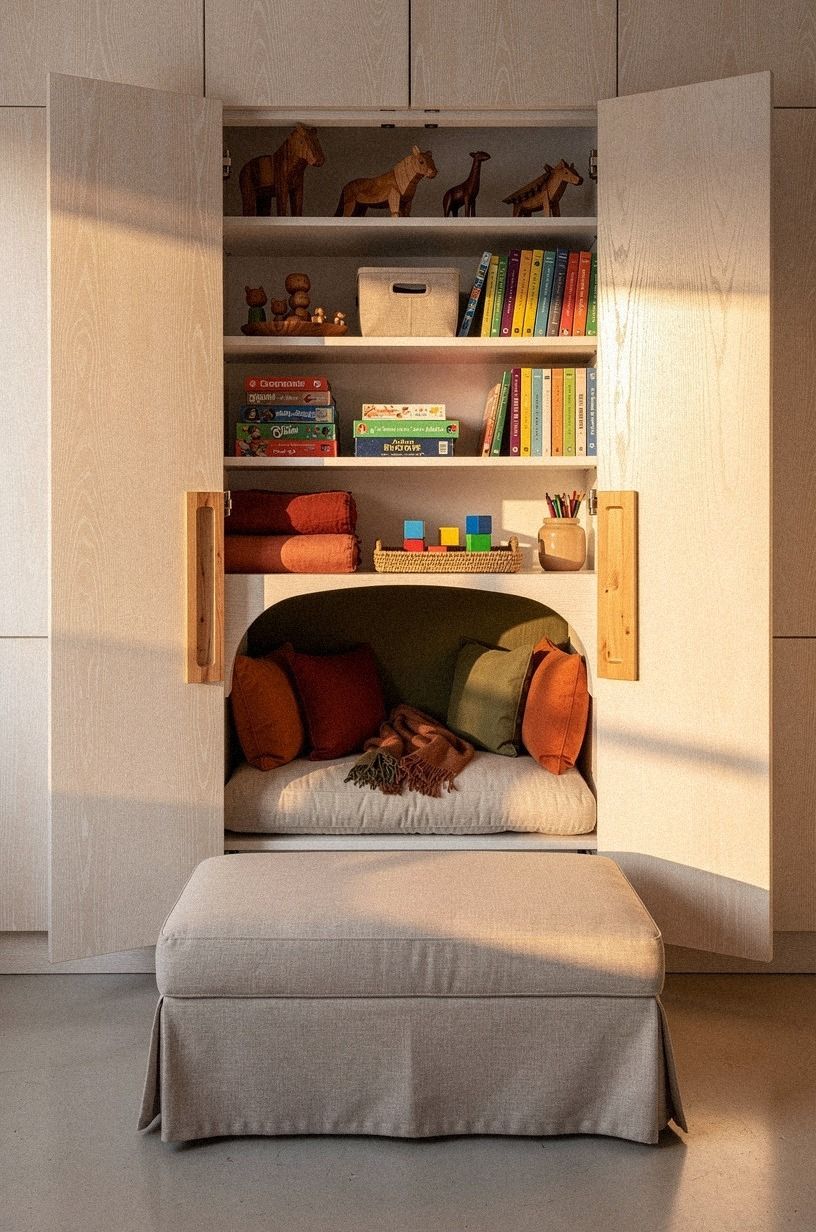
Begin with the piece that buys you cover fast: a skirted ottoman parked where a child would naturally drift, not shoved awkwardly against a wall. In the photo, the ottoman sits centered in front of symmetrical cerused white oak panels, and that placement matters because you want the entry to read as furniture first, play zone second.
If your opening is wider than about 30 inches, a 36 to 42 inch ottoman gives you enough visual weight without making the passage feel blocked.
I like a skirt more than exposed legs because the fabric softens the reveal and hides toy scuffs. A washable Belgian flax linen slip in oatmeal works harder than velvet in a family room, and it doesn’t start looking precious after one snack spill.
You can use a hinged storage ottoman from Target Threshold or Wayfair and stash the highest-rotation toys inside, so the hiding spot earns its keep before the panel even opens.
But don’t push the ottoman flush to the panels. Leave a hand’s width behind it. Kids need room to slip past, and you need room for the skirt to hang straight instead of bunching.
That tiny gap is what keeps the setup from looking fake. Rubber furniture pads on the floor keep the ottoman from drifting.
For six more clever storage ottoman setups, see our bedroom storage ideas roundup.
2Anchor the hideout with a paneled play wall
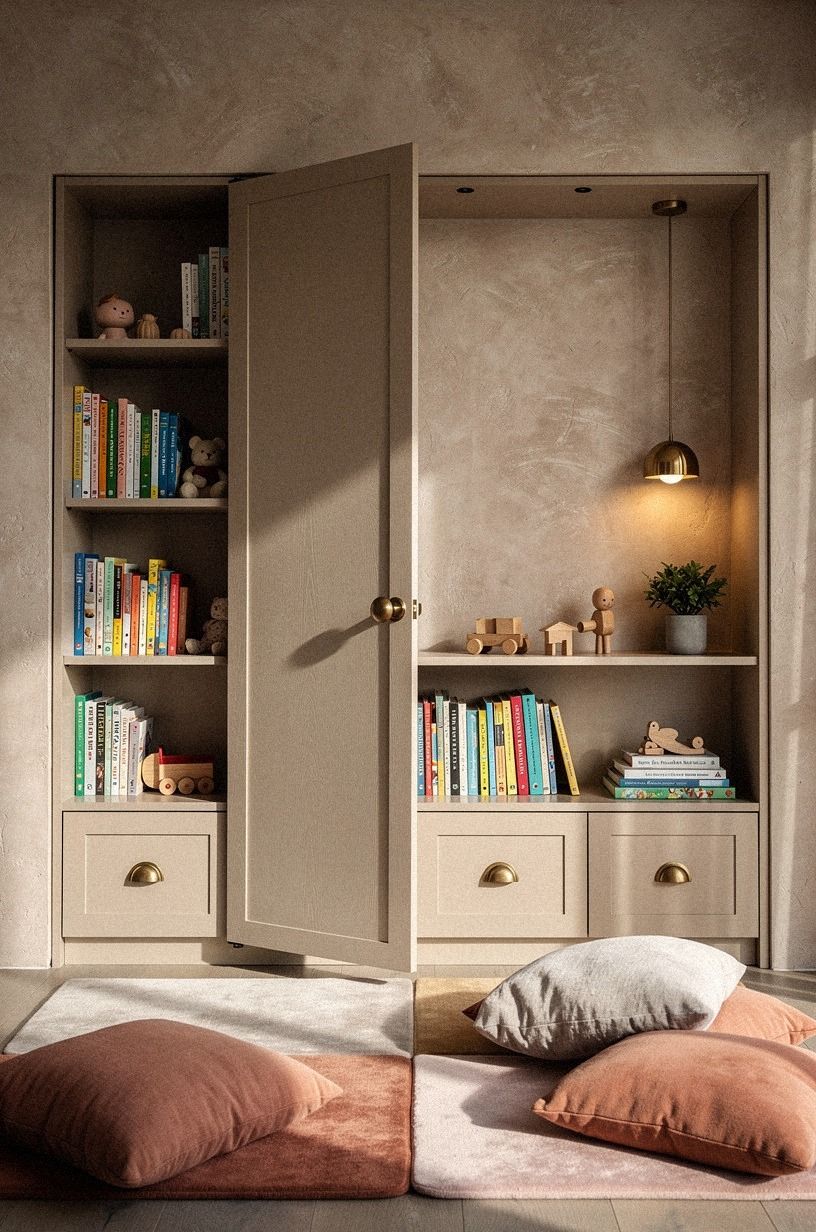
Once the entry works, give your hideout a back wall that feels intentional rather than improvised. A paneled play wall is what makes the nook read like a tiny built-in, and built-ins are what get kids to treat a corner as their room and not just a pile of cushions.
Start by choosing a panel pattern that matches the rest of your millwork so the whole wall doesn’t scream “kids zone” when it’s shut. A simple shaker style with a 2.5 inch rail and a flat recessed panel is the move that disappears best.
The mistake I see constantly is buying beadboard panels in cute shapes. They date fast.
Solid panels with crisp shadows look more like a real closet door than a play scene. A flat recessed panel with a 2.5 inch rail gives the right scale for the disguise.
You want guests to glance at the wall and assume it’s a closet until a small human swings it open.
Frame the wall with primed MDF or poplar and paint it the same trim color as your room. For the trim coat, Benjamin Moore White Dove OC-17 in a satin finish wipes fingerprints off without dulling the surface.
Add two soft-touch push latches at the bottom so even a 4 year old can open it. The 3-Minute Wall Test: if you can swing the panel and reach inside in under three seconds, you’ve built the right thing.
3Layer floor cushions inside a curtain corner
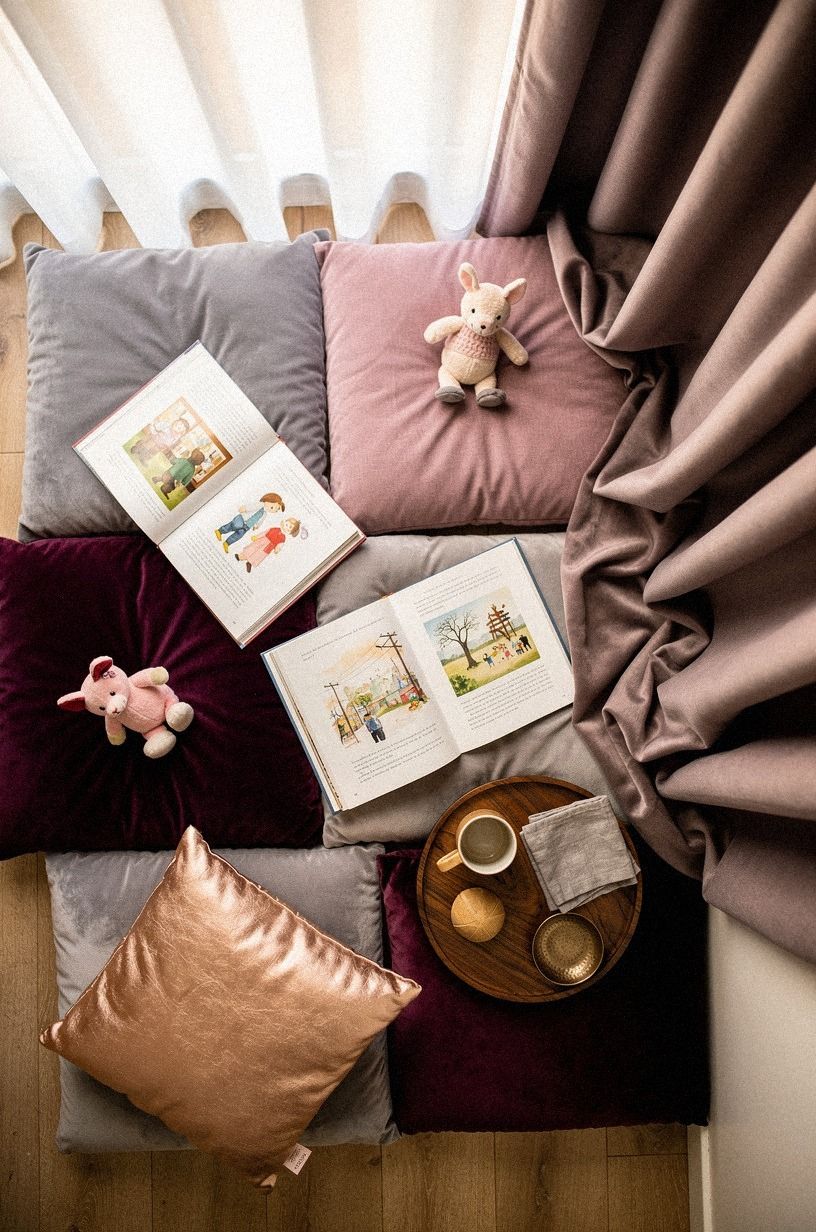
If you need the softest version of this idea, steal a corner and close it with curtains. The overhead shot in the photo is full of layered cushions, open books, soft toys, and a walnut tray, which tells you the nook has to feel low, tactile, and easy to reset. Start with a 5×7 ft rug, then stack two or three oversized floor pillows so kids can read, flop, and pile blankets without the whole corner collapsing.
The best mix is one large base cushion in Turkish cotton, one firmer square in canvas, and one smaller lumbar shape for back support. You don’t need a matching set. Mixed textures make the corner feel collected, while matching foam pads can tip into daycare territory fast.
If you’re torn between firm and squishy, our best pillow for reading in bed guide covers the layering logic that works on the floor too.
Hang the curtains from a ceiling track or a tension wire if you’re renting. A soft blue stripe or a muted clay check looks better here than cartoon print fabric because you want the play room to blend into the grown-up room when the curtains stay open. And keep a little walnut tray inside for crayons and library books.
It gives the mess one place to land, and the morning reset drops from 15 minutes to about 4. Works every time!
4Hang a canopy under the stair landing (does it actually work?)
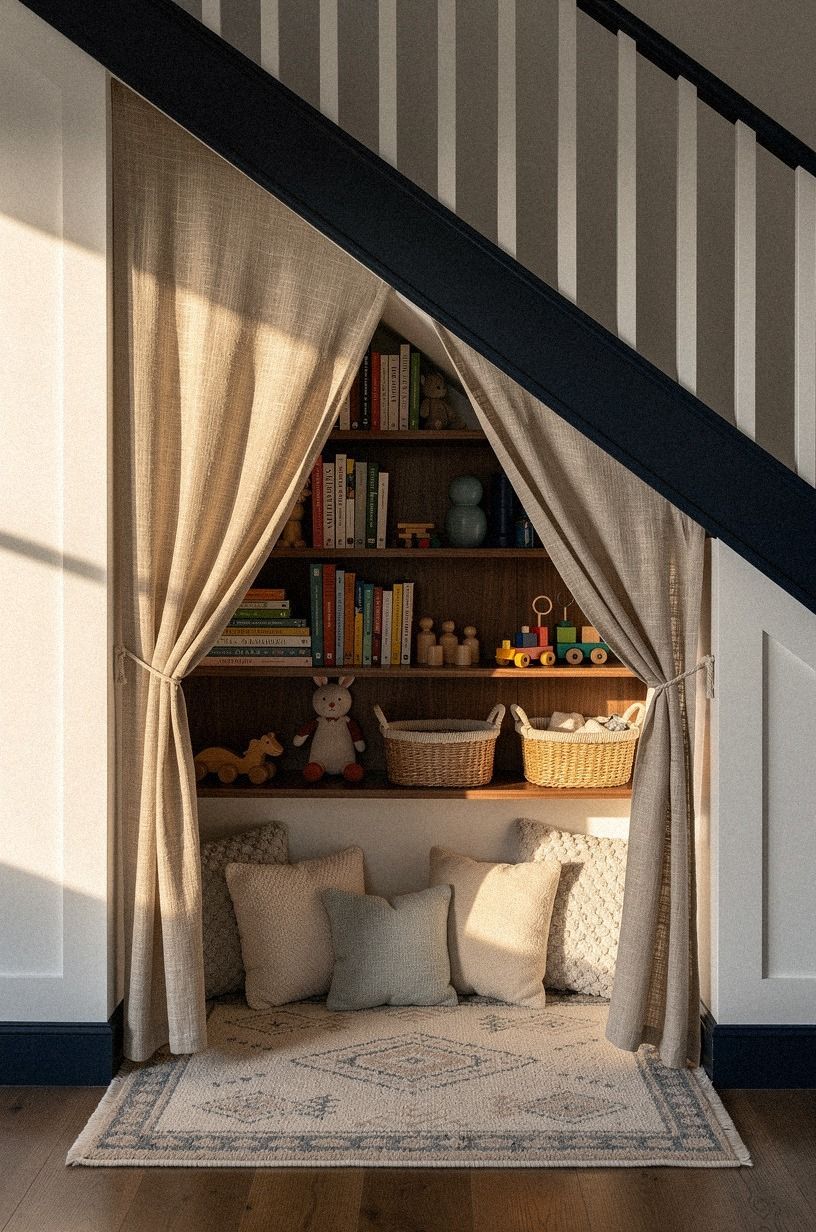
Under-stair space begs for a hideout, but only if you treat it like a room and not a leftover triangle. You need at least 5 feet of headroom at the entry and a clean stretch of about 5 by 7 feet inside, otherwise you’re cramming a kid into a crawlspace nobody wants.
A double curtain rod setup or a single pivot panel both work; I’ll lean you toward curtains because they’re reversible and cheaper. If your stair underside hits those minimums, a canopy turns the dead space into a clubhouse faster than any add-on playhouse we’ve tried.
The move is layering three things at different heights. A low bouclé floor pad covers the cold subfloor. A short curtain rod mounted into the stair stringers drops a soft cotton canopy without eating headroom.
Then a single warm bulb in a cerused white oak cage pendant at about 6 feet finishes the mood. The whole thing costs less than a bunk mattress and looks ten times more custom.
You can hang the rod with two toggle bolts into the stair stringers, no exposed framing needed. Skip the floor pad if your stair underside sits on a concrete slab. Lay down a cotton dhurrie rug instead so moisture doesn’t get trapped.
You’re adding a real room where there wasn’t one, and you’re not asking your living room to do double duty. For small-footprint layouts, our 10 loft bedroom ideas that make a small space actually feel intentional cover the same squeeze-the-most-out-of-it logic.
5Build a crawl-through arch beside the sofa
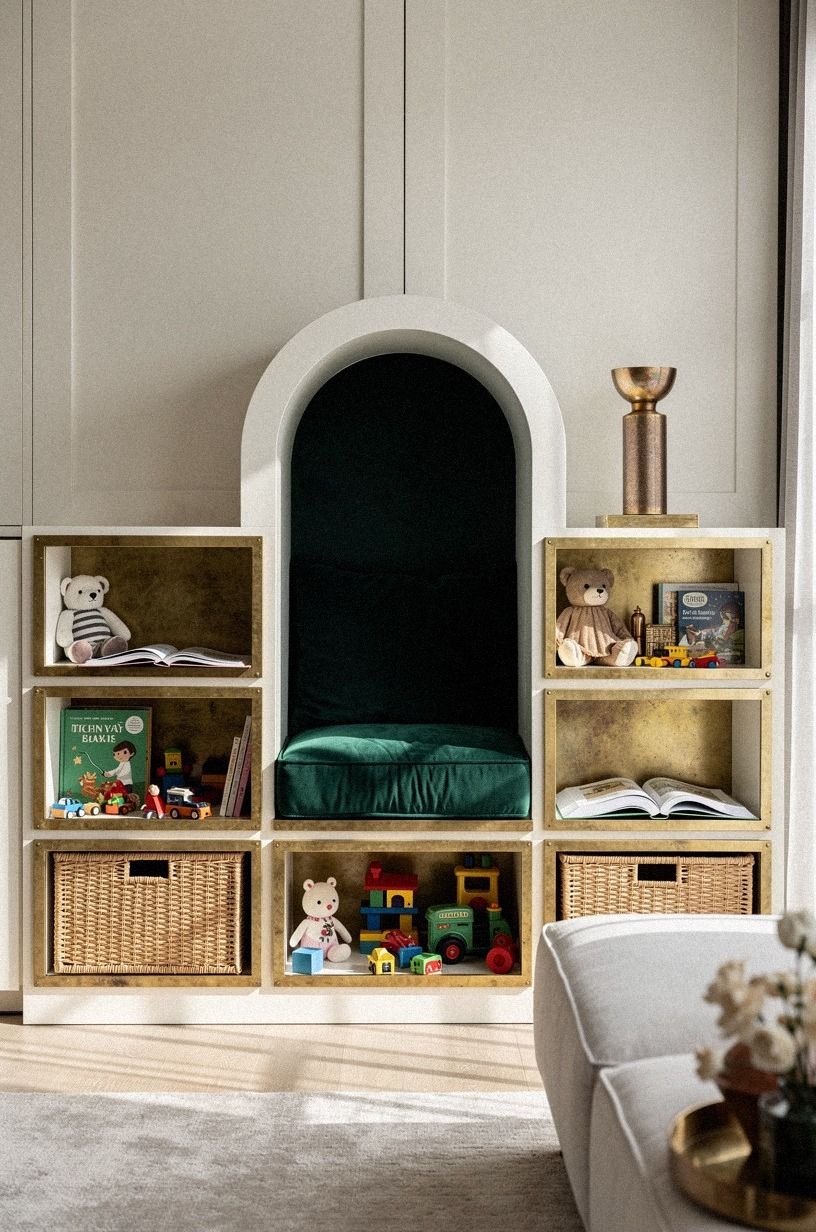
A child-height arch beside your sofa can look oddly elegant if the millwork around it matches the room.
6Hide toy bins inside window-seat drawers
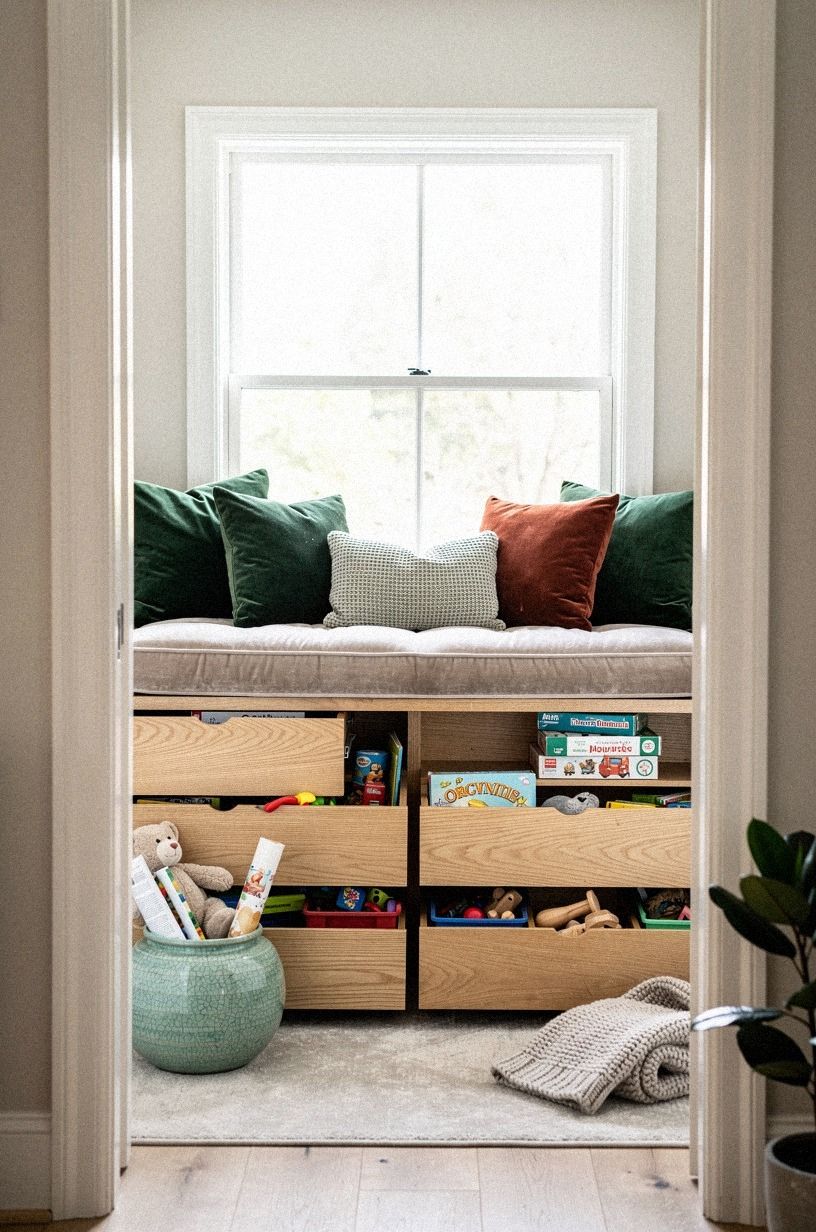
A window seat is the easiest place to hide bulk because the storage already belongs there. In the photo, natural oak drawers slide open just enough to reveal soft bins. That’s exactly the look you want: useful, not shouting.
Deep drawers under a seat can swallow board games, train tracks, and backup art paper while the top stays adult enough for a reading pillow or a cup of coffee. A 5 by 7 ft bookcase flipped on its back is the easiest starting frame.
Go for full-extension slides if you can. Cheap hardware is where these projects start feeling frustrating, and you will notice the difference every day. Blum soft-close runners are the sweet spot for price and reliability.
A drawer that stops short means toys pile up in the dark back half where nobody can reach them. Full-extension is the better splurge than a fancier paint color, honestly.
Face the drawers in natural white oak or oak-look veneer so they connect to the rest of the room, and line the inside with labeled canvas bins instead of loose plastic tubs.
If your seat depth is around 18 to 20 inches, you can store a surprising amount without eating into the walking path. That’s the hidden storage logic that keeps a family room sane. For the rug under the seat, our bedroom rug sleep guide breaks down which pile heights survive a kid zone.
7What if you want the play door to read as art first?
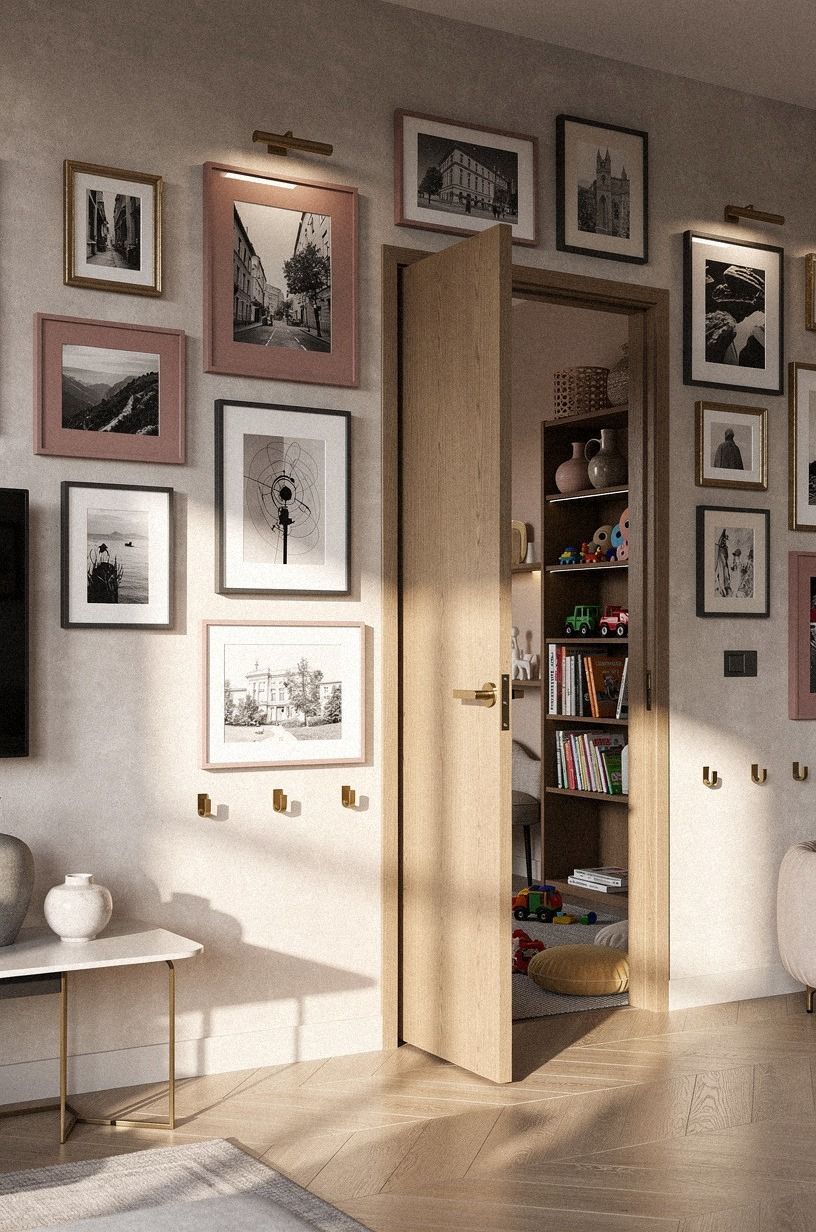
Camouflage works best when you lean into what the wall already looks like. If you’ve got a gallery wall going, make the play door just another frame. CB2 framed prints at 16 by 20 inches fit the panel-and-frame move cleanly.
If you’re working with a blank wall, hang one oversized piece over the panel and let the door vanish behind the canvas. I tried both and the canvas version won every time, because pictures don’t ask the eye to do math the way a row of small frames does.
Go with a 24 by 36 inch framed vintage botanical print or a chunky abstract, then mount the play door flush to the wall with hidden hinges so the door doesn’t tip forward when it’s closed. You’ll want the bottom hinge weighted enough to carry the wood, otherwise the door sags after a few months and the seam shows.
Make sure your door swings away from the entry, not toward it. You’d be surprised how many people forget this part and then have to squeeze past the open door every time a kid crawls in. The whole point of the disguise is that guests don’t see it coming.
Hinges matter more than the frame you pick up. Solid brass concealed hinges rated for the door’s weight hold alignment longer than the cheap spring-loaded ones. If the gallery wall isn’t your thing, our how to decorate bedroom guide has a wall-art section that solves the same “make it look styled first” problem.
8Farrow & Ball Stiffkey Blue inside the nook
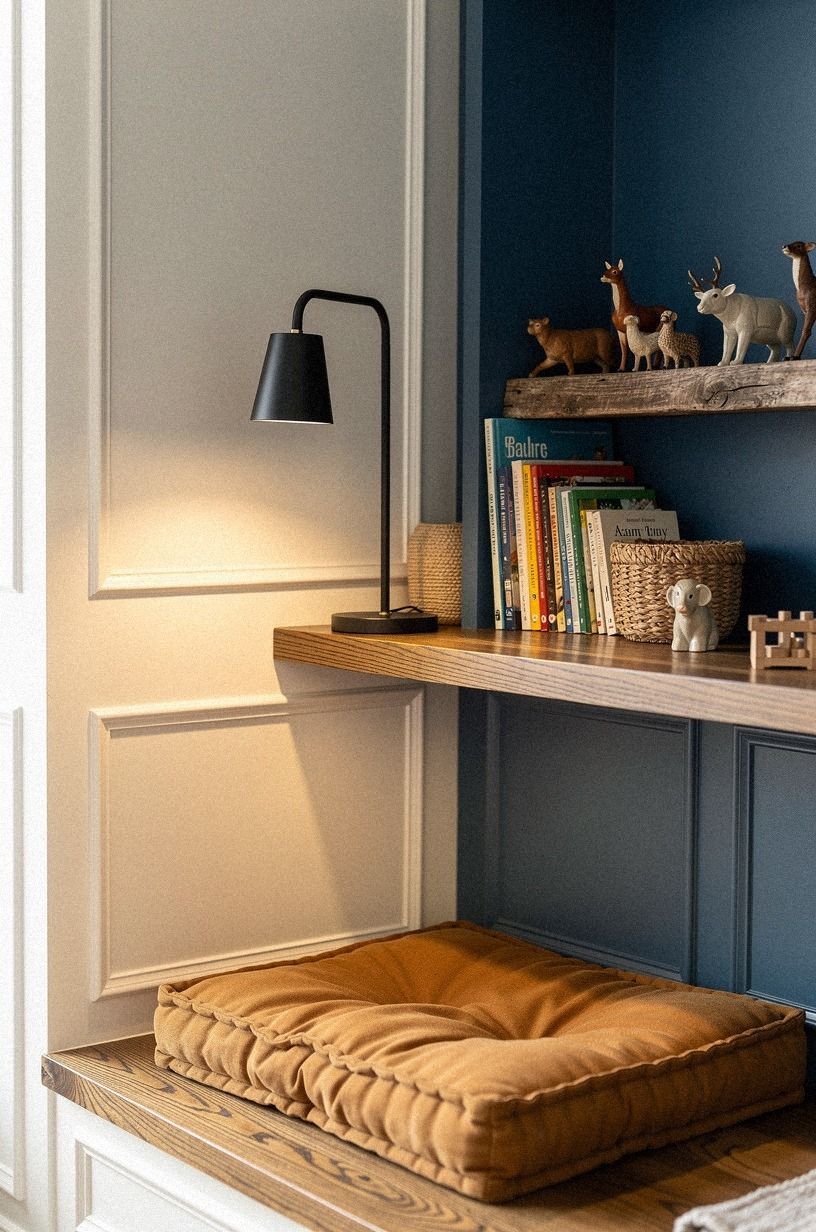
Sometimes the easiest way to make your play corner feel special is to shift the color only inside the nook. In the photo, the interior sits in a rich storybook blue with warm white millwork, a camel cushion, and black reading lights. You step in and it feels like a different chapter.
I’d test Sherwin-Williams Open Air SW 6491 if you want the airy version, or push deeper with Farrow & Ball Stiffkey Blue No.281 if your nook gets solid daylight.
Pair it with camel cotton canvas on the floor so the color doesn’t turn chilly. Blue plus tan is steady. Blue plus gray can go flat by 3 p.m., especially in a north-facing room.
And keep the outer trim warm white. That’s the part people skip, then wonder why the nook looks pasted on. The contrast is the whole story here.
It works every time!
9Install touch-latch cabinets for the supply wall
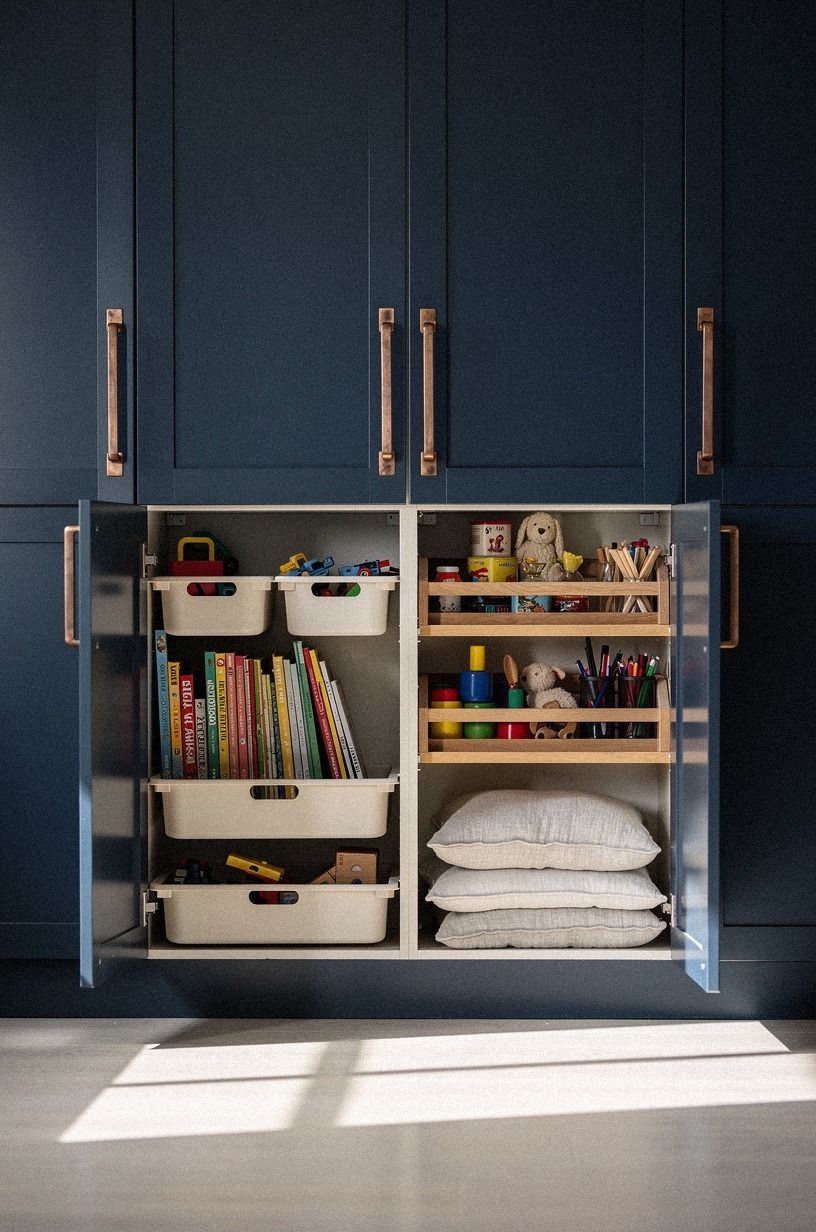
A wall of low cabinets can hold your entire supply problem if the fronts stay clean. The image shows midnight-blue cabinetry with low doors ajar and ivory bins inside.
That’s exactly how hidden storage should work: dramatic when opened, quiet when shut. I use the Three-Minute Reset Rule here.
If you can’t toss crayons, tape, costume bits, and sticker books back in within three minutes, the system is too fussy.
Paint the cabinet face in midnight blue enamel and keep the interiors lighter so you can see what’s inside fast. Touch latches matter because visible hardware breaks the illusion, and they help little hands open doors without tugging.
Just buy decent ones. The bargain packs fail first, and nothing kills the charm like a door that pops open on its own.
Use ivory or sand fabric bins instead of rainbow plastic, and divide supplies by activity, not by toy type. One bin for coloring, one for building, one for dress-up extras.
You’ll reset faster, and your hidden play room won’t turn into a junk drawer with better paint. The Container Store Drop-Front bins in kraft at 12 by 15 inches are the right size for crayons and tape.
If you want a full breakdown of bin sizing by activity, our pillow storage ideas piece covers the same labeling logic that’s kept my own bins sorted for two years.
10Why a tiny desk behind bookcase doors beats a homework nook
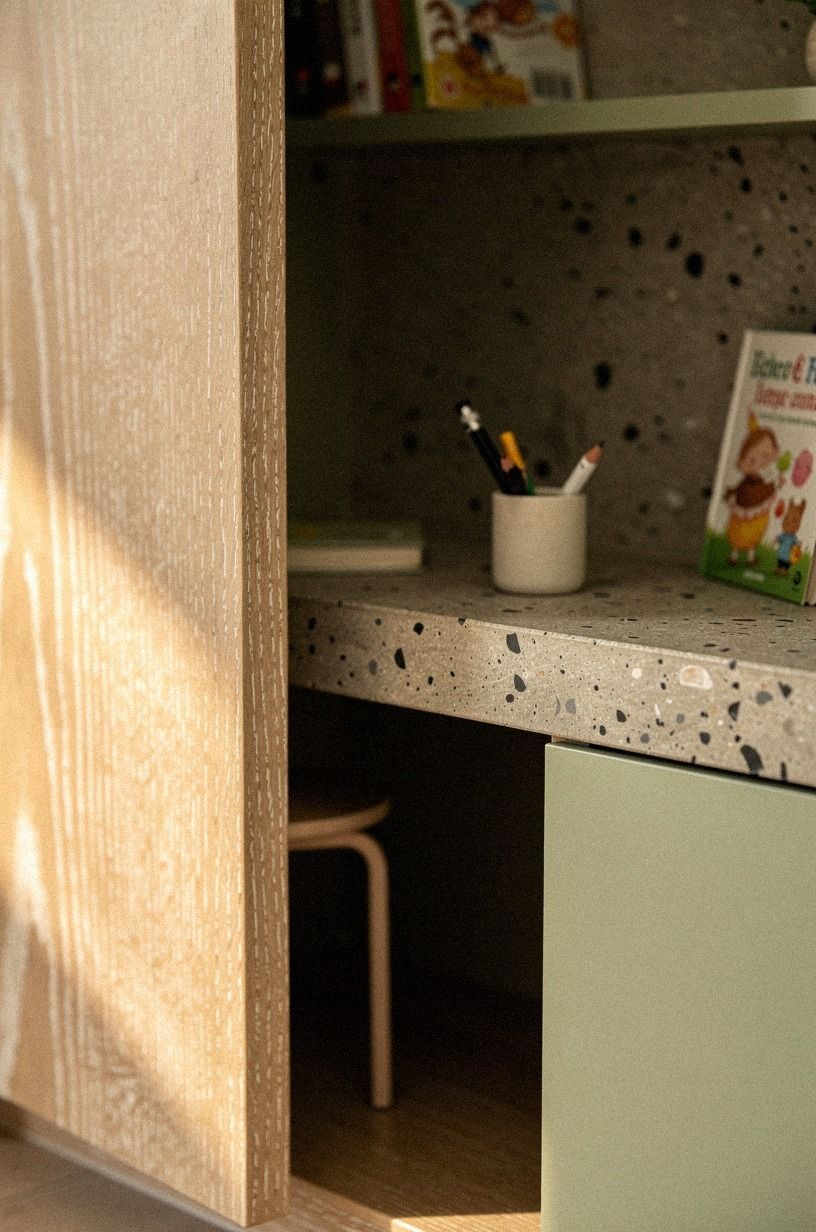
A tiny desk inside bookcase doors is such a good use of awkward depth because it creates a quiet task zone without claiming a full office footprint.
11Frame the entrance with scalloped trim
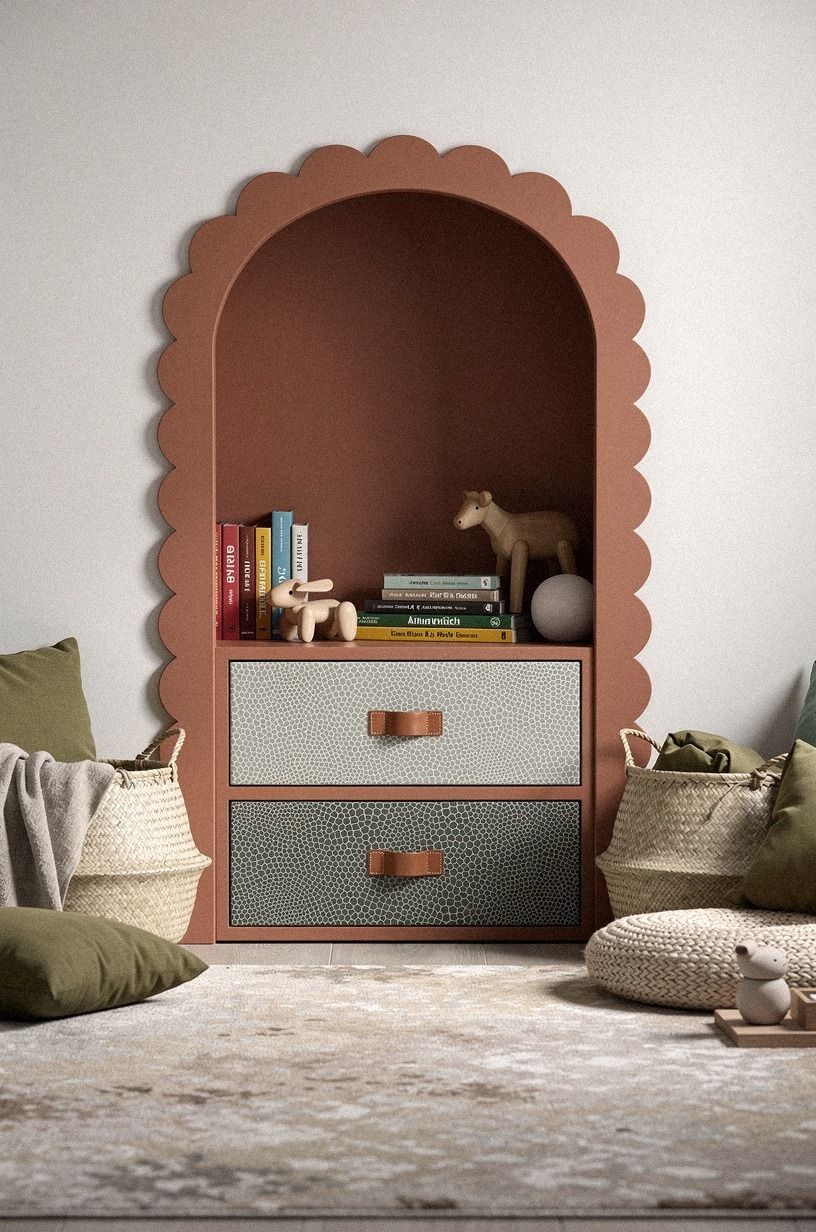
Scalloped trim can go sweet fast, so the goal is to keep the shape playful and the palette grounded. In the photo, terracotta scallops frame a child-height opening over a stone-toned rug, and that combination works because the trim reads architectural, not sugary.
I call this the Soft-Edge Rule: when the shape gets whimsical, the color has to get earthier. Large-scale scallops at 4 to 6 inches across read as architecture, not craft fair.
Use a muted clay like Farrow & Ball Pink Ground No.202 cut with white, or a true terracotta if the rest of your room is quiet. Let the rug stay stony and plain. Pattern on both surfaces starts feeling busy, and kids already bring enough visual chaos.
The bigger curve is more charming too!
The trim itself can be MDF if you’re painting, which keeps the cost down, but cut the scallops wide enough to look deliberate from across the room. Tiny scallops feel crafty. Bigger ones feel custom, and that difference shows up immediately.
12Add battery sconces inside the hidden corner
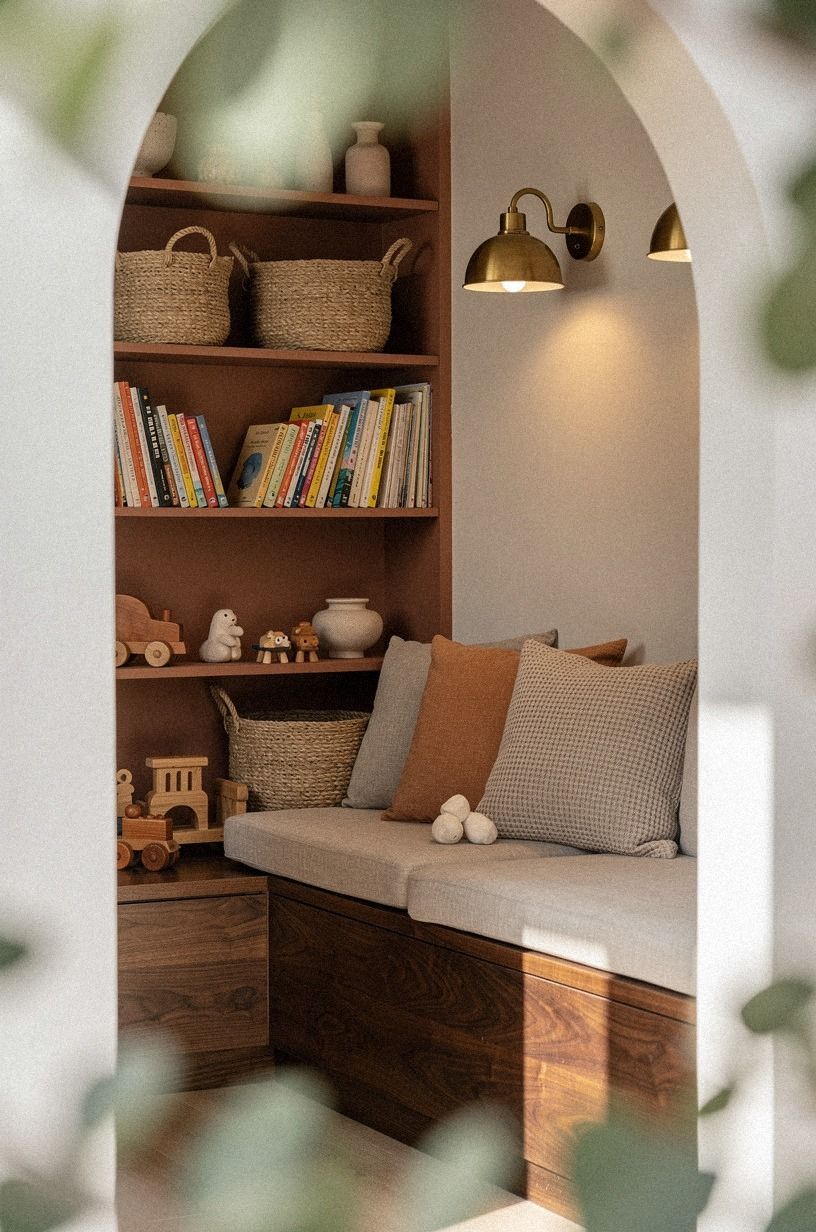
Lighting changes whether a nook feels like storage or a place you want to stay.
13Should you actually slide a barn door across the play zone?
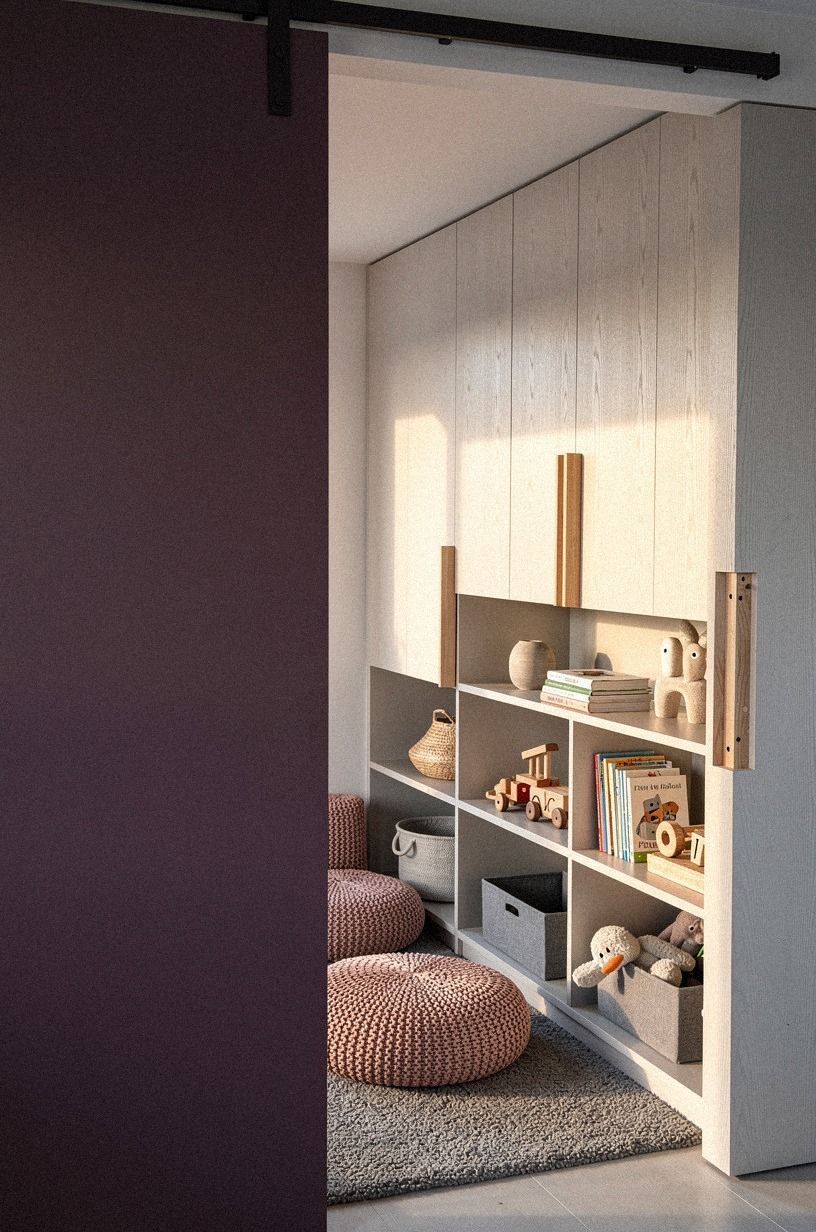
A sliding door works when you need full closure without a swing arc, but color and scale matter a lot. The standard “barn door” you see on Pinterest is 36 by 84 inches with matte black hardware, and that scale works for a closet. A kidscale barn door at 28 by 60 inches feels right.
For a kid play zone, knock the door down to about 28 by 60 inches so a child can push it themselves without shoulder-checking it. The adults-using-it factor is real, but the kid-using-it factor is the one you’ll live with every day.
The hardware should be quiet. Soft-close rollers are not optional.
Loud barn doors wake up napping toddlers and make the room feel cheap. Spend the extra twenty bucks on soft-close, you’ll thank me. Kroger hardware barn-door kits at $89 ship with soft-close and black flat track in one box.
Paint the door in the same family as the wall it’s mounted on. If the wall is white, go Benjamin Moore White Dove OC-17 on the door and stop trying to make it a feature.
The point of a sliding door is to disappear into the room when it’s open and seal the chaos when it’s closed. If you want the door to feel like a real design move, mount it on aged brass flat-track hardware instead of matte black. Brass ages into something warmer and matches the rest of your millwork.
14Finish with labeled baskets behind the panels
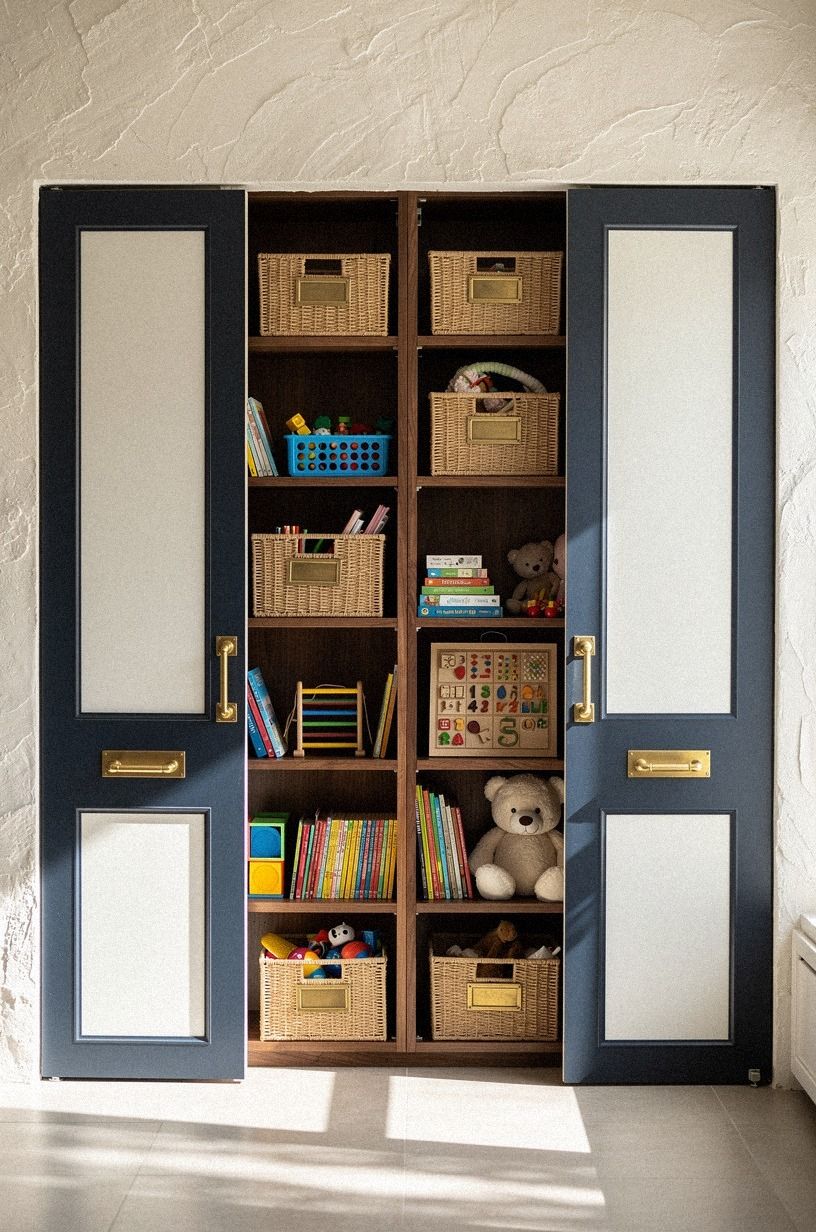
The final step decides whether the play room stays lovable on a Tuesday. In the image, navy-and-white walnut panels open to woven baskets with blank labels, and that’s the right ending because it turns cleanup into muscle memory. I use the One-Glance Rule here: if you can identify where blocks, dress-up, and drawing stuff go in one glance, kids can too.
Pick matching baskets with enough structure to stand upright even when half-empty. Woven seagrass or paper rope in a natural tone works well against navy lacquer or walnut interiors because the contrast stays calm.
Loose floppy bins look harmless, then they slump, tip, and make every shelf feel messy. For the under-bench basket sizing, our under bed storage ideas guide covers the same “buy one size up and let it breathe” rule.
Keep labels simple. Blocks.
Costumes. Books. Art.
That’s it. Full sentences on labels are for adults, and adults aren’t the ones you need to convince at cleanup time.
When the system is this clear, the room closes up fast and your living room comes back. If you’re stretched on space, our 19 genius hidden storage ideas cover the dead-space moves we lean on for tight floor plans.
Before You Pull the First Panel
If I sound picky about these choices, it’s because I am. Hidden play spaces go wrong in two predictable ways: people either make them so decorative that kids can’t really use them, or so toy-forward that the grown-up room never recovers. The best version sits right in the middle.
You want your nook to feel irresistible to a child and almost ordinary to everyone else. That’s harder than buying bins. It’s a sequencing problem, not a furniture problem.
Start with the architecture, then the softness, then the storage, then the glow. In that order.
I wouldn’t start with paint or scallops, because cosmetic details can’t rescue a clumsy layout. A good opening, a believable disguise, and reachable storage do more than any trendy finish.
If your child sleeps in that corner on weekends, our kids sleep schedule guide helps you keep bedtime steady even when the room itself is unusual.
Here’s the budget reality most people need before they start buying baskets and trim:
What would I spend on first? Storage hardware, a good rug, and lighting. Not the novelty door.
Not the extra trim.
I learned that after doing a cute version first and then rebuilding it because the drawers stuck and the corner felt gloomy by late afternoon. Kids don’t care whether your latch came from a premium brand. They care whether the room opens easily, feels soft under them, and looks like it’s theirs the second they crawl in.
The Questions Worth Answering First
What is the best playroom setup for a small living room?
A curtain corner or window-seat drawer setup is the best place to start because it keeps the footprint light and the cleanup fast. The small-space win is that both ideas borrow room you already have instead of demanding a new wall.
A slim IKEA KALLAX birch-effect stack on its side gives you about 12 square feet of storage in a footprint that looks like a low bench. For tighter floor plans, our small bedroom ideas guide covers the same “borrow, don’t build” approach.
Where can I buy hidden playroom pieces on a budget?
Start with IKEA and Target Threshold for bins, floor cushions, and kid-scale seating. Then check Facebook Marketplace for bookcases and storage ottomans.
The money saver is mixing one new anchor piece with secondhand basics. Painted wood always blends better than you’d think. A solid IKEA BILLY bookcase repainted in your trim color looks just like a custom built-in when the doors are closed.
How much does a hidden playroom makeover cost?
Most budget-friendly versions cost about $150 to $600, while a more built-in look usually lands between $1,000 and $3,500. The cheapest upgrades are paint, bins, curtain tracks, and labels. Full custom millwork is where the number climbs fast.
For tighter budgets, our budget mattress guide and storage rundowns both speak to the same anchor-piece-plus-secondhand-basics math.
Can I create a hidden playroom on a budget?
Yes, and you don’t need custom carpentry first. The low-cost path is a tension-rod curtain, a 5×7 rug, stacked cushions, and labeled bins inside furniture you already own.
Paint the inside of the nook only if you want the strongest payoff for modest money. The curtain swap alone is reversible when you move, which matters if you’re renting.
Is a hidden playroom worth it in a small space?
Yes, especially in a small room, because hidden storage pulls double duty and the tiny footprint makes the nook feel more intimate. The payoff is better than in a huge room.
Keep shelves between 36 and 48 inches so kids can reset the space themselves. For more on the sleep side, our small bedroom mattress ideas roundup covers the kid-scale mattress picks that fit tight nooks.
Is a hidden playroom a good idea for a rental?
Yes, if you keep the moves reversible. The renter-friendly version uses peel-and-stick color, tension rods, rechargeable sconces, and freestanding bookcases with doors.
Removable hooks and framed art can camouflage an entry without leaving the landlord a surprise. The whole thing can come out in under an hour when your lease is up.
Where I’d Start First
If I had to pick one step, I’d start with the paneled play wall. A believable wall changes the whole room because every later choice gets to hide inside it.
Build the disguise first. Then the cushions, color, and lighting feel intentional instead of improvised.
You’ll save yourself at least one redo, and you’ll know exactly where the kid zone starts and the living room ends.