
Timeless detail bookshelf door ideas work best when the room already feels believable, layered, and old enough to have a story. I learned that the hard way. My first bookcase door looked like a stunt, not millwork, because I treated the moving shelf like a prop instead of part of the room. Once you match the trim, weight, color, and styling, the whole thing settles down and reads as architecture. And that’s when you get the double take. It’s a quiet, elegant shift, but wow, it lands!
Quick Answer
If you only do four things, do these. The rest is detail.
– Paint the moving shelf the exact trim color. This is the move that buys you the most discretion per dollar spent. – Run one matching crown profile across the whole wall. Carry it from fixed shelves to moving face to baseboard so the seam vanishes. – Style books in uneven stacks, not perfect rows.
Disorder is what hides a hinge gap, and you’ll see guests stop searching for the door. – Light the wall with warm 2700K picture lights. No blue, no overhead, no halos.
Pool the glow so the books read at night.
These four changes get you 80% of the disguise. The other ideas below are how you push the illusion into architecture.
- Camouflage a swinging bookcase inside wall-to-wall shelves
- Build a false library beside the fireplace
- Use touch-latch shelves with no visible handle
- Frame the hidden door with matching crown molding
- Style uneven book stacks to break the seam
- Install a pivot bookcase with brass gallery rails
- Paint the bookcase door the living room trim color
- Hide the latch behind a sculptural bookend
- Why do picture lights make the seam disappear?
- Wrap the opening in arched library millwork
- Anchor the detail door with lower cabinet storage
- Blend hinge gaps behind vertical book rows
- Use glass-front shelves for a cabinet-door disguise
- Panel the back wall in dark library green
- Conceal caster wheels under a plinth base
- Repeat living room sconces across the bookshelf wall
- Stage a reading chair beside the disguised opening
1Camouflage a swinging bookcase inside wall-to-wall shelves
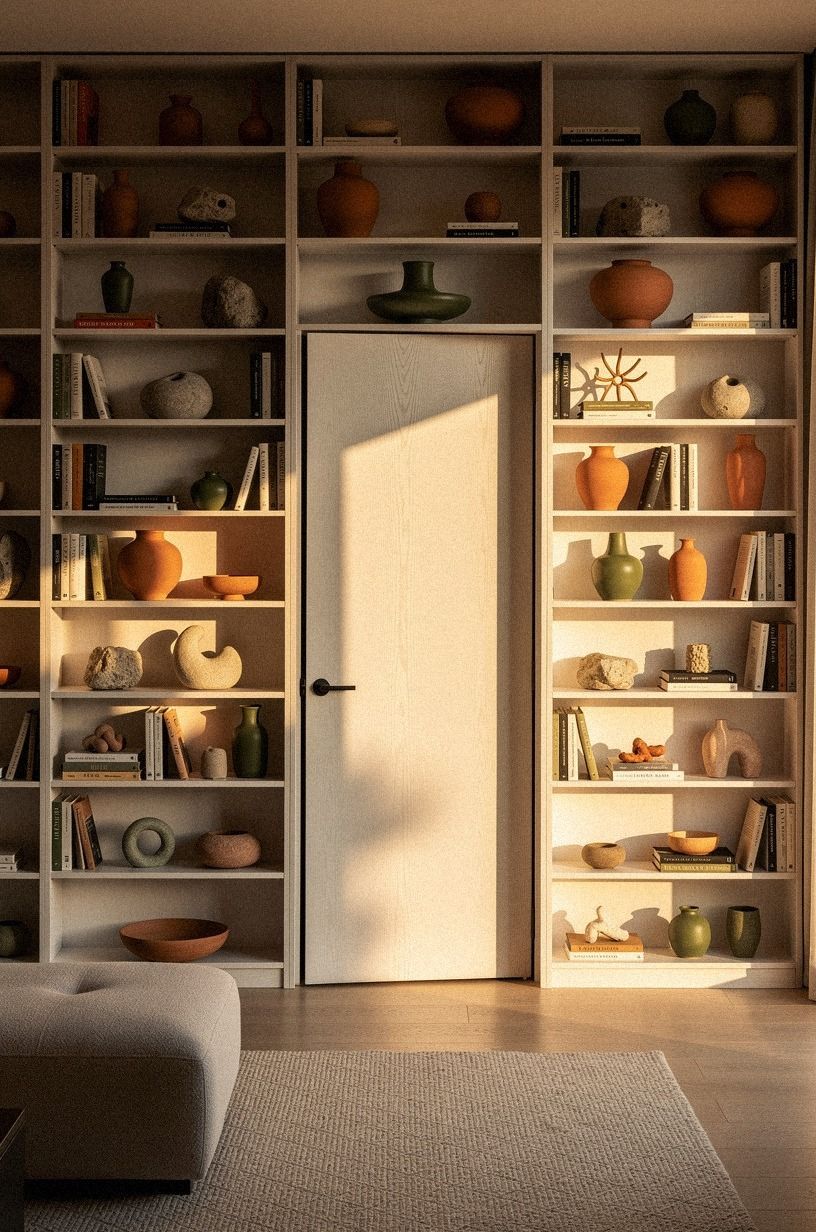
Build the moving case as one bay inside a full wall of shelving, then let the surrounding units do the quiet work for you. You want the eye to register one long library wall, not one special panel. In a living room with terracotta pottery, stone accents, and olive notes, a cerused white oak finish keeps the grain visible without turning yellow and gives the wall a warm read.
Give yourself enough breathing room on both sides so the swing clearance feels intentional, not pinched. I like deeper fixed shelves nearby and a slightly shallower moving case because your eye reads the whole composition first. Stack pottery low, books mid-height, and softer objects up top.
If you’re planning a broader concealed-entry wall, our hidden bar behind a bookcase reveal walks through scale and rhythm.
2Build a false library beside the fireplace
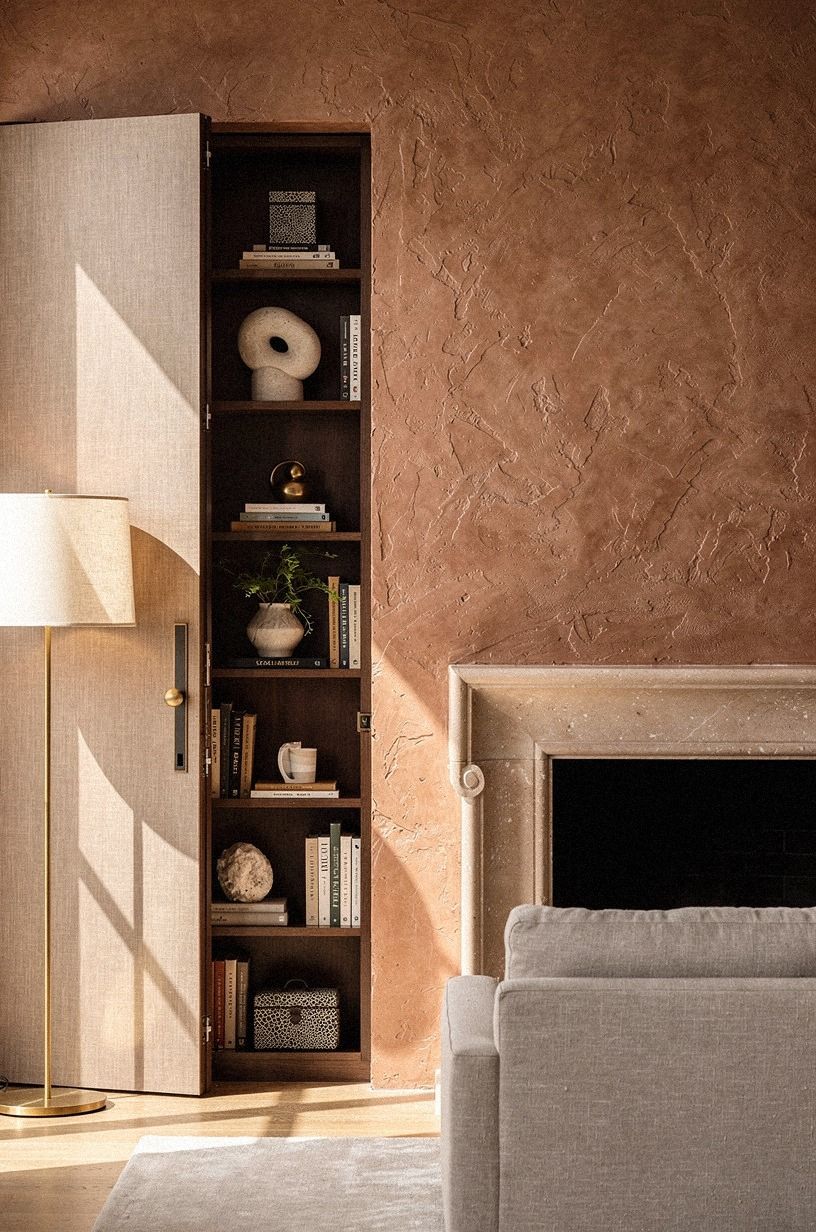
Treat the fireplace wall as the anchor and the bookcase door as the supporting actor. If your hearth is already dressed in clay, linen, and brass, build a narrow false library beside it so the opening feels like an extension of the surround. The warm glow from aged brass picture lights helps the shelf face feel established and elegant, which matters more than fancy joinery.
But keep the shelf styling a little quieter here. Too many bright jackets will pull the eye right to the seam.
I’d also skip a high-contrast mantel color in this setup because you want the fireplace and library to read as one old-house gesture. For more lounge-style millwork, our speakeasy seating and furniture ideas shows how velvet, leather, and brass can carry a side wall.
3Use touch-latch shelves with no visible handle
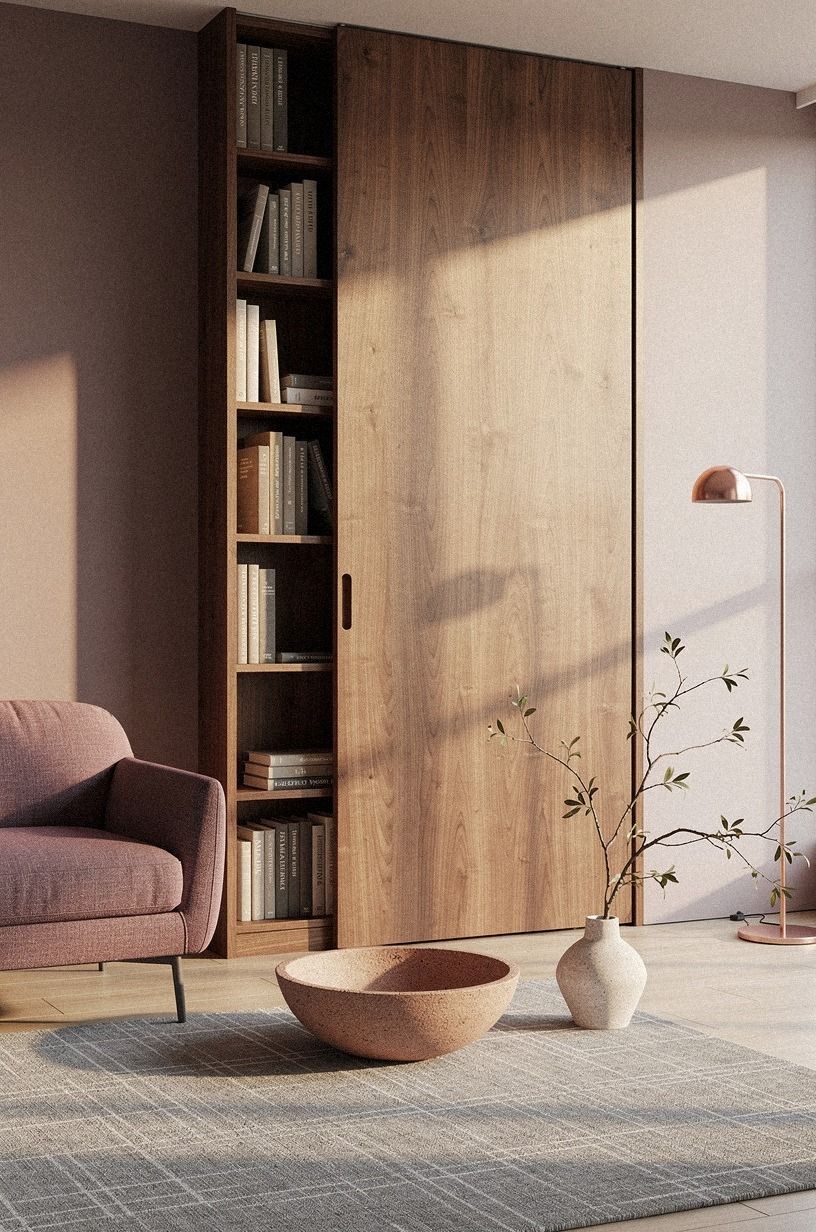
Nothing gives the game away faster than hardware in the wrong spot. A touch-latch system lets you keep the face clean, which is perfect when the shelves are wrapped in book-matched walnut veneer and the room leans plum, gray, and rose gold.
That’s especially useful when you want the room to read soft, not engineered. Push from one edge, let the door release, and keep every visible line calm.
You do need to plan the weight. A loaded door is heavy, and cheap latches get annoying fast. I made that mistake once, and the shelf started needing a shoulder check by week two.
Go for fewer objects, tighter editing, and a reliable touch latch rated for cabinet doors that carry real mass. If you’re weighing push-open against handled entries, our hidden bar behind a mirror door breakdown maps the differences honestly.
4Frame the hidden door with matching crown molding
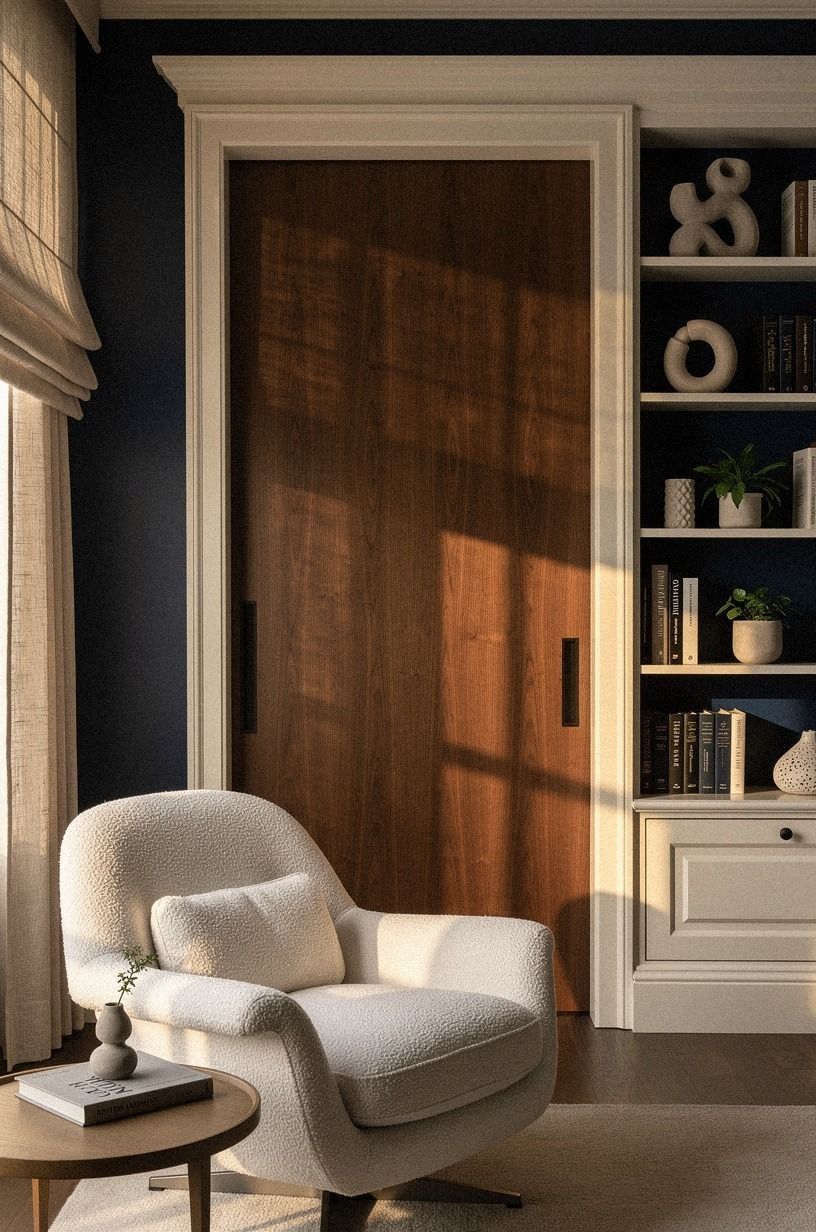
When crown molding wraps straight across the top, the opening starts to read like proper built-in millwork instead of a novelty insert. That matters even more in a navy and white room, where contrast is already doing a lot of visual work. A band of walnut millwork under crisp crown gives you the kind of old-library order that hides movement beautifully and makes the wall feel balanced.
Carry the same crown profile across the fixed shelves and the moving shelf face, then repeat it at the baseboard so the vertical break gets lost. You’ll notice the room feels calmer right away.
But honestly, that calm is what sells the illusion. For trim continuity in a more formal room, our hidden bar bedroom entrance ideas show how millwork carries a heavier space.
5Style uneven book stacks to break the seam
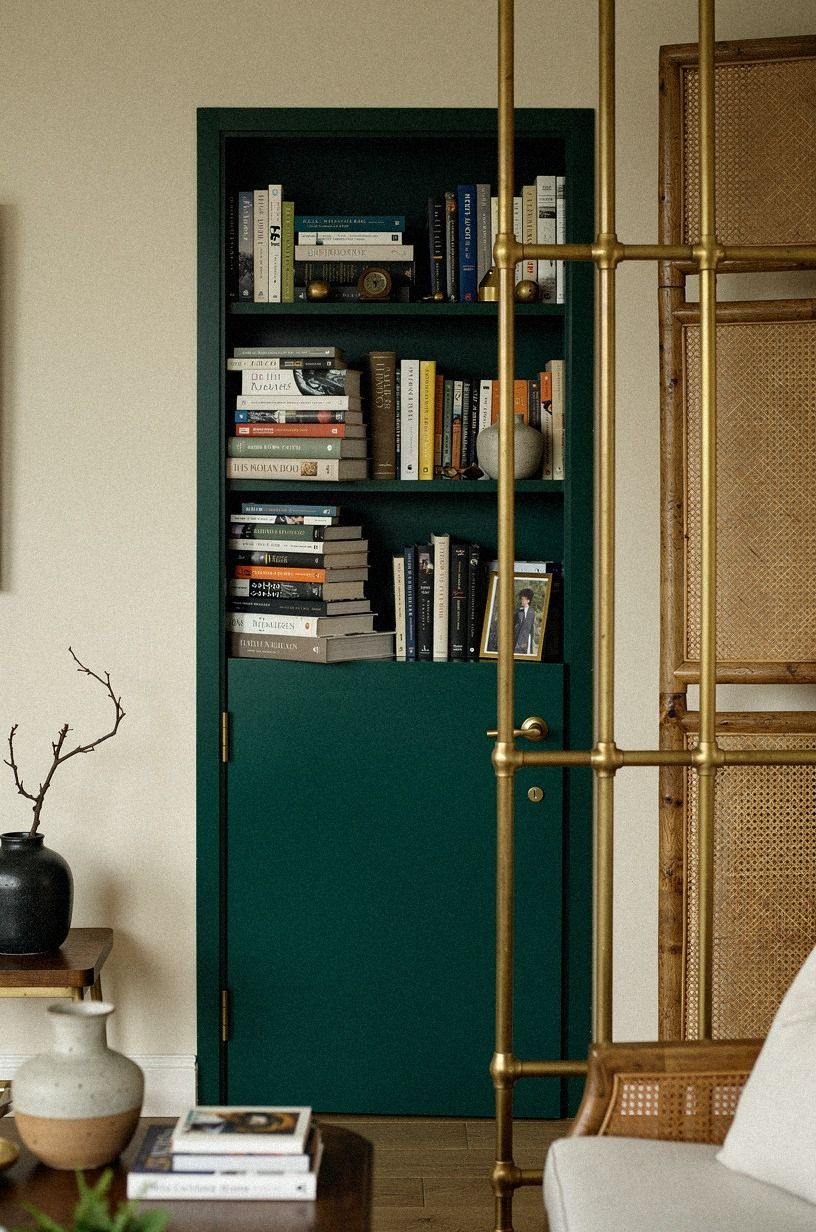
Perfect rows make people suspicious. Uneven stacks feel lived in, and that small bit of disorder helps blur where the moving shelf starts and stops.
In an emerald, gold, and cream room, mix upright books with short horizontal stacks, then weave in one unlacquered brass object that catches light without acting like a target. The whole effect feels charming instead of staged.
And the stacks should vary in height, not clutter. Leave one shelf partly open, let another carry a low bowl, and offset the tallest stacks away from the seam.
But don’t line up all your spines in one neat plane because that creates a ruler-straight shadow. If you like layered styling that still hides a door, our hidden dining room bar ideas show you how to disguise breaks with decor.
6Install a pivot bookcase with brass gallery rails
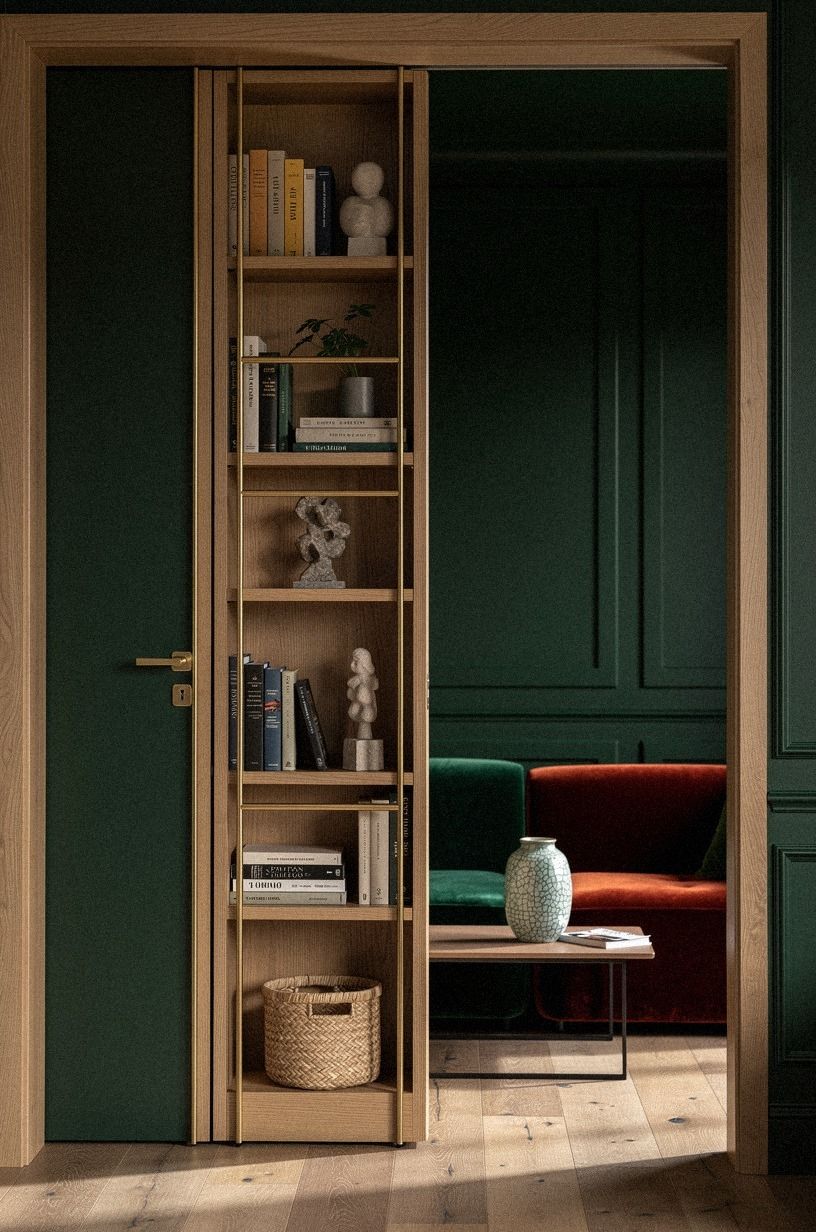
A pivot system feels old-money in the best way when the room already has depth. It’s a very different vibe from a flat slab door.
In a forest green, rust, and natural oak living room, brass gallery rails across the shelf fronts bring just enough polish to make the whole unit feel inherited. The wood here should stay tactile, and natural oak with a low-sheen finish keeps the face from looking overworked. It reads luxurious without getting stiff!
You’ll want to check pivot clearance before you commit. A pivot door needs a clean swing path, and a deep-pile rug can catch if the bottom reveal is too tight.
Aim for a visual balance that still feels grounded: weight low, books center, art high. For circulation lessons that transfer, our under-stairs hidden bar guide is worth the read.
7Paint the bookcase door the living room trim color
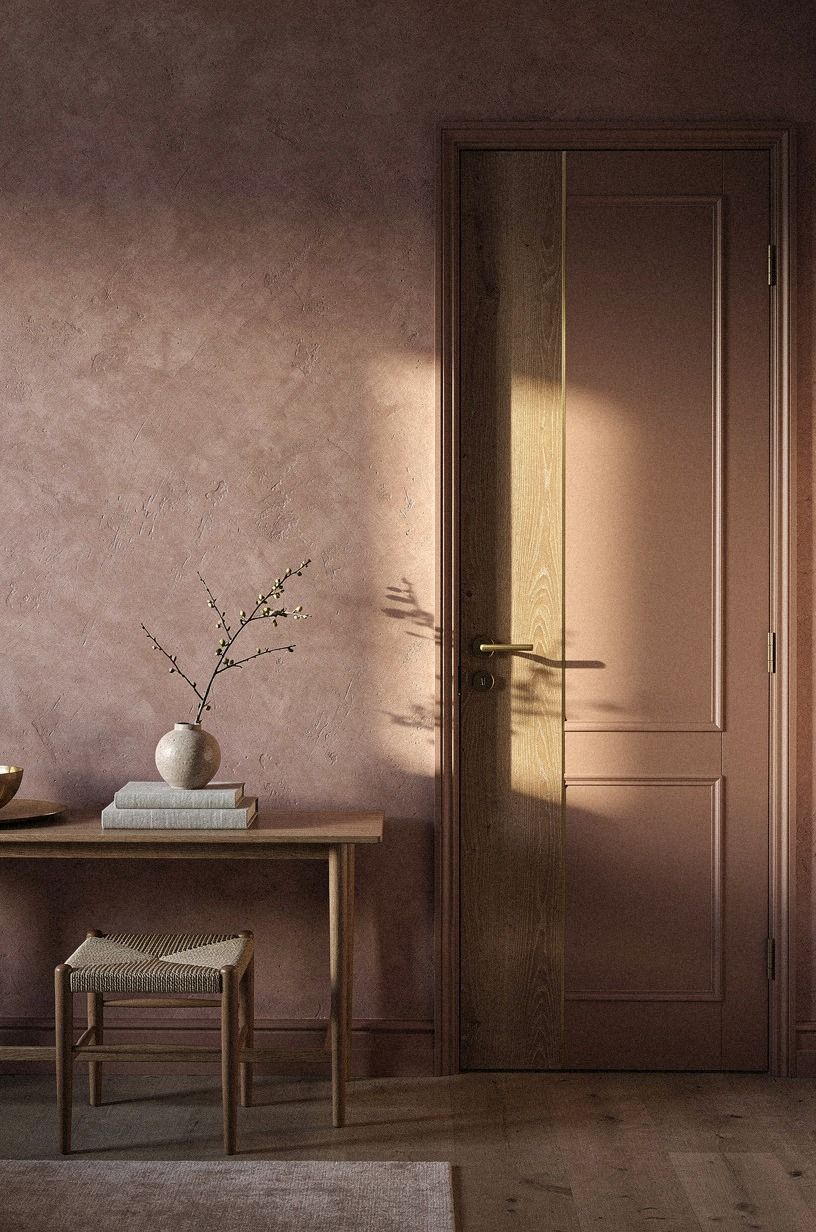
If you want the easiest win, paint the moving shelf the exact trim color instead of turning it into a feature. Same sheen, same formulation, same number of coats, and your eye stops reading it as a separate object. This is the move that quietly buys you the most discretion for the least money, and it’s the one I’d reach for first on almost every project.
The color itself should match not just the trim, but the undertones around it. A trim in Benjamin Moore White Dove OC-17 wants a moving shelf in the same flat or eggshell, not a higher gloss that would catch the light and announce itself.
If your room runs warm, lean the shelf toward a soft Accessible Beige SW 7036 rather than a stark white that reads colder than the wall. If your trim already leans cool, Pale Oak OC-20 keeps the door in the same family without pulling yellow.
The point: never let the moving shelf be the brightest or the darkest plane on the wall.
I’d skip any high-gloss finish here too. Satin or eggshell catches light the way wood does, and that’s the language your eye already trusts on a built-in. Plan two coats, light sanding between, and resist the temptation to add a feature color on the back panel until the rest of the wall is done.

8Hide the latch behind a sculptural bookend
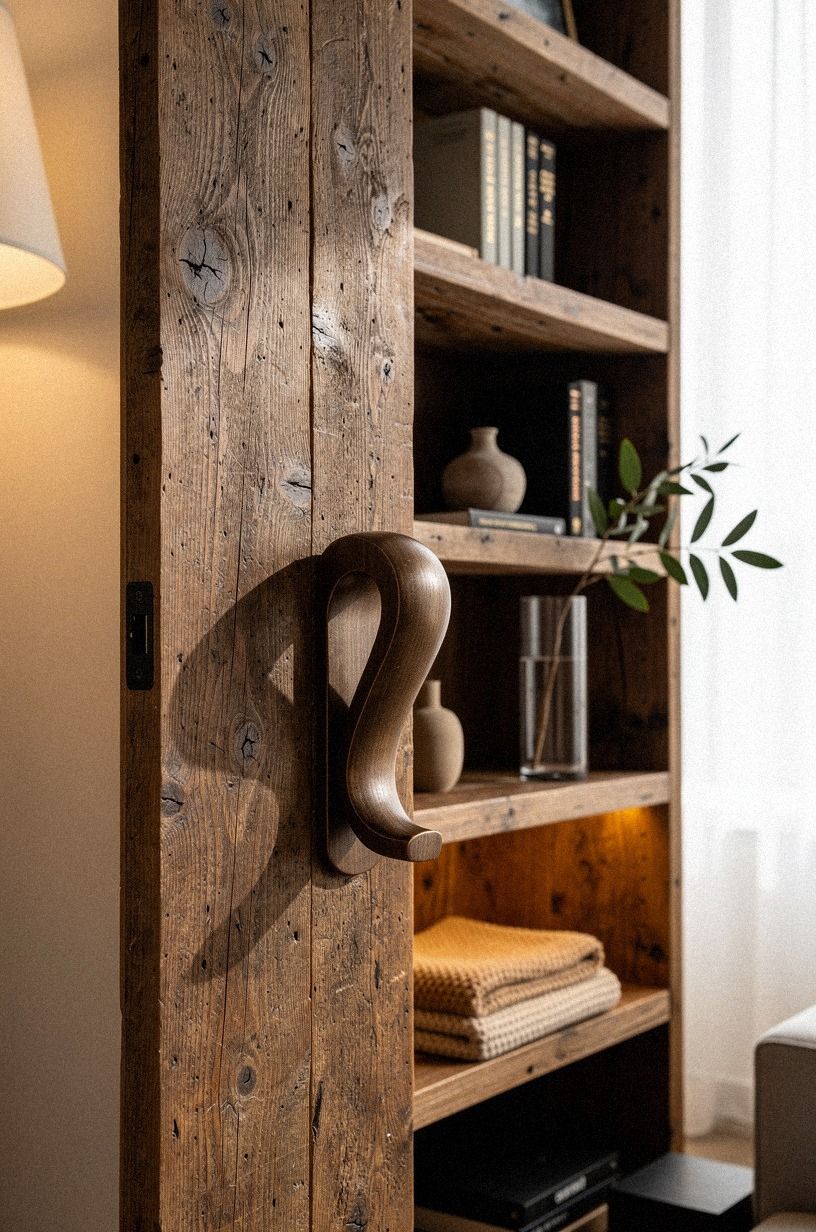
A good latch should disappear into your styling rhythm. That’s the whole point. Put it behind a heavy object that belongs on the shelf anyway, like a stone bust, a carved horse head, or a stacked metal form.
On reclaimed teak shelves in a warm white and camel room, a single weathered teak surface already gives you enough texture, so the object can stay simple.
You don’t need anything gimmicky. In fact, I’d avoid novelty bookends because they make guests look closer.
Choose a stone bookend with mass, place it where your hand can reach naturally, and keep the adjacent shelf sparse so the motion feels smooth. For more concealed-access ideas that still feel residential, our hidden bar behind a bookcase reveal gives you a few smart placement cues.
9Why do picture lights make the seam disappear?
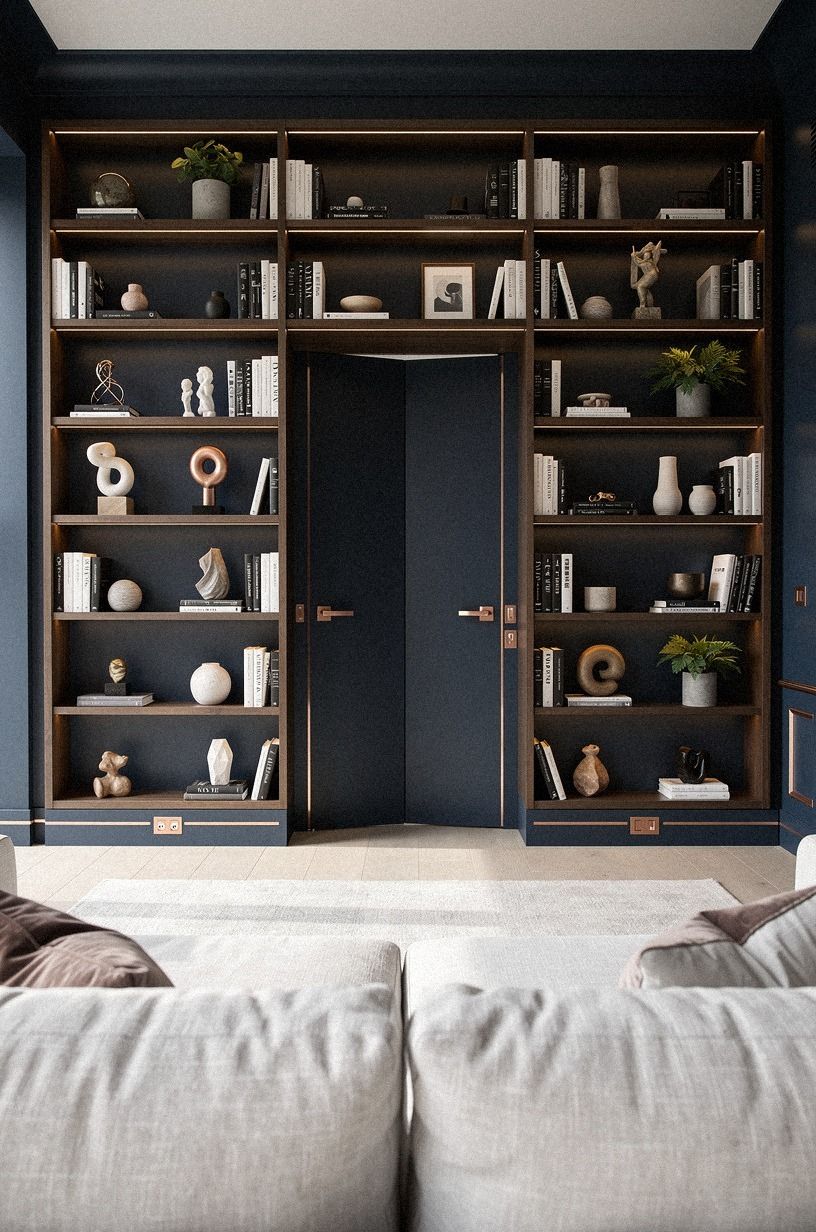
Light is one of the fastest ways to make a bookcase door feel permanent. Picture lights spread glow across the shelves, flatten shadows around the seam, and make the room read like a library at night.
In a midnight blue, copper, and ivory scheme, warm bulbs over midnight blue shelving create that pooled evening light people remember. It’s intimate, soothing, and genuinely gorgeous.
Keep the warm bulbs in the cozy end of the range, and space the fixtures so the glow overlaps instead of striping the wall. Why does that matter?
Because dramatic scallops of light can make the breaks more obvious. I like two or three smaller fixtures more than one oversized one. For more atmosphere-driven entries, our speakeasy lighting ideas lean into the same mood-first approach.
10Wrap the opening in arched library millwork
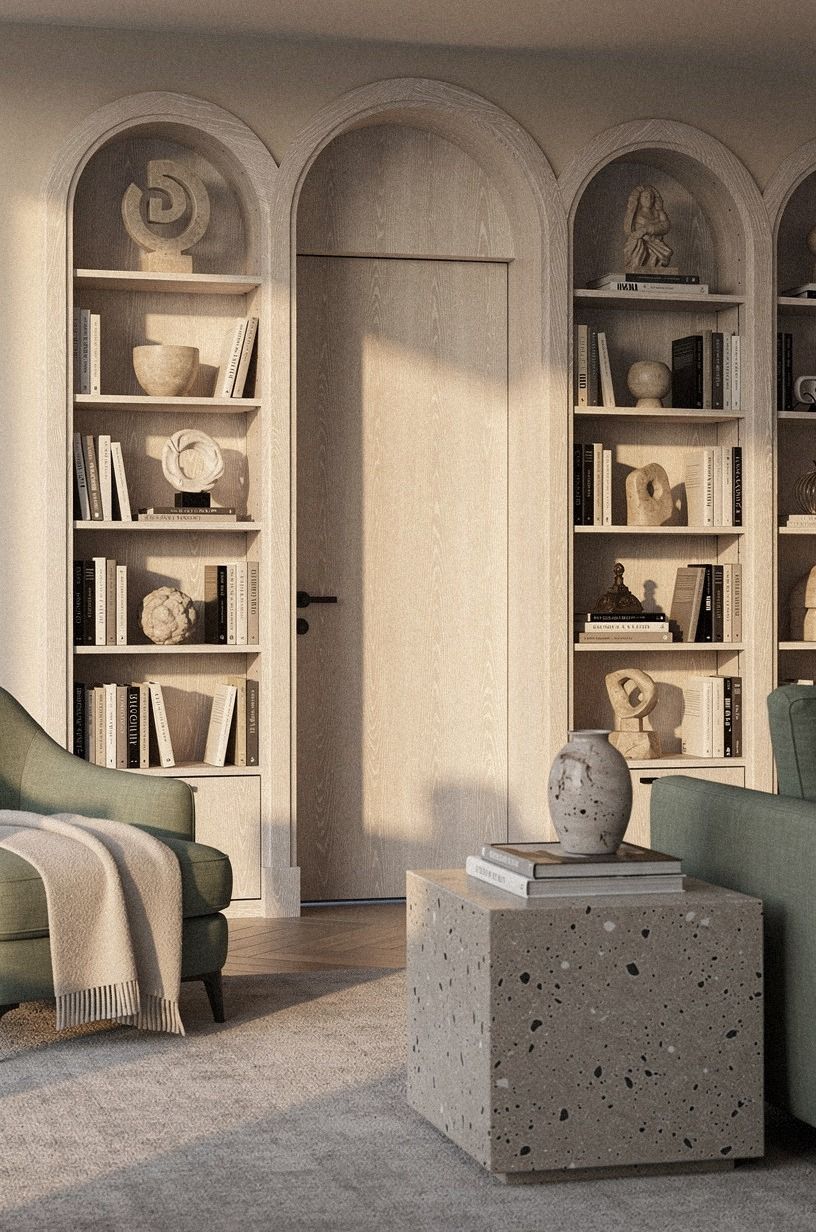
An arch softens the reveal and makes the whole entry feel older than it is. If the room is sage green, warm cream, and natural wood, wrapping the opening in an arched surround instantly gives the shelf wall a collected, almost country-house quality. I’d pair that shape with Sherwin-Williams Evergreen Fog SW 9130 nearby because it keeps the green grounded instead of sugary.
Make the arched surround broad, not fussy, and repeat the arch somewhere else in the room if you can. A cabinet inset, mirror top, or niche echo will help the form feel native.
But keep the shelf face simple. Too many carved details on the moving panel will call attention to the mechanics. If you are weighing softer millwork shapes, our hidden room door ideas guide compares openings that disappear versus openings that perform.
11Anchor the detail door with lower cabinet storage
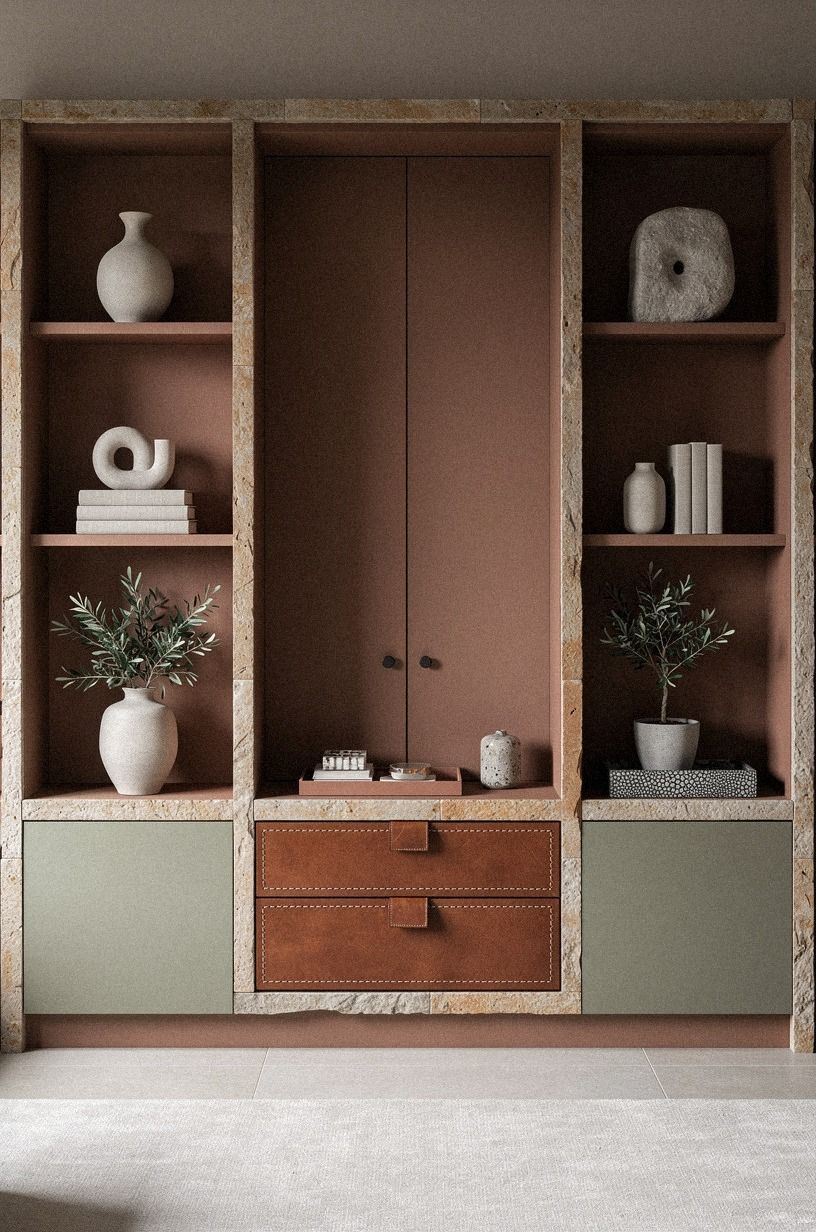
Lower cabinets do more than add storage. They give the whole wall a base, which helps the moving shelf feel structural instead of tacked on.
In terracotta, stone, and olive built-ins, cabinet doors below the shelves let you hide the heavier visual weight down low. A skin of shagreen-inspired fronts or painted slab panels can keep the composition quiet.
This is also where lower cabinets save you. Use the lower cabinets for blankets, games, or less pretty electronics, then let the upper shelves stay edited and believable.
You’ll thank yourself later when the room has to work hard every day. I wouldn’t leave the bottom open unless the room is huge because exposed baskets tend to make the seam more obvious.
For another example of concealed storage supporting an entry, our bookcase reveal story shows the same grounding effect.
12Blend hinge gaps behind vertical book rows
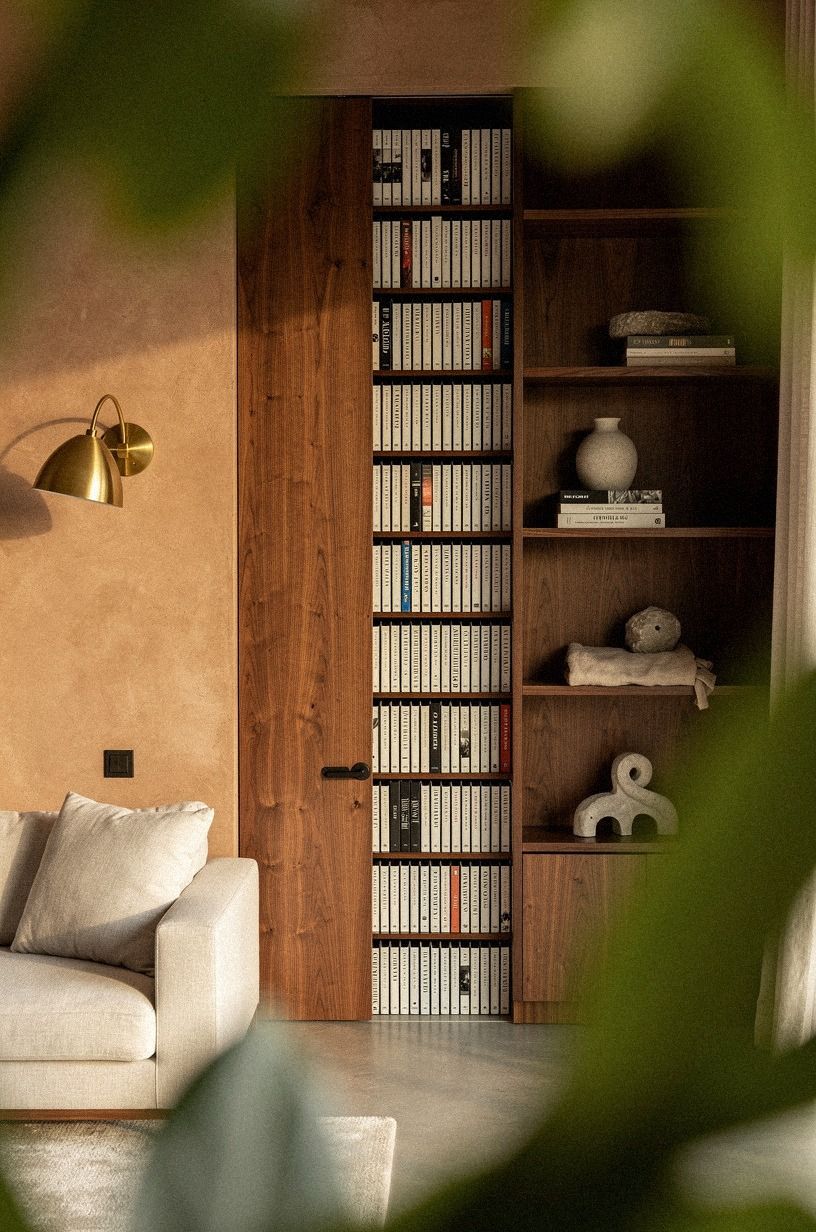
Hinge gaps are small, but your eye catches them fast if the shelf styling goes horizontal. A vertical row of tightly packed spines along the seam is the cheapest fix in this entire article, and it’s the one most people forget to plan. Books standing tall create a shadow line that breaks the visual straightness a hinge needs to disappear.
Style the seam column with oversized art books or uniform hardcovers in the same color family so the spine line reads as one continuous block. If your shelf is 12 inches deep, run two rows of spines front-to-back at the seam and skip objects entirely on that shelf. The hinge lives in the gap between the moving panel and the fixed frame, and a dense column of paper blocks the angle your eye would otherwise trace.
I’d also avoid objects with reflective trim near the seam. A brass clock, a silver frame, anything with a sharp edge of light, will mirror the gap back at you.
Keep that column quiet and let the rest of the styling carry the eye. If your door swings instead of pivots, the same logic applies on the latch side: a stacked horizontal pile of paperbacks right next to the handle reads as a styling choice, not a cover-up.
13Use glass-front shelves for a cabinet-door disguise
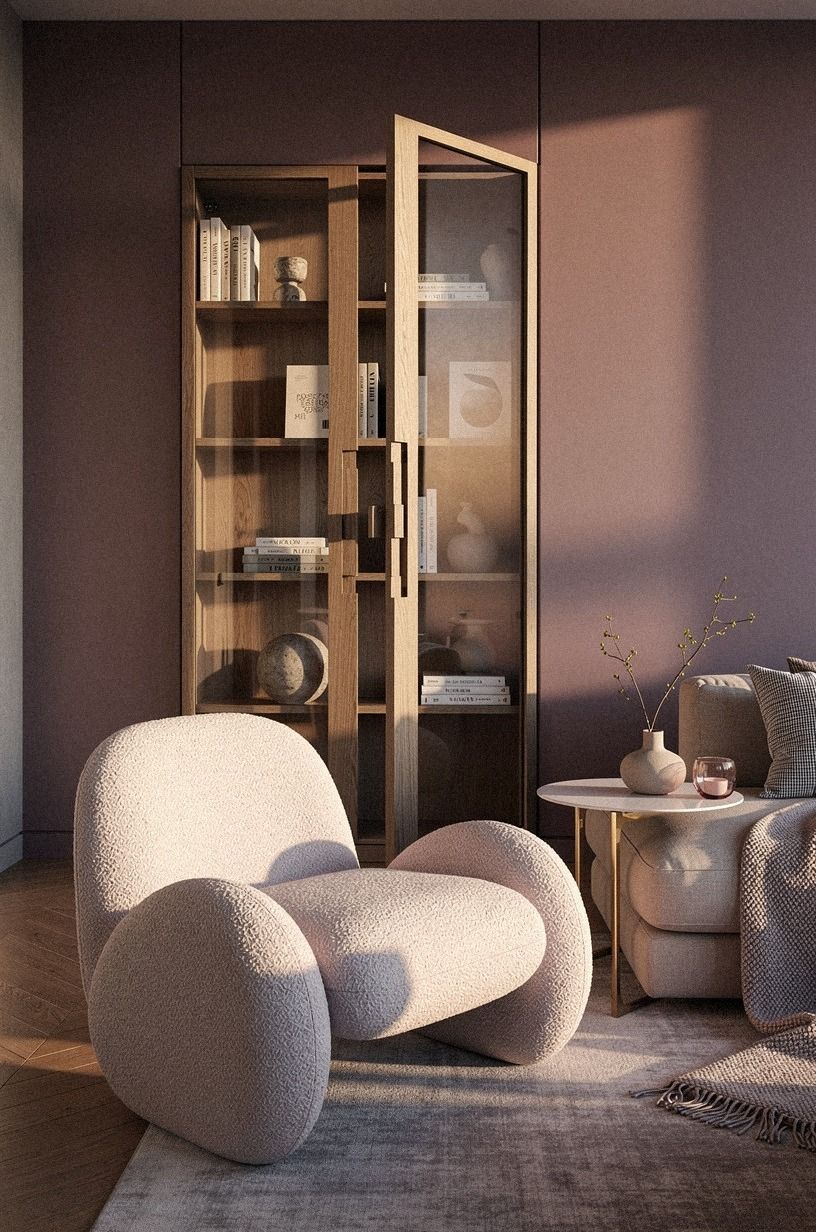
Glass-front shelves change the whole read of the wall because they shift the piece from bookcase to cabinet. In a plum, gray, and rose gold room, that subtle category change is useful.
Guests stop looking for a moving library and start reading the wall as storage. Thin muntins and warm reflections over rose gold hardware help the disguise feel intentional.
I’d only do this if you are willing to keep the inside styling disciplined. Glass reveals everything, so clutter will break the spell fast.
Use tonal books, ceramic boxes, and one glass-front bay object per shelf. And keep fingerprints under control because cloudy panes cheapen the whole thing.
For more disguised-entry inspiration, our speakeasy entrance ideas show how cabinet language can hide a passage better than open shelving.
14Panel the back wall in dark library green
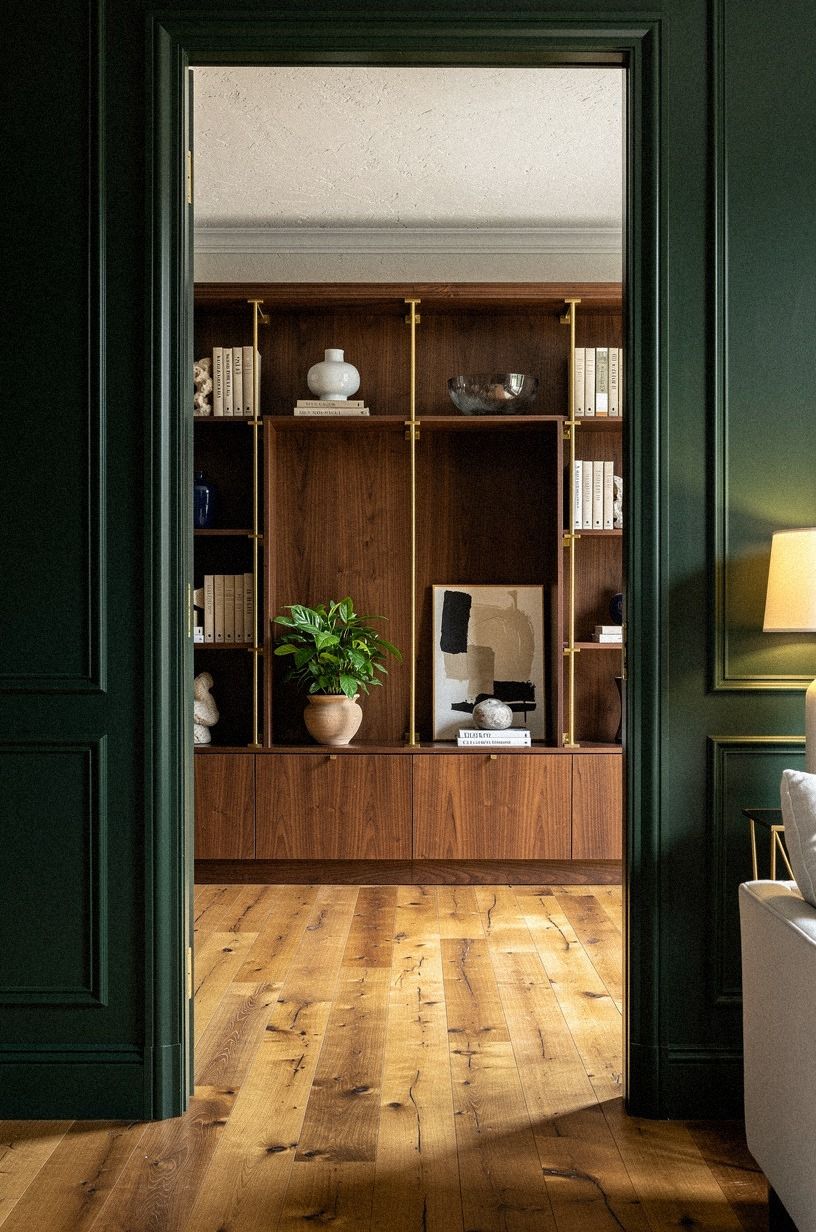
A dark back panel gives the books depth and makes the seams recede. It’s one of the fastest mood shifts in the whole room.
I like this move most when the room already has navy, white, and walnut in the mix because the extra depth feels earned, not theatrical. Farrow & Ball Hague Blue No. 30 can work here, but if you want a greener old-library note, go deeper and muddier rather than brighter.
Paint only the back panel first and leave the shelf fronts lighter if you’re nervous. That contrast pulls the eye inward and makes the room feel more architectural. But I wouldn’t stop at one lonely dark panel.
Repeat the tone in a lamp shade, spine color, or textile so it does not feel random. For more hidden-room build logic, our step-by-step guide to building a hidden room walks through the sequence.
15Conceal caster wheels under a plinth base
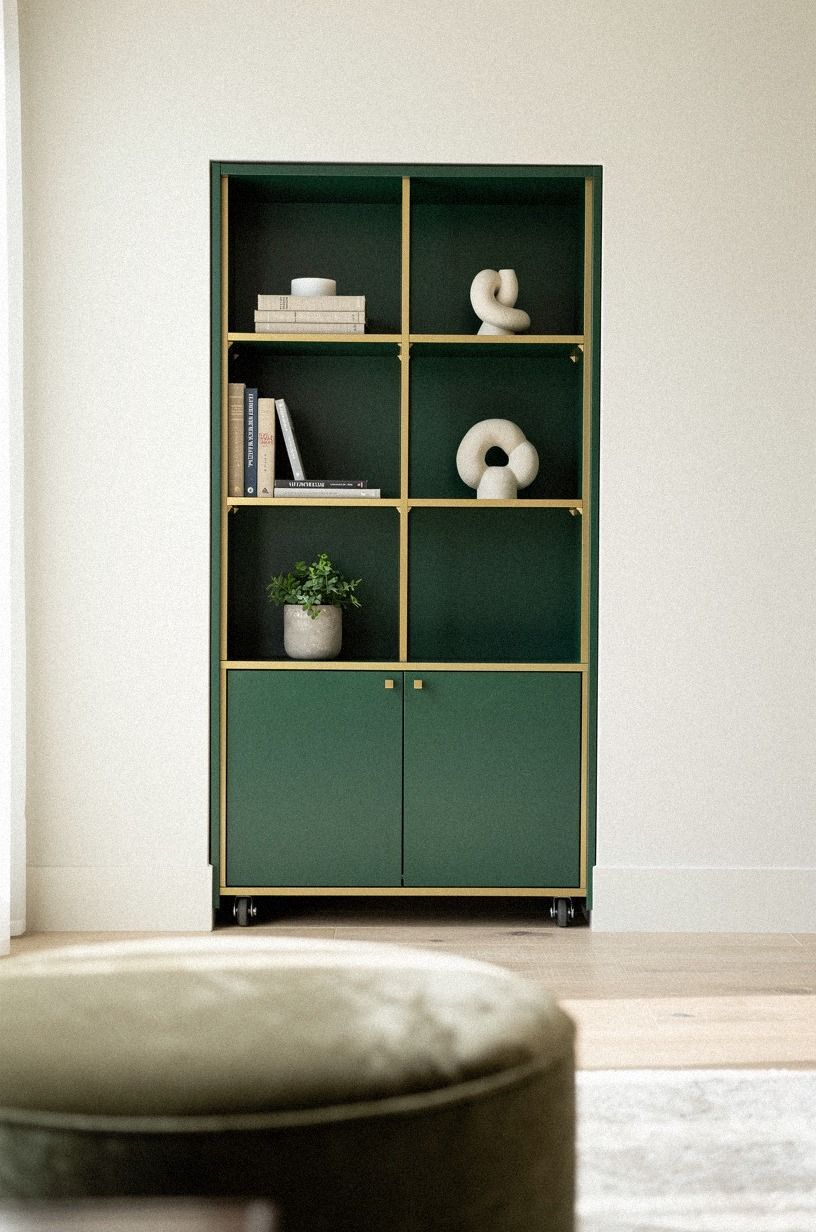
If your build relies on caster support, the base needs to look like furniture-grade millwork, not garage hardware. A plinth lets you hide the mechanics while giving the wall a grounded, custom look. In an emerald, gold, and cream built-in, a painted toe detail under mohair velvet seating nearby helps the whole setup feel designed rather than engineered.
Check your floor level before the build starts because even a slight dip can make the caster run feel rough. You also want enough base depth to mask the wheels without creating a clunky front edge.
I learned a skinny plinth reads cheap fast. For more disguised structure ideas, our hidden bar behind a bookcase round-up covers several base treatments that keep mechanics quiet.
16Repeat living room sconces across the bookshelf wall
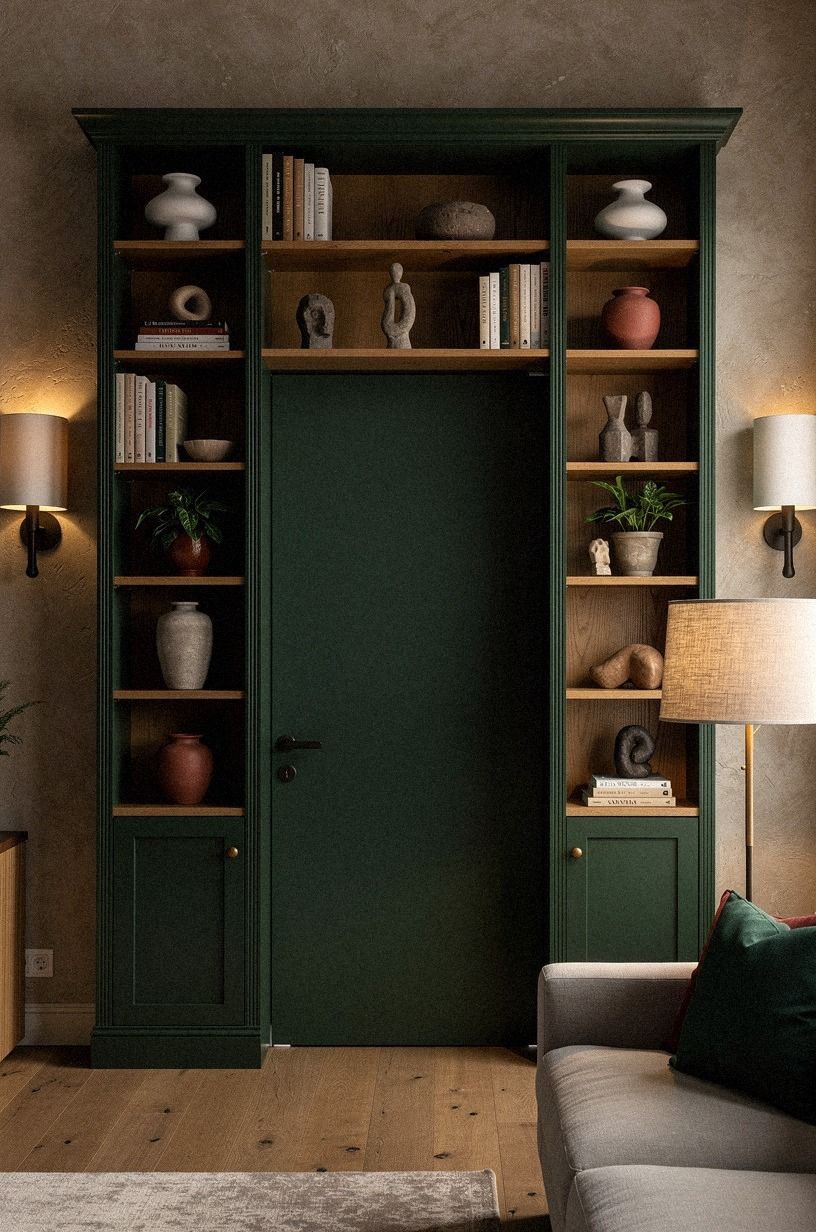
Repeating the same sconces across the whole wall makes the bookcase door disappear into a larger lighting plan. A sconce placed every four feet reads as architecture, not as a single light honoring one feature. The wall starts to feel like part of the room’s bones instead of a clever insertion, and that’s exactly the read you want for a concealed entry.
Match the finish, scale, and shade across every fixture so the rhythm holds. If your living room already runs unlacquered brass, stay there. Mixing a polished brass sconce next to an aged bronze one breaks the spell and tells the eye to inspect each fixture as its own object.
I aim for two sconces minimum flanking the wall, ideally three if the run is longer than eight feet, all switched together so the whole wall lights up with one click.
Keep the shades in a warm natural linen rather than anything opaque or colored. Linen filters the bulb into a soft amber pool that flatters both books and stoneware. If you want more layered lighting logic, our speakeasy lighting ideas cover how warm pools sell an atmosphere without a single overhead fixture.
17Stage a reading chair beside the disguised opening
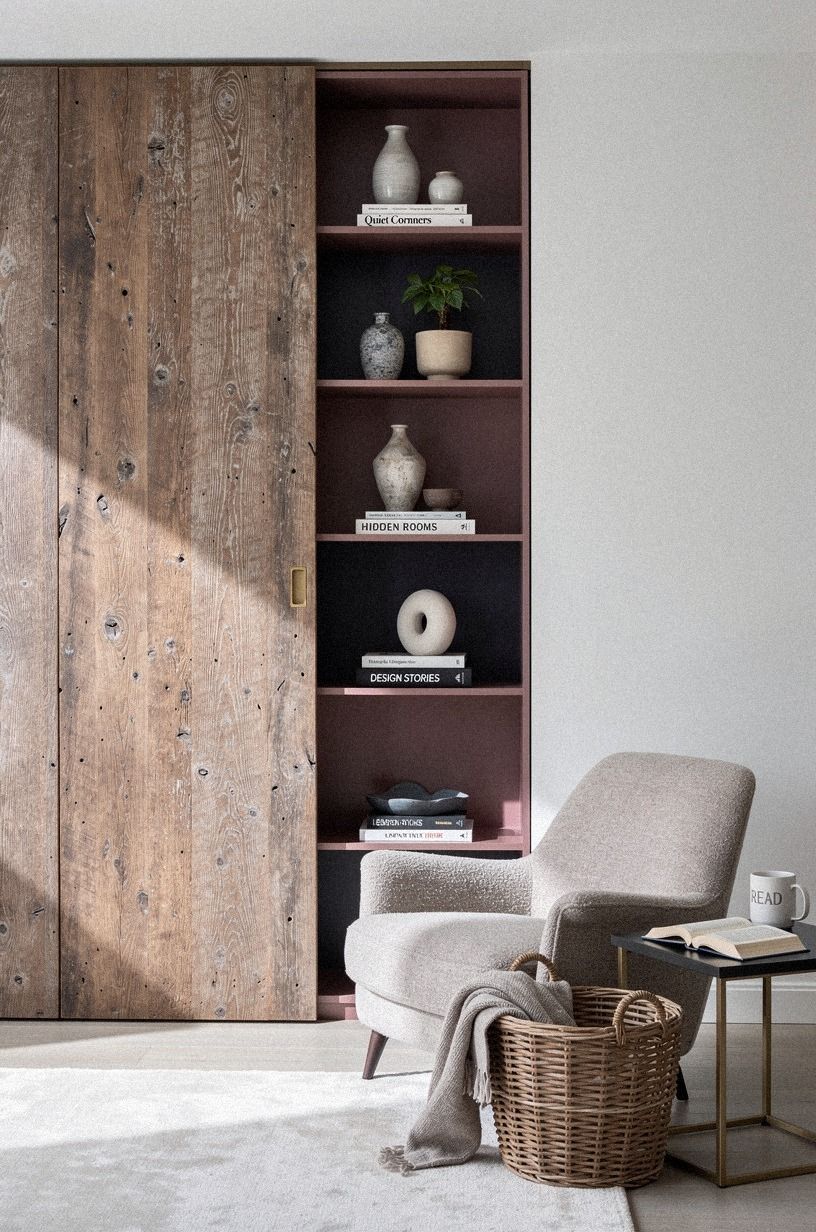
A reading chair gives the wall a reason to exist. It’s a small move with big payoff.
Put one beside the disguised opening and the whole zone starts to feel like a destination, not a puzzle. That’s what makes the corner feel inhabited.
On weathered teak shelves in a dusty rose, charcoal, and brass room, a deep chair in camel leather or bouclé under reclaimed teak shelving adds the human cue that sells the setup.
Keep the chair honest in its footprint. Your chair should invite use without blocking the swing path, so watch the clearance and test it before the room is finished.
I like a chair with a visual gap under the seat because it keeps the corner light. If you want more styled hideaway inspiration, our hidden bar behind a bookcase feature shows how seating can make the passage feel like part of everyday living.
The Quiet Millwork Rule
A convincing bookcase door doesn’t live in a vacuum. It lives inside a room with proportions, trim, light, and seating that all have to hold together.
If you’re pricing the whole project, the useful answer is that a layered living room around a concealed bookcase can cost very different amounts depending on whether you’re styling, furnishing, or commissioning millwork. Start with the room first, then the moving shelf.
That order saves you from spending on mechanics before the space even feels believable. And yes, that order matters a lot!
A few room dimensions help too. A sofa usually lands at 35-40 inches deep, a coffee table is often 16-18 inches tall, and the rug under a seating group is usually 8×10 or 9×12.
Those basics matter because a convincing bookcase door does not live alone. It lives inside a room with proportion.
The Quiet-Library Test
The version that works in real life is not the flashiest build. It’s the one that feels like it belonged to the room before you ever noticed it.
I’ve gone back and forth on this because the dramatic builds are fun to look at, and some of them photograph beautifully. But once you live with a concealed door, you stop caring about the reveal and start caring about whether the wall feels calm at 8 p.m. with the lamps on.
That’s why I keep coming back to classic millwork instead of novelty. Matching crown, proper baseboards, edited shelf styling, and one room-wide material story do more for the illusion than any theatrical latch.
In practice, the room has to carry two jobs at once. It has to hide the opening, yes, but it also has to feel like a living room you would use every day.
Books that are too staged feel fake. Shelves that are too empty feel suspicious. Hardware that is too clever turns the whole thing into a talking point when what you really want is quiet.
I also think homeowners overspend on the wrong parts. They pour money into mechanisms and forget the shell. Real talk: if the lighting is cold, the rug is undersized, and the paint has no depth, the clever door will not save the room.
You cannot layer warmth on top of a room that never got its basics right. I’d rather see you buy fewer objects, paint the backing a richer tone, and invest in one solid material like 3/4-inch white oak than add gimmicks you’ll be tired of in a year.
And there’s a deeper design reason this look keeps pulling people in. A concealed entrance promises privacy, but what it really delivers is atmosphere.
It makes the room feel tucked away, held, a little more inward. That mood lands best when the details are honest.
Linen that wrinkles a bit. Brass that softens over time. A chair you will read in, not just photograph.
That is the part that worked for me.
One last thing. The best bookcase doors I have ever seen were not the most expensive.
They were the most patient. Someone moved in, lived with the wall for a month, edited the styling twice, swapped a hinge once, repainted a shelf back panel in a quieter green, and then stopped touching it. The room got there because someone let it settle.
That patient rhythm is the move nobody sells you. The door mattered, sure.
The room around it mattered more.
A Few Things Worth Answering
How do I hide a bookcase door so guests can’t find it?
Paint the moving shelf the exact trim color and repeat the crown profile across the whole wall. Style books in uneven stacks so the seam stays blurred. Warm 2700K picture lights over the shelves close the deal.
What kind of bookshelf works best for a hidden door?
A full-height bay of solid wood or veneer-wrapped MDF at 12 inches deep handles the weight and the books without bowing. Pivot hardware lasts longer than touch latches on heavier doors, and a plinth base hides the mechanics cleanly.
Can I build a hidden door bookshelf without custom millwork?
Yes, with IKEA BILLY units trimmed out in matching crown, baseboard, and paint, you can fake custom for under $800. The trade-off is depth and weight: a single tall BILLY won’t swing as smoothly as a solid panel, and you’ll want to reinforce the back.
How much does a hidden bookshelf door cost?
A DIY build with stock cabinets and 2700K picture lights lands around $500 to $1,200. A mid-range custom build with real walnut veneer, pivot hardware, and matching millwork runs $3,000 to $7,000. A full custom millwork job with arched surround and brass gallery rails climbs from there.
Will a hidden door damage my wall or ruin a rental?
Not if you stay reversible. Freestanding shelving trimmed out in matching paint, tension-mounted picture lights, and peel-and-stick back panels all come off cleanly. For more concealment ideas that stay flexible, our speakeasy door ideas cover low-damage atmosphere upgrades.
Where I’d Start First
If I had to pick one, I’d start by painting the bookcase door the exact trim color. You cannot hide a moving shelf if the color jumps first. Everything else on this list builds on that quiet foundation, and it costs a single can of trim paint.
Pin this list for your next weekend, and when you’re ready to plan the wall, our hidden bar behind a bookcase reveal walks through scale, clearance, and lighting for the full build.