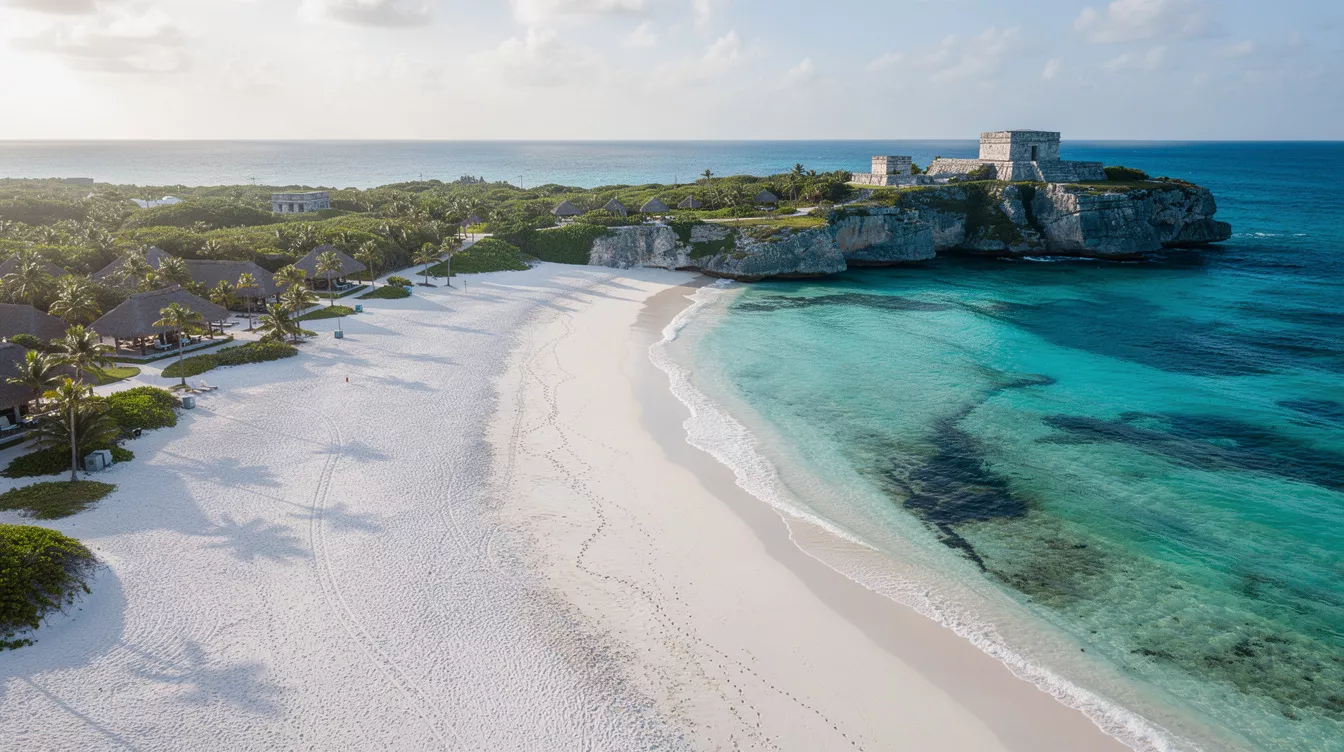
The smell hits before the view does. On a June morning in Tulum’s hotel zone, the hydrogen sulfide from decomposing sargassum reaches you on the path between two palapa-roofed hotels, a low sulfur note that the Instagram photos never captured. The water in those photos is pale blue-green. The water on a bad sargassum morning is hidden behind a brown wall of seaweed piled three feet deep against the sand.
Both of these things are Tulum. The difference is a Caribbean current, a calendar, and a choice about where along 3 miles of hotel-zone beach you decided to sleep.
The beach is 3 miles long and the north end isn’t the south
At the northern tip of the hotel zone, the Tulum archaeological zone sits on a limestone bluff. El Castillo rises roughly 39 feet above sea level, and directly below it, a short beach called Playa Ruinas stretches about 100 yards at low tide. But the current here runs strong because of the headland geometry, there are no amenities, and swimming is often unsafe.
South from the ruins, the hotel zone proper begins. Beach clubs line this stretch, with day passes running $50-$120. And at the far southern end, near the Tulum Biosphere Reserve entrance, the public beach opens into a slightly different current pocket that sometimes clears faster after a sargassum event.
Because the coast faces due east into the open Caribbean, there’s no significant offshore reef deflecting incoming seaweed. Playa Norte on Isla Mujeres sits protected by a lagoon geometry that Tulum simply doesn’t have. That exposure is the defining physical fact of every beach decision you’ll make here.
Sargassum arrives on a schedule most hotels won’t send you
When the seaweed comes and why Tulum gets hit harder than Cancún
The Atlantic sargassum belt runs north and west on Caribbean currents that intensify between May and October, with June through August typically the worst months. Cancún’s northern hotel strip sits behind a partial offshore reef shelf that deflects some incoming seaweed. Tulum doesn’t have that buffer, so accumulations arrive heavier and more frequently during peak season.
Cleanup crews at larger properties start work at 5am. But a local boat captain who has run the coast for decades will tell you that two hotels just 400 meters apart can have completely different mornings depending on which micro-current ran overnight.
What a bad morning looks like versus a manageable one
A manageable sargassum day means a narrow band at the waterline, cleared before 8am, with open water beyond. A bad morning means a 3-to-5-foot brown wall, a sharp sulfur smell, and murky water through midday. And because most beach club day passes are non-refundable, walking the beach before 7am before buying a pass is the single most practical thing a first-time visitor can do.
When the beach actually works, and the cenote backup plan
The months that deliver the photographs
November through February is the reliable window. Sargassum drops sharply after October, water temperature holds around 79-81°F, and the northeast trade wind keeps the air manageable. December and January are peak season, with hotel-zone rooms running $300-$900 per night. But March and April sit in a shoulder window that experienced visitors treat as the best trade-off: lower prices, minimal seaweed, and morning light that hits El Castillo flat from the east at sunrise with no filter needed.
Beaches under ecological pressure teach you to build a backup plan. At Tulum, that backup is already better than most main events.
Gran Cenote and the inland alternative
Gran Cenote sits about 3 miles northwest of the hotel zone entrance, on the road toward Cobá, with admission around $20. The water is groundwater-fed through Yucatán limestone, gin-clear, 75°F year-round, and completely unaffected by any Caribbean current. Stalactites hang above the waterline, small freshwater turtles move through shafts of light from the open ceiling, and the smell is cold stone, nothing else.
Dos Ojos, a larger twin-cavern system about 7 miles south of the hotel zone, offers snorkeling through connected cave pools. On a June morning when the beach is compromised, neither of these is a consolation. They’re a genuinely different trip.
Tulum town versus the hotel zone
Tulum pueblo sits on Highway 307, roughly 3 miles west of the beach. It’s a working Mexican town with a main street, a market, and lunch plates at $4-$8. Guesthouses run $40-$90 per night, and the beach clubs are still reachable on a day-pass basis. How a town manages its beach access shapes the entire visitor experience, and at Tulum that tension between public shoreline and private beach clubs is real.
The trade-off is a 10-15 minute transit each way. But the families who run the town-side guesthouses will point you to the beach stretches that cleared fastest the morning before.
Your questions about Tulum’s beaches answered
How do you get from Cancún to Tulum’s beach zone?
Cancún airport sits roughly 80 miles north of the hotel zone. The ADO bus from the terminal to Tulum town runs around $14-$18 and takes 2-2.5 hours. A private transfer direct to the hotel zone runs $70-$110. Renting a car gives you flexibility for the cenote circuit and Cobá ruins, about 27 miles northwest of Tulum town on Highway 109.
What’s the best month to visit Tulum for beach conditions?
November through February carries the lowest sargassum risk and the most consistently swimmable water. March and April offer a favorable window before the late-spring accumulation cycle builds. Booking the most-photographed destination without checking the calendar is how most beach disappointments happen. June through September, especially August, carries the highest probability of significant seaweed.
What does a week in Tulum actually cost?
A mid-range week in the hotel zone, with a room at $200 per night, beach club day-passes at $80, cenote entries, meals in town, and transport, runs approximately $2,200-$2,800 per person. Budget travelers staying in the pueblo, eating local, and limiting beach club access can bring that to $900-$1,200. Luxury properties in the hotel zone start at $500 per night and require advance booking in high season.
At 6am on a November morning, before any beach club attendant has arrived, the sand at Tulum’s hotel zone is cool and unmarked. The ruins sit dark against a sky just beginning to separate from the sea. The water is flat. The smell is salt, nothing else.