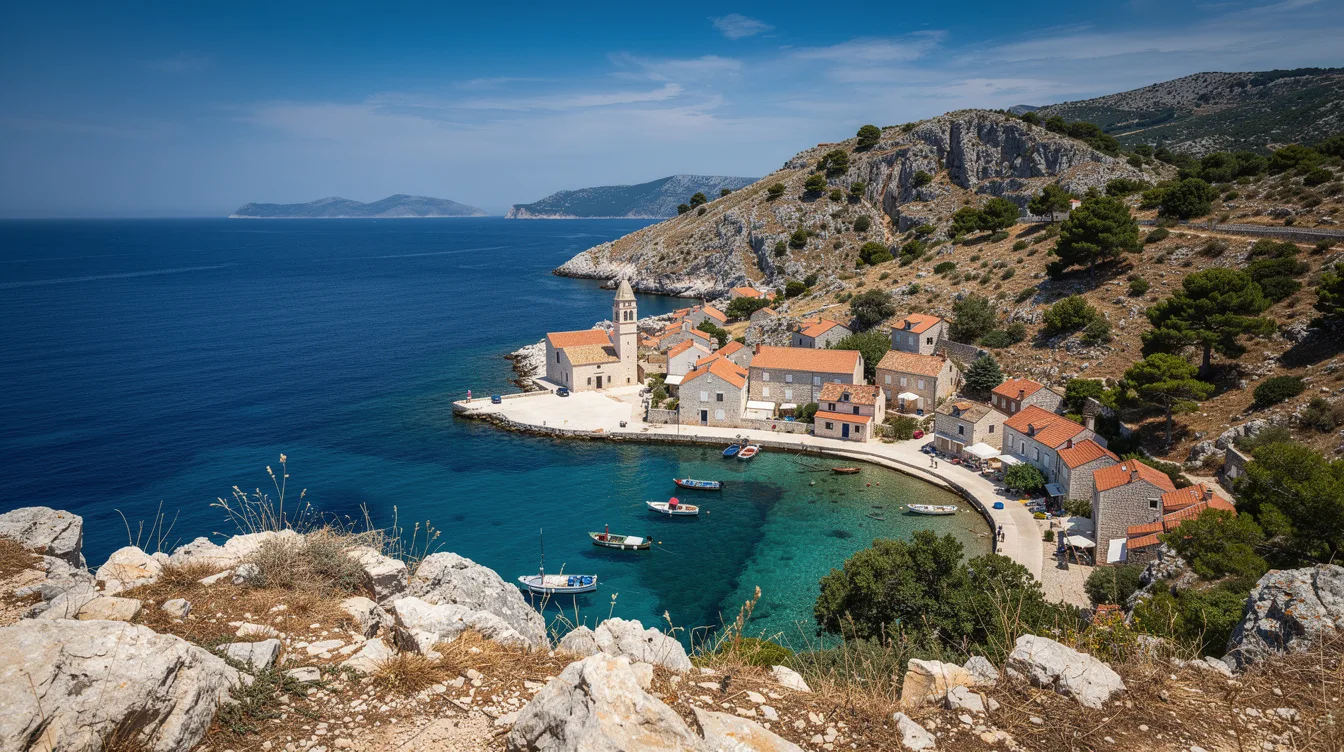
Croatia has a coast full of islands that have been photographed to death. **Vis** is not one of them. It sat closed to visitors for decades as a Yugoslav military base, and that accident of history is why it still feels like the Adriatic before the crowds arrived.
No sprawling resort strips. Just coves and vineyards, with two towns worth knowing.
A closed island is a preserved island
The military status kept developers out. So when the island opened up, there was nothing to undo: no half-built hotel blocks, no waterfront replaced by concrete.
You feel it most in the pace. Dalmatians have a word for it, pomalo, which is less a schedule than a philosophy. Take it slow, and take it later.
And the trade-off is real. Summer bookings tighten fast, so you plan further ahead here than you would for Hvar.
Two towns, and they don’t feel alike
Vis Town sits on the eastern side, where the ferries come in. It’s the arrival point, the administrative center, the place with the harbor bustle.
Cross to the west and you get Komiža, an old fishing port that runs on a different clock. It’s the better bet for waterfront dinners and for watching the sun drop into open water.
The bus between them takes about 15 to 20 minutes. Useful, but it runs on its own logic, so most people rent something with wheels of their own.
How you actually get there
Can you reach Vis without a car?
Yes, and the passenger catamaran from Split is the fastest way, at roughly 1 hour 15 to 1 hour 30. It lands you in Vis Town on foot, which is fine if you’re staying in town.
The Jadrolinija car ferry takes longer, about 2 hours 15 to 2 hours 30, but it brings your vehicle. Schedules shift with the season, so check them before you book anything else.
On the island, a scooter is the practical choice if you travel light and don’t mind winding roads. A small car earns its keep for far coves, luggage, or a hot afternoon.
Stiniva is worth the effort, and the effort is real
Stiniva is the cove everyone comes for, a narrow gap between high cliffs that opens onto a pebble beach. You arrive by boat or by a steep walk down.
That walk is not a stroll. And in July and August the cove fills, which is exactly why the shoulder months are the smarter play.
Beyond Stiniva there’s a whole roster: Srebrna, Stončica, Milna, Grandovac, Rukavac. Pick by what you want, sand or pebbles, snorkeling or nobody around.
The blue cave, and the case for an early alarm
The Blue Cave, Modra špilja, sits on the neighboring islet of Biševo and draws boat excursions all season. Go early in the morning. The queues build through the day, and there’s no shortcut past them.
Back on Vis, Fort George stands above Vis Town, worth the climb for the view and the history both.
Climb Hum, then eat
Mount Hum is high enough to put the whole island under you. On an island this compact, that’s the vantage point that makes the map make sense.
Then there’s the food, which is the quiet argument for coming at all. Order the local white wine, Vugava, alongside grilled fish or octopus, or a peka if you can plan a day ahead.
When to come, honestly
May, June, or September. The sea is agreeable, the crowds are thinner, and prices tend to soften. That’s the compromise most travelers are actually looking for.
July and August are gorgeous and busy, particularly at Stiniva and Biševo. If you go then, lock in the ferry, the car, and the room early.
October rewards drivers, walkers, and eaters. But services and connections thin out, so check what’s still running.
The climate helps: Mediterranean, with more than 2,600 hours of sun a year, and summers that are hot and dry.
What you’re really signing up for
You’re trading nightlife density and easy logistics for water, quiet, and good fish. That’s the deal, and it’s a fair one.
And you should know the island won’t meet you halfway. It doesn’t perform for visitors, because for most of its recent history it never had to.
Come in June, take the catamaran, and give yourself the afternoon in Komiža with nothing scheduled. The harbor smells of salt and diesel, the light goes gold around the fishing boats, and nobody is in a hurry to get anywhere.