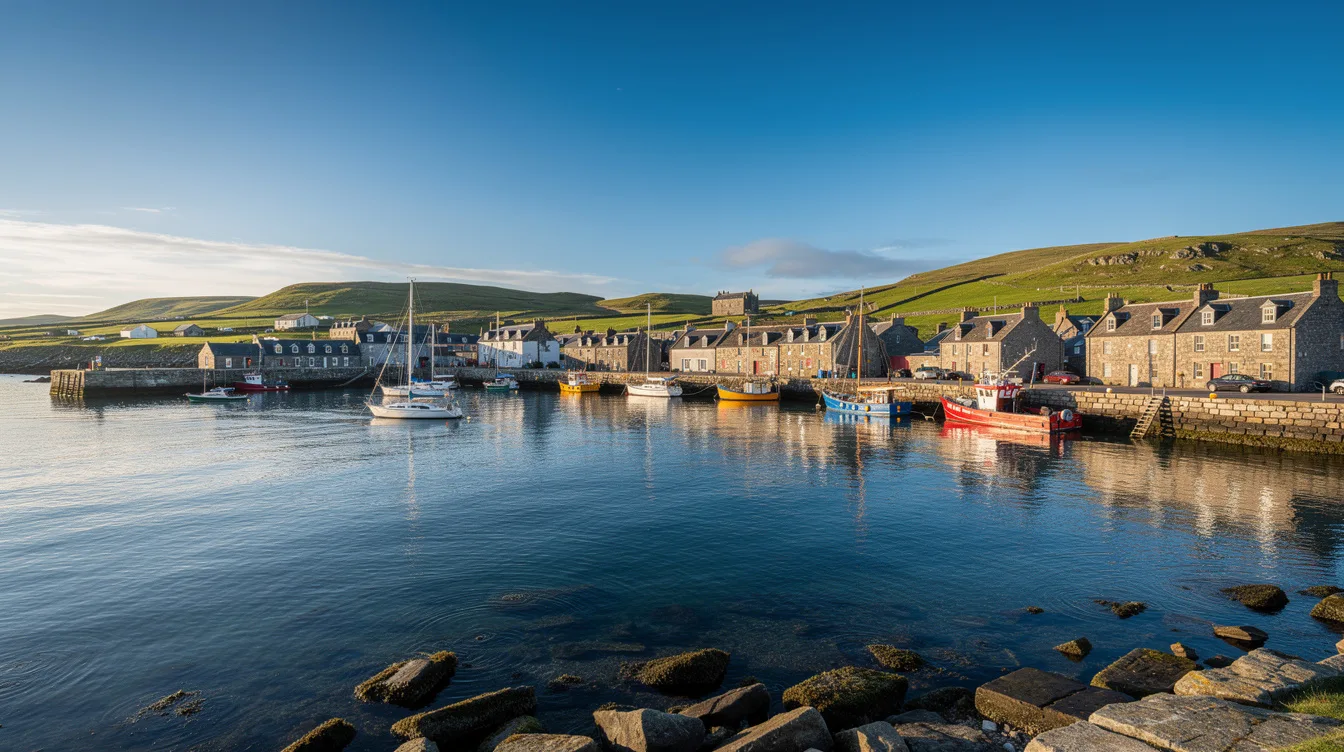
Stromness doesn’t announce its history with grand monuments. Its proof sits at the harbor edge, where stone houses press close to the water and the lanes climb sharply uphill. In 1780, Captain Cook’s ships Discovery and Resolution called here on their return from Hawaii, after Cook’s death.
That link gives this small Orkney town a pull that Kirkwall can’t quite match. You arrive by ferry or bus, then find a working harbor town that still feels shaped by tides, weather, and departures.
A harbor tied to Cook’s final voyage
Cook himself never stepped ashore at Stromness on that final return. But Discovery and Resolution did, and that is enough to make the waterfront feel larger than its scale. You can walk the harbor and picture ships taking shelter before facing the long route south.
And Stromness had reason to know such vessels. Hudson’s Bay Company ships and whaling fleets were regular visitors, while many men from the area worked as traders, explorers, and seamen. The sea was never scenery here.
It was the town’s way outward.
At the Stromness Museum, that maritime past gets useful context through collections connected to whaling, local seafaring, Scapa Flow, and objects brought back from Greenland and Arctic Canada. It’s compact, but it makes the Cook connection feel less like a plaque and more like part of a long harbor record.
The main street is the real reason to linger
The old town runs along a winding flagstone street, with local-stone houses, small shops, and narrow lanes slipping off toward the hillside. It’s the kind of place where you should resist making a tight itinerary, because the next turn often looks better than the last.
But don’t expect a large historic district. Stromness has 1,700 residents, according to the 2022 count, and its center is small enough to cover on foot. That compactness is the point, though.
The harbor, the piers, and the steep side streets all sit close together.
You’ll notice the air first, salt-heavy around the waterfront, then the hard texture of flagstone underfoot. The town is lively enough for a slow browse through independent shops, cafés, and studios, but it never feels like it is performing for visitors.
And that makes it a better choice than a rushed stop. Give the street time after you arrive, especially if the ferry has set you down directly in town. The waterfront houses hold the view while the harbor keeps moving below.
Art and maritime history share the same small town
The Pier Arts Centre is an unusually strong reason to stop in a town this size. Its collection of twentieth-century British art changes the rhythm of a harbor walk, giving you a quiet indoor pause between wind, stone, and water.
That contrast works. You can spend part of the day with modern art, then return to a street whose history was built around ships and tidal currents. And if you only choose one cultural stop, pick based on your mood: Pier Arts Centre for art, Stromness Museum for the sea.
Can you explore Stromness without a car?
Yes, for the town itself. The old center, harbor, museums, shops, and nearby waterfront walks are manageable on foot, while the X1 service links Stromness with Kirkwall and St Margaret’s Hope.
But a car is useful if you want to push farther across Mainland to places such as Skara Brae or the Heart of Neolithic Orkney. Stromness is a satisfying base, not a substitute for the wider islands.
The cliffs make the western edge feel bigger
Beyond town, head toward the Point of Ness or Warebeth beach for coastal views. Stromness faces the Atlantic across cliffs, so even a short outing can feel exposed and elemental.
The trade-off is simple: weather will set the terms. There is no season specified in the available sources, and Orkney’s western coast is not a place to promise soft conditions. Bring layers, then treat clear visibility as a gift rather than an entitlement.
But the geography explains Stromness better than any museum label. To the south, strong tides run past the Point of Ness through Hoy Sound. The town’s Old Norse name, Straumnes, refers to that tidal headland.
Getting there is part of the story
NorthLink’s ferry from Scrabster, near Thurso on Scotland’s north coast, arrives directly in Stromness. That entrance matters. Instead of driving into a town and hunting for its center, you step off near the harbor that made the place important.
Stromness is also about 8.7 miles west of Kirkwall, making it an easy contrast to Orkney’s larger town. It is quieter, but not isolated, and it also works as a practical departure point for ferries to Hoy, Flotta, and Graemsay.
Stay long enough for the harbor to empty between arrivals. By the time the last ferry pulls away, the water darkens beside the stone piers, and Stromness feels once again like a town waiting on the tide.