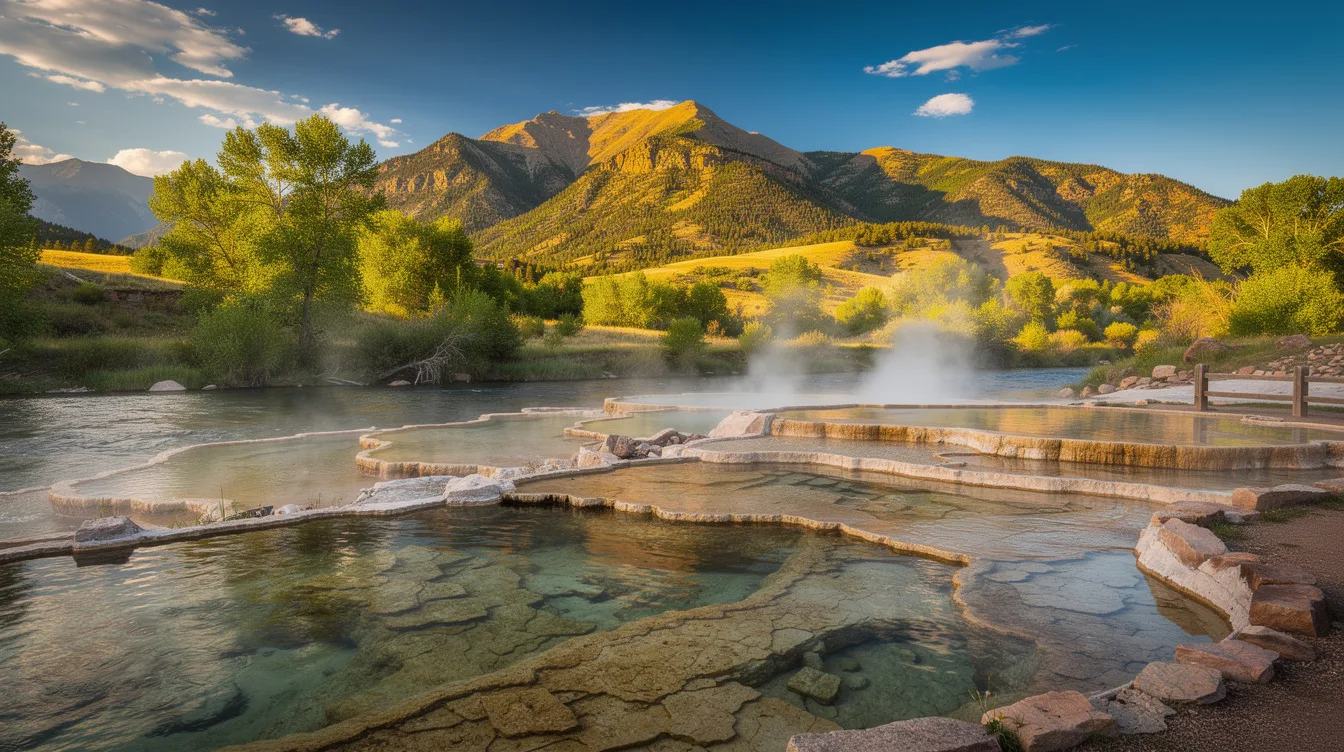
Pagosa Springs is overlooked in Colorado because it asks you to slow down. The town’s Mother Spring drops more than 1,001 feet below ground, a depth that gives this small mountain stop an outsized claim: it is presented as the world’s deepest geothermal hot spring.
And that depth isn’t a roadside curiosity. The Mother Spring feeds hot-spring facilities along the San Juan River, so you can spend an afternoon soaking above water that begins far below the town.
The Mother Spring is the reason to stop
The water at the Mother Spring is about 144°F, which explains why the primitive springs on the upper riverbanks aren’t for entering. They’re free to see, but extreme heat makes them a look-don’t-touch experience.
But the developed pools solve that problem. The Springs Resort & Spa, Healing Waters Resort, and Overlook Hot Springs Spa use the geothermal water for soaking, giving you several ways to experience the town’s defining feature without guessing where it is safe.
You’ll notice the contrast quickly. The source itself is raw and sulfur-rich, while the soaking pools turn that force into an easy end-of-day ritual. This isn’t a place for rushing through one photo and leaving.
And the spring’s depth answers the title’s promise early: more than 1,001 feet below Pagosa Springs sits the geothermal source that supplies the town’s hot-water identity. It is a remarkable fact, but the better part is how quietly the town puts it to use.
At 7,126 feet, take your first day slowly
7,126 feet above sea level changes the pace. If you arrive from lower elevation, hydrate, go easy on alcohol, and skip intense exertion on day one, especially if you plan to combine a hot soak with time outdoors.
But don’t mistake gentle pacing for boredom. The San Juan River runs through the middle of town, and Pagosa Springs sits at the foot of the San Juan Mountains. You can step from a riverbank view into warm mineral water without a long transfer.
The town had 1,571 residents in the 2020 census, so it feels more like a real mountain community than a resort strip. That’s the appeal for travelers who want a couple of quiet nights. It’s less convincing if you need polished shopping or late-night energy.
And there’s a practical reason to stay more than one night. The elevation can catch up with you, while the hot springs reward a slower schedule. Give yourself time for a soak after you’ve adjusted.
Summer trails, winter snow, one useful base
In summer, Pagosa Springs works best as a base for hiking, biking, fishing, river time, and camping in the surrounding San Juan National Forest. Summer highs average around 79°F, but evenings can feel cool at this elevation.
But autumn may be the smarter choice if crowds wear you out. Aspen color and quieter streets pair naturally with hot springs, and the town’s smaller scale feels like an advantage once the outdoor rush eases.
Winter has its own equation. Wolf Creek Ski Area is about 20 minutes away, so you can ski and then soak the same day. Snow and occasional pass closures can complicate plans, though, especially on US Highway 160 near Wolf Creek Pass.
You should check local fire restrictions, trail closures, and road conditions shortly before leaving. Dry conditions can change access, and mountain weather doesn’t care how neatly you planned the itinerary.
Getting there is simple, staying is the point
Pagosa Springs is 47 miles east of Durango on US Highway 160, in Archuleta County. Durango-La Plata County Airport is about 60 miles away, with a drive of roughly 1 hour and 15 minutes depending on conditions.
And the New Mexico border is about 35 miles south, which makes this an easy Colorado stop to fold into a wider road trip. Mesa Verde and Great Sand Dunes are also roughly two hours away, though that can make Pagosa feel like a convenient waypoint rather than a destination.
Can you make Pagosa Springs a short trip?
Yes, but two to four nights is the better fit. You can arrive, soak, and leave, yet the town makes more sense when you leave room for a river walk, a mountain day, and another unhurried session in the pools.
By the time evening cools the riverbanks, warm mineral water rises through town and the mountains fade into shadow. That’s when Pagosa Springs stops feeling overlooked and starts feeling properly scaled.