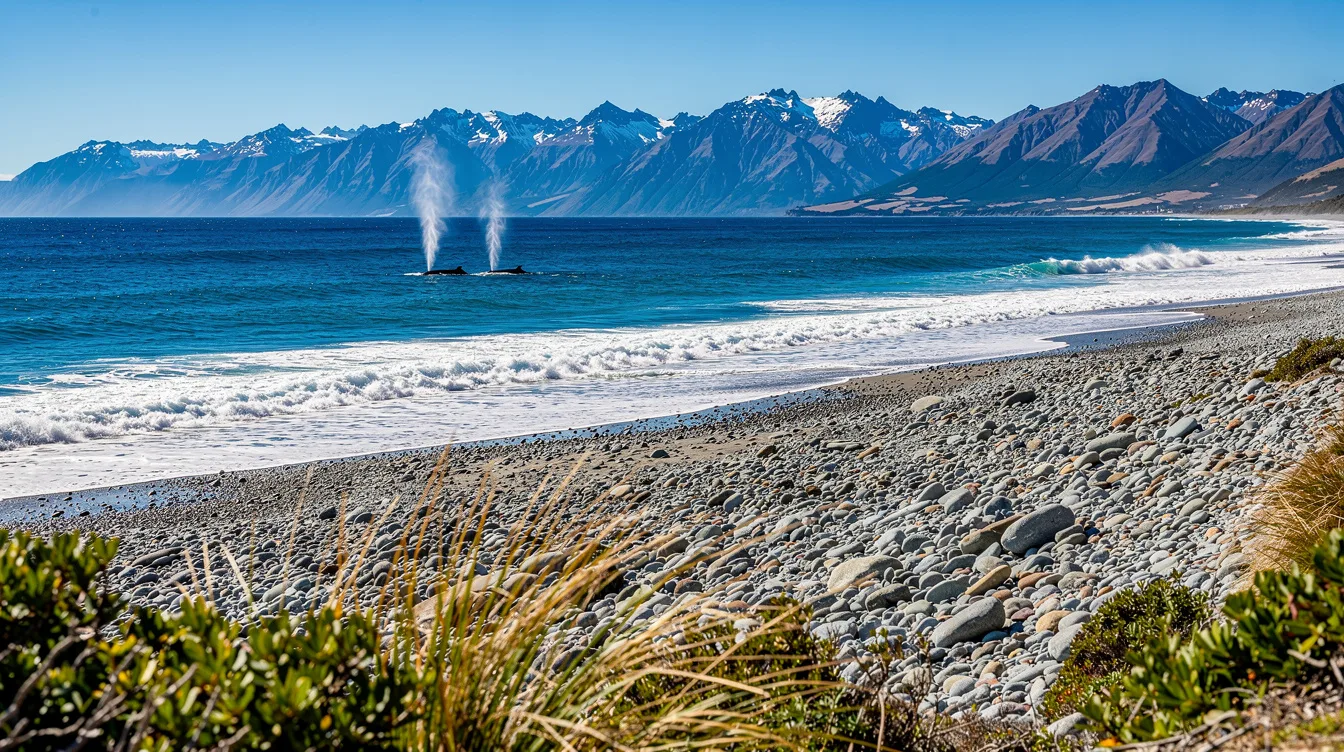
Kaikōura gets plenty of visitors, yet most South Island itineraries still treat it as a quick stop between Christchurch and Picton. That misses the point. Here, sperm whales can feed just 0.6 miles offshore, because the seafloor drops away with startling speed beside the Kaikōura Peninsula.
The town sits on New Zealand’s South Island east coast, where the Seaward Kaikōura Range rises straight behind the Pacific. You don’t come for polished resort energy. You come because mountains and deep water meet so abruptly that the view keeps asking you to look twice.
The canyon is the reason whales stay close
Kaikōura Canyon begins near the peninsula, with water around 98 feet deep at its head before it falls quickly. It reaches roughly 6,600 feet deep where it meets the Hikurangi Channel. That steep underwater drop brings the deep ocean unusually close to shore.
And that is why sperm whales can approach the coast. The canyon’s deep water is only one kilometer from the shoreline south of the peninsula, so you’re looking at an offshore wildlife experience without a long run into open water.
The canyon is also unusually productive, with 10 to 100 times the marine-life density recorded in other deep-sea habitats. That number explains Kaikōura better than any postcard phrase could. The water may look calm from shore, but there is serious activity below it.
Whale watching is only part of the water story
You can also encounter dusky dolphins, fur seals, and albatross around Kaikōura. The choice is pleasantly focused rather than overwhelming. If whales are your priority, make that the main event, then leave room to watch the coast from land.
But don’t expect wilderness solitude at every turn. Kaikōura receives around 1 million visitors a year, and whale watching is the draw. It feels popular because it is popular, though the town’s permanent population was estimated at only 2,350 residents in June 2025.
That contrast gives the place its particular rhythm. You might share a boat with travelers, then find yourself listening to surf below the peninsula cliffs. For you, that split is a benefit: there are established ways to get out on the water, without a large-city feel back on shore.
The Kaikōura Peninsula rewards slowing down
Kaikōura Peninsula Walkway is the land-based counterpoint to the boat trip, a popular clifftop route with ocean views and frequent seal sightings. The air can carry salt, and the sea below has that dark blue-gray weight of cold Pacific water.
And the mountains are always in the frame. The Seaward Kaikōura Range rises immediately behind the coastline, so even a simple coastal walk has a sharper backdrop than you’d expect from an east-coast town.
You should bring patience around wildlife and give seals their space. The payoff isn’t a guaranteed neat photo. It’s the odd pleasure of seeing a marine town work at two speeds, with the surf below and the road traffic passing farther inland.
Crayfish still matters here
The name Kaikōura combines Māori words for food and crayfish, which makes seafood more than a menu trend here. Crayfish remains part of the local economy and the town’s identity. If you order it, you’re tasting the food that gave the place its name.
But the history behind that seafood is not uncomplicated. Over-fishing contributed to crayfish declines in the mid-20th century, and Kaikōura’s earlier economy also depended on whaling. Today’s whale watching carries a different logic, built around seeing animals alive offshore.
You can feel that change in the town’s modern focus on marine visitors. It is a practical ecotourism base, not an invented fishing-village fantasy. That honesty makes it more interesting, especially when the same coast has held both extraction and observation.
Getting there requires a road check
Kaikōura is about 111.8 miles north of Christchurch on State Highway 1. Driving usually takes about two to two-and-a-half hours from Christchurch, depending on conditions. From Picton, the drive is roughly two hours.
And check current road and council updates before you leave. A tourism advisory flags severe-weather flooding and recommends avoiding non-essential travel, so this is not a destination to approach with a rigid timetable.
That said, the route is part of the appeal once conditions cooperate. By the time you reach Kaikōura, the mountains are close, the Pacific is beside you, and the canyon is already dropping into darkness less than a mile from shore.