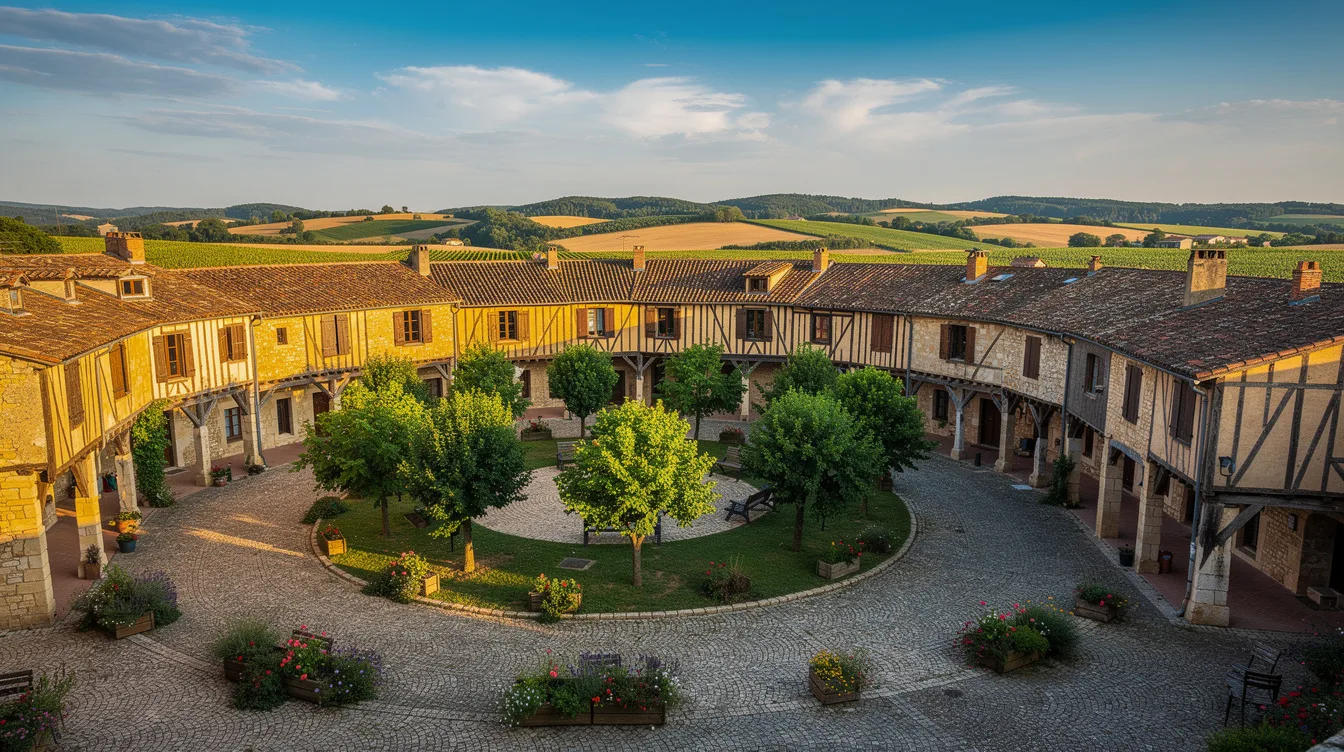
Fourcès is the kind of French village that makes a straight walk impossible. Overlooked by tourists, it has a round central square built on the site of an old castle, with half-timbered houses and arcades curving around it.
And that circle changes the way you experience the place. You don’t arrive at a grand avenue or a rectangular market square. You arrive at a compact medieval village in the Gers, near Castelnau-d’Auzan and Montréal-du-Gers, where every turn brings you back to the center.
I think the shape is Fourcès’s strongest argument. It feels orderly, but never formal, and the plane trees soften what could otherwise feel like a museum courtyard.
The round square explains everything
But Fourcès wasn’t planned like a classic bastide. It grew as an old castelnau, a settlement organized around a castle rather than a straight grid.
And the central circle occupies the former motte castrale and the site of the primitive castle. That castle was destroyed in the 15th century, yet its outline still controls the village today.
Walk slowly and look upward. The houses follow the curve in a way that makes the square feel enclosed, while the arcades create patches of shade along the edges.
You can read the history without rushing to a sign or museum. I prefer that kind of history, because the buildings explain the place before anyone explains them to you.
For a useful orientation before you go, the Gers Tourisme guide to Fourcès focuses on the village’s circular design and main sights.
Start at the clock tower, then let the village narrow your route
And the 13th-century Tour de l’Horloge gives the visit a clear starting point. It once served as an entrance into the town, so passing beneath it feels like crossing from modern roads into the older settlement.
But don’t treat the tower as a quick photograph. Stop beneath the opening, study the masonry, and notice how the passage frames the village beyond.
The church of Saint-Laurent adds a later layer. Built in 1875 over the remains of a 13th-century church, it has a neo-Gothic style and stained glass restored to match the earlier work.
If you like buildings with visible repairs and changes, you’ll find more to notice here than in a perfectly polished monument. I think Fourcès is at its best when several periods remain visible at once.
The village is small, with about 260 residents, and that scale matters. You can pause often without losing the thread of the place.
The old bridge leads toward a greener Fourcès
And the village doesn’t end at the square. The Auzoue borders the settlement, bringing a softer edge to the houses and opening the walk toward paths and arboretums.
But the riverbank isn’t a grand viewpoint, and that is part of its appeal. You get shade, vegetation, and a quieter rhythm after the close geometry of the center.
The old bridge dates from the 15th century. Cross it if you want to see Fourcès from another angle, where the clustered roofs and timbered façades feel less like a stage set.
You can also follow sections of the GR654, an itinerary connected with the routes to Santiago de Compostela. I like this contrast: a village shaped for defense now opens into walks beside the water.
April brings flowers, but the village doesn’t depend on an event
And the traditional Flower Market takes place on the last weekend of April. It fills the round square with a seasonal reason to visit, while keeping the castle site at the center of village life.
But you shouldn’t plan around the market unless you want that extra activity. Fourcès has enough architectural detail for a slower visit outside the event, and the peaceful atmosphere is easier to notice without a crowd.
For groups, the local tourism office offers a guided visit lasting one hour, with advance booking required. You can use that option if the castle site and village layout deserve more context than a self-guided walk provides.
There is no supplied distance from a major city, so plan by local landmarks rather than an invented driving time. Fourcès sits in the Gers region of Occitanie, near Castelnau-d’Auzan and Montréal-du-Gers.
The Plus Beaux Villages de France listing is another practical place to check before setting out.
Why the circle stays with you
And Fourcès earns its place among France’s recognized villages through one clear idea: a round square shaped by a vanished castle.
But its appeal isn’t only medieval. You notice the plane-tree shade, the cool passage beneath the tower, and the change from arcades to river greenery.
If you give yourself time to walk without a checklist, the village becomes easier to understand. I think that is the real reward, because the architecture works best as a sequence rather than a single sight.
By late afternoon, the square settles back into itself, with the old castle site hidden beneath the trees and the Auzoue moving quietly beyond the bridge.