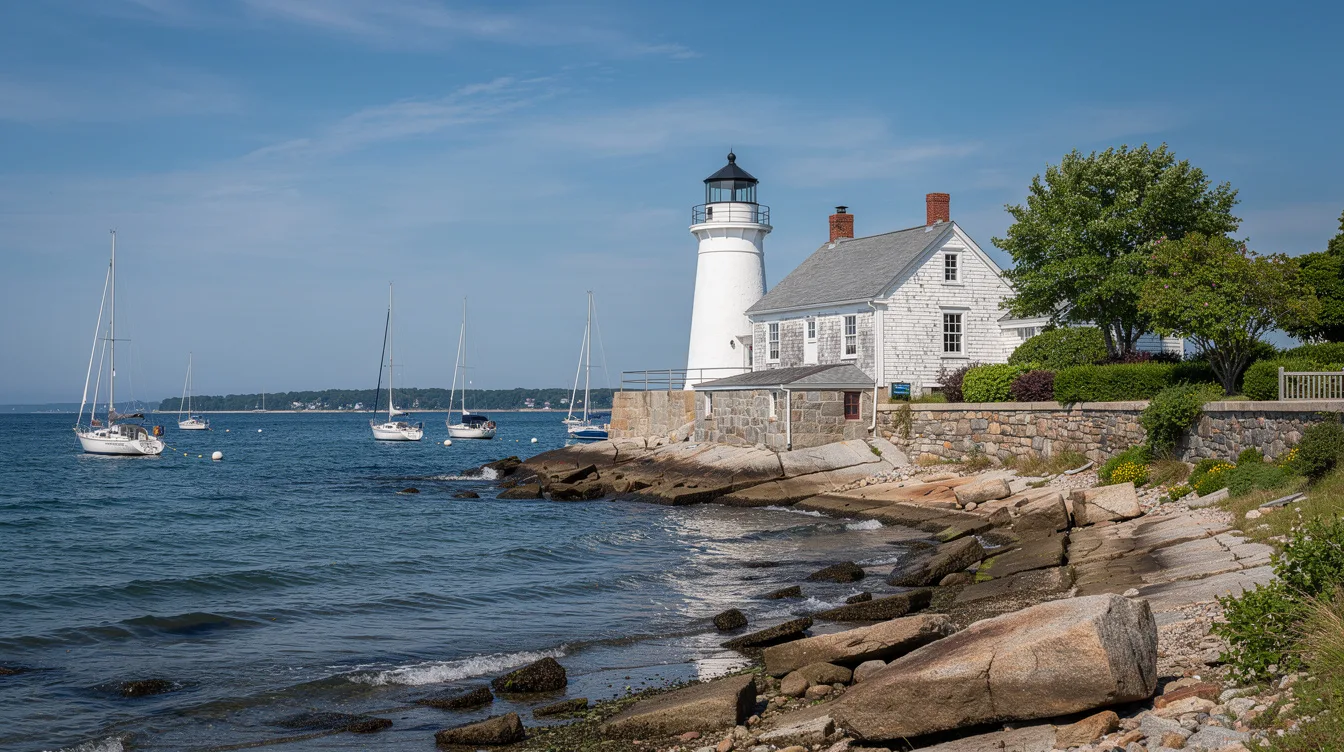
Stonington Borough sits on a narrow point in southeastern Connecticut, close to Rhode Island and about 10 minutes from Mystic. Coastal crowds often rush past it. That works in your favor, because the harbor still feels like a place with work to do.
At its tip stands the low stone Stonington Harbor Light, built in 1840. In 1925, it became America’s oldest lighthouse museum. The claim is simple, and the building makes it believable.
The Borough has just 976 residents, according to the 2020 Census. You can feel that scale on its compact streets, where water appears at the end of a walk and the commercial activity stays close to the harbor.
A lighthouse with a longer story than its size suggests
The Old Lighthouse Museum is the reason to come, especially if you prefer maritime history with salt on it rather than a polished waterfront production. It is a modest structure. But its small scale is exactly what gives the visit its force.
Stonington Harbor Light became the flagship museum of the Stonington Historical Society in 1925. Because the building once guided vessels into this harbor, its history is tied to the water outside rather than separated behind a distant exhibit wall.
And the Borough has carried that maritime identity for a long time. During the 19th century, Stonington supported fishing, whaling, sealing, and direct trade with the West Indies, then became a port of entry in 1842.
A small granite Customs House faces Main Street just north of Cannon Square. You do not need a packed itinerary here. Walk slowly, look toward the sound, then let the compact setting explain why this place once mattered.
Is the lighthouse museum worth a stop from Mystic?
Yes, if you want a quieter counterpoint to Mystic. Mystic is about 10 minutes away, but Stonington feels more residential and less built around the visitor’s schedule. The trade-off is that the Borough is small, so come for an unhurried walk rather than a full day of attractions.
And don’t expect grand scale. Expect stone, water, old streets, and a museum whose age is the point. For travelers who like places that reveal themselves without much announcing, that restraint feels refreshing.
The harbor is still a workplace
Stonington Harbor is sheltered between Little Narragansett Bay and Fisher’s Island Sound. Sailboats and working boats share the view, which keeps the waterfront from becoming a stage set for summer visitors.
Connecticut’s last remaining fishing and lobstering fleets operate here. That working presence changes the mood. The harbor is handsome, but it is not precious, and the smell of saltwater belongs to the job as much as the scenery.
But this is not a rough-edged port town either. Historic 18th- and 19th-century homes, independent shops, seafood restaurants, galleries, and cafés line the compact center. It is lively, but never loud in the way larger coastal stops can be.
The Borough covers about 0.7 square miles, and roughly half of that area is water. That geography keeps the experience intimate. You are rarely far from a harbor view, though the tight footprint also means you should enjoy wandering more than checking off sights.
Water Street and the main village streets connect Cannon Square and Wadawanuck Square. The architecture includes colonial, Federal, and Greek Revival homes. Because modern industry and heavy traffic largely bypassed the Borough, the streets have kept their close-set, old coastal rhythm.
History here was never entirely gentle
Stonington’s calm harbor has seen violence too. From August 9 to 12, 1814, British vessels bombarded the town during the War of 1812 after demanding its surrender.
The attack lasted three days. The town was damaged, though the account records one fatality, an elderly woman who was already mortally ill. It is a sharp contrast to the quiet water you see now.
And there had been an earlier attack during the American Revolutionary War, when British ships fired into the dock and stores. Local militia returned fire. The details make this waterfront feel less decorative and more hard-won.
That history is part of why the lighthouse matters. A light at the edge of a small peninsula is not just a charming object. It belongs to a town shaped by trade, defense, fishing, and the changing demands of the coast.
How to make Stonington a good coastal stop
If you are driving, the usual route is I-95 Exit 91. Rail travelers can look to Mystic, New London, or Westerly stations, then plan the final connection. The Borough is easy to reach by regional standards, but you will want a plan beyond the station.
Start at the lighthouse, then walk Main Street and the harbor. From there, Water Street gives you galleries, cafés, shops, and seafood restaurants without forcing you into a long route. You can keep the day loose, which is the best way to use this town.
The nearby Velvet Mill adds a different texture, with local businesses and makers in a former mill complex. It also hosts a seasonal Saturday farmers’ market. But the harbor remains the stronger reason to linger.
Stonington is not trying to compete with Mystic’s larger draw. It does something better for the right traveler: it leaves room for the sound of rigging, a low stone lighthouse, and working boats easing through the harbor.