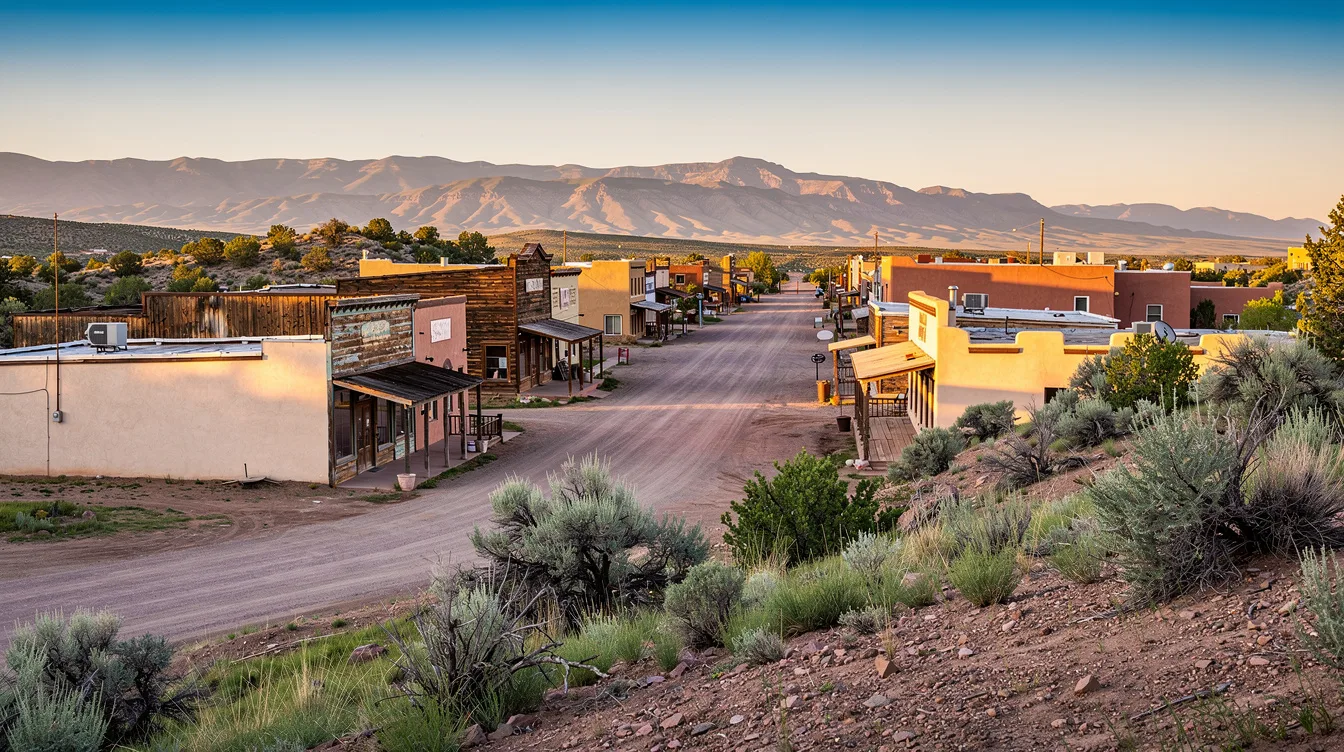
Madrid, New Mexico, sits only 27 miles from Santa Fe, but it doesn’t feel like a quick suburban detour. This former coal town nearly emptied after World War II. Then artists began moving in during the 1970s, turning its old main street into an arts community with a stubbornly independent streak.
It’s pronounced “MAD-rid,” not like Spain’s capital. And that small correction tells you what kind of stop this is: a place that rewards slowing down long enough to notice the difference.
A coal town that changed its mind
Coal made Madrid a significant company mining town in the late 19th and early 20th centuries. When demand fell around World War II, the town largely became a ghost town. The empty buildings mattered because they left room for a different kind of revival.
Artists arrived in the 1970s, and the former mining settlement began filling with galleries, studios, shops, and cafés. But don’t expect a polished arts district designed for a fast photo stop. Madrid feels more improvised than curated, which is precisely its appeal.
Today, the 2020 census counted 247 residents. That small number gives the main street its scale. You can browse at your own pace, hear a door open down the block, and avoid the feeling that every storefront is competing for your attention.
Is Madrid worth more than a quick stop?
Yes, if you give it a half-day. The research points to Madrid as a relaxed road-trip stop rather than a place needing several days, and that’s the right expectation. You’ll get more from lingering over the studios and cafés than from trying to turn it into an all-day itinerary.
Follow State Road 14, not the interstate
Madrid is on New Mexico State Road 14, the Turquoise Trail Scenic Byway. The route runs between Albuquerque and Santa Fe as an alternative to I-25, so the town makes sense as part of the drive rather than a separate expedition.
It is about an hour north of Albuquerque. And because it sits between the two cities, you can fold it into a Santa Fe day without committing to a long backtrack.
The approach is part of the point. A scenic byway asks you to trade speed for a little more attention, and Madrid gives that choice a useful payoff: a walkable historic main street where you can step in and out of independent businesses.
The main street is the itinerary
Start by browsing the independent galleries, studios, shops, and cafés along the historic main street. You don’t need a strict route here. Let the windows decide, then give yourself permission to stop when something pulls you inside.
The Madrid Old Coal Town Museum is the essential history stop. Visit it early if you want the galleries to mean more afterward. The town’s shift from coal mining to art lands differently once you understand that the revival grew from a place that had largely been left behind.
Then stop at the Mine Shaft Tavern, one of Madrid’s signature historic venues. It’s a sensible pause, especially after the museum, because it keeps the day rooted in the town’s older identity instead of treating every storefront as interchangeable.
But Madrid isn’t a place to rush through with a checklist. The best version of this visit is loose. Browse a gallery, sit at a café, walk back past a shop you skipped, and let the little breaks make the afternoon.
What to expect before you go
This is an arts community in a tiny former mining settlement, not a full-service city. That intimacy is the draw, but it also means you should arrive with modest expectations and treat Santa Fe or Albuquerque as your larger base for the trip.
And don’t confuse it with the Spanish capital when you search directions. Santa Fe County is the Madrid you want, on State Road 14 southwest of Santa Fe.
The strongest reason to go is simple: Madrid makes the drive between two major New Mexico stops feel less efficient and more memorable. By the time you return to the road, the old main street has done its work, with art behind the windows and the mining town still visible underneath.