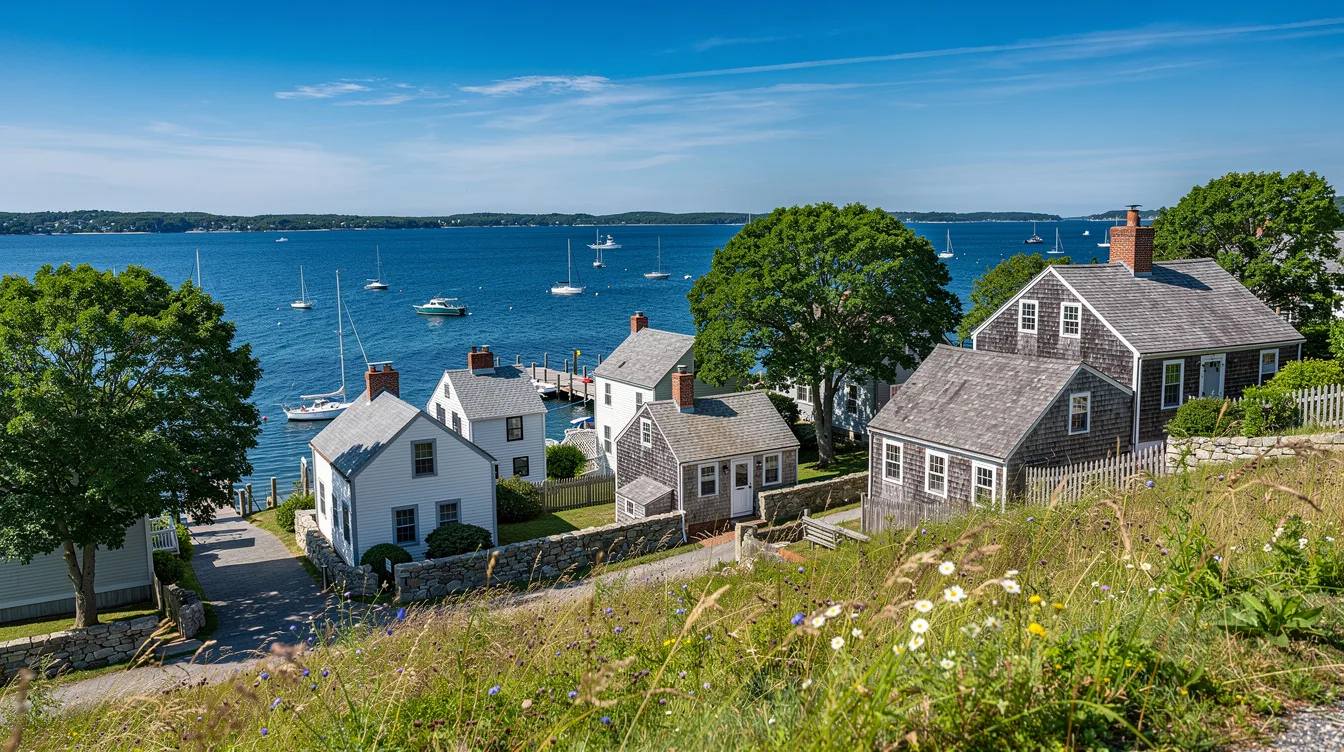
Nearly 300 homes in Marblehead’s historic district predate the American Revolution. That’s the reason to come. This Massachusetts town feels less like a museum than a working harbor where salt air slips between old wooden houses.
Marblehead sits about 18 miles northeast of Boston, on Massachusetts Bay in Essex County. You can reach it in 30 to 45 minutes by car, traffic permitting. But the streets tighten quickly, so leave the car parked once you arrive.
A colonial town built for wandering
The town was founded in 1629, and its Old Town still makes that date feel unusually close. Narrow lanes curve past weathered facades and small corners of harbor light. You should walk without an agenda here, because the best turns are often the least obvious.
And the central claim holds up on the ground: nearly 300 pre-Revolutionary homes remain in the historic district. They aren’t arranged behind ropes. They’re part of a residential town, which makes the experience more intimate but asks visitors to be considerate.
The buildings are the draw, yet Marblehead isn’t frozen in place. Doors open, cars edge through, and the harbor keeps calling attention away from history. That tension works.
You get the old woodwork and the ordinary rhythm of a place where people still live.
The harbor is where Marblehead loosens up
Marblehead Harbor is the visual center of town, filled with sailboats and framed by Marblehead Neck. The water changes the mood of Old Town immediately. After the close streets, the open harbor feels like a long exhale.
And this is a sailing town with an opinion about boats. Marblehead calls itself the “Yachting Capital of the World,” a bold claim that makes more sense when masts fill the view and the breeze taps lines against their poles.
You don’t need to sail to enjoy it. Walk the waterfront, pause at the docks, then look across toward the Neck. It’s lively, but rarely city-loud.
The sound is mostly rigging, gulls, and conversations carried briefly over the water.
But don’t expect a resort strip. Marblehead is residential and polished, with more harbor atmosphere than nightlife. If you want packed entertainment, this town will feel quiet.
If you want a coastal afternoon with room to breathe, that restraint is its advantage.
Three stops that explain the town
Abbot Hall, with its clock tower, gives you a clear landmark after Old Town’s crooked lanes. Inside is a large reproduction of The Spirit of ’76. The building connects Marblehead’s local streets to the larger story of the Revolution without turning the visit into a lecture.
From there, head to Fort Sewall, an old military site overlooking the harbor and ocean. The position explains itself once you stand there. Wind reaches you first, then the wide water and the clustered roofs behind it.
At Chandler Hovey Park, Marblehead Light Tower puts a clean punctuation mark on the point. This is where you go for the outward-facing view. But it’s more exposed than the harbor, so bring a layer when the breeze is up.
You can also visit the Jeremiah Lee Mansion, an 18th-century Georgian home tied to the town’s maritime wealth. Its appeal is specific, not broad. Go if old houses interest you, skip it if you’d rather stay outside near the water.
Summer brings beach time, not a beach-town makeover
Devereux Beach is Marblehead’s main beach and the practical summer stop. It gives you sand and a break from walking, especially after Old Town’s hard pavement. But Marblehead is still a historic harbor town first, not a sprawling seaside resort.
Summer is the best season if you want that beach pause alongside harbor walks. The town’s rocky coves and sailing culture are part of the appeal, too. You’ll get more from the day if you treat the beach as one chapter, not the whole itinerary.
For a quieter coastal walk, Marblehead Neck Wildlife Sanctuary offers a different pace from the streets and docks. You can trade clapboard houses for shore-side nature without leaving town. That contrast keeps the visit from becoming one long architecture tour.
Getting there without overcomplicating it
If you’re coming from Boston, drive when you can. Public transit usually means taking the MBTA commuter rail to Salem, then a taxi or rideshare for roughly 10 minutes. The total trip is about 45 minutes, so Marblehead works well as a day trip.
And Salem is the natural pairing if you want more history and harbor time in one outing. Marblehead feels calmer by comparison, though it’s not empty in summer. Start early, walk Old Town before the day warms, then let the harbor slow you down.
By late afternoon, sailboat masts darken against the water, and the narrow streets begin to feel quiet again.