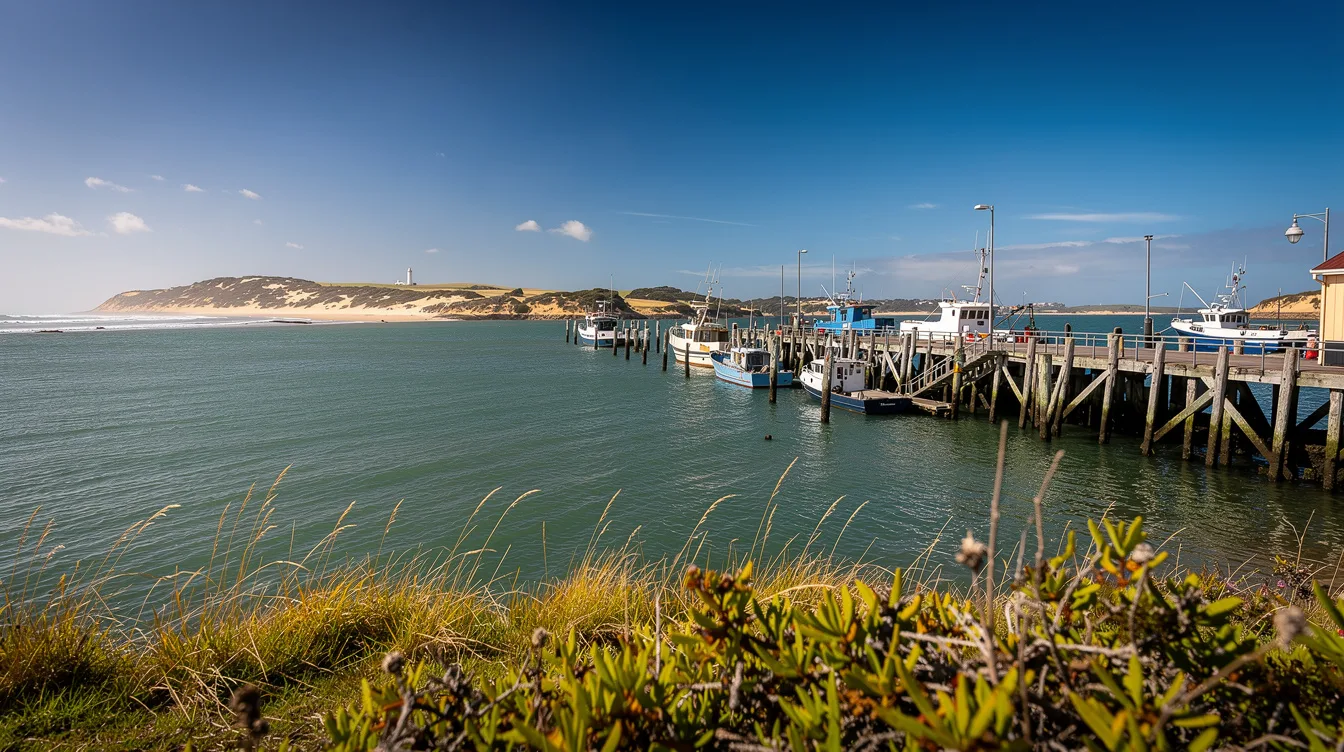
Port Fairy is the small Victorian town where the Port Fairy Folk Festival has returned every year, without interruption, since 1977. That continuity matters because this isn’t a town borrowing a festival mood for one weekend. Each March, music becomes part of a place already shaped by boats, bluestone cottages, and the Southern Ocean.
You’ll find it in southwest Victoria, where the Moyne River meets the coast. And the setting helps explain the pull: fishing boats sit on the river while broad streets lead toward salt air and old Norfolk pines.
A March tradition with real staying power
The festival takes place during the Labour Day long weekend in March. It has run continuously since 1977, which gives Port Fairy a claim many larger destinations can’t make. The annual return is the story, not a new event chasing attention.
But March requires some planning. Festival time brings a fuller town, so accommodations should be booked early. You’ll trade spontaneity for the rare pleasure of seeing a quiet coastal town move to a different rhythm.
For visitors, the appeal is the contrast. Port Fairy feels calm for much of the year, then the festival gives its historic streets a reason to stay awake after dark. And because the event arrives during a long weekend, it suits a slow stay better than a rushed stop.
Fifty protected buildings give the town its texture
Port Fairy has 50 buildings protected by the National Trust of Australia. That number is more useful than a vague claim about character, because you can feel the difference while walking the center: stone cottages, older churches, and wide streets remain part of daily life.
Sackville Street and Bank Street are good places to wander without an agenda. But don’t expect a polished historic set. These are working streets with cafés and residences, which keeps the town lived-in rather than overly staged.
The town was once called Belfast, and it developed through maritime activity in the 19th century. It later became Port Fairy again. The harbor history still shows in the active fishing fleet along the Moyne River, where ropes, hulls, and tidal water give the center a sharper edge.
Griffiths Island is the walk to save for late light
Griffiths Island is the easiest coastal escape from town, with dunes, ocean views, and its white lighthouse. Go late in the day if you can. The lower light softens the sand and makes the water look colder than it is.
And this is the kind of walk that can quietly take over an afternoon. You can hear the wind before you reach the more exposed sections, while the town drops behind you. The island also has a breeding colony of short-tailed shearwaters.
East Beach is the convenient choice near the center if you want time by the water. Beyond the river mouth, the Shipwreck Coast feels more open and less contained. But conditions on this coast can be changeable, so the beach is best treated with respect rather than as a guaranteed lazy-day plan.
It’s far from Melbourne, which is part of the point
Port Fairy sits 180.2 miles west of Melbourne and 17.4 miles west of Warrnambool. That distance makes it a proper destination, not a quick detour. From Melbourne, the drive takes about 3 hours 30 minutes to 4 hours, depending on the route and stops.
You’ll want at least one night here. Two is better if you want room for the harbor, the island, and nearby Tower Hill Wildlife Reserve. The reserve is an old volcanic caldera where emus, kangaroos, koalas, and birds can often be seen.
But Port Fairy works best when you don’t overfill the schedule. Warrnambool may be closer for practical needs, yet Port Fairy has the quieter base-camp feeling. You can spend the morning walking, then let the river and harbor decide the rest.
A coastal town that knows when to be quiet
The town stands on the traditional lands of the Eastern Maar People. That context belongs in any visit, because Port Fairy’s older story did not begin with its cottages or its colonial port.
Outside festival weekend, Port Fairy’s pleasures are simple and convincing: a walk beside the Moyne, a slow look at the old stonework, and the ocean close enough to smell. It’s lively in March, but never asks you to hurry through it.
By the time the last light falls around Griffiths Island, the lighthouse is white against the dimming coast and the sound of the water carries back toward town.