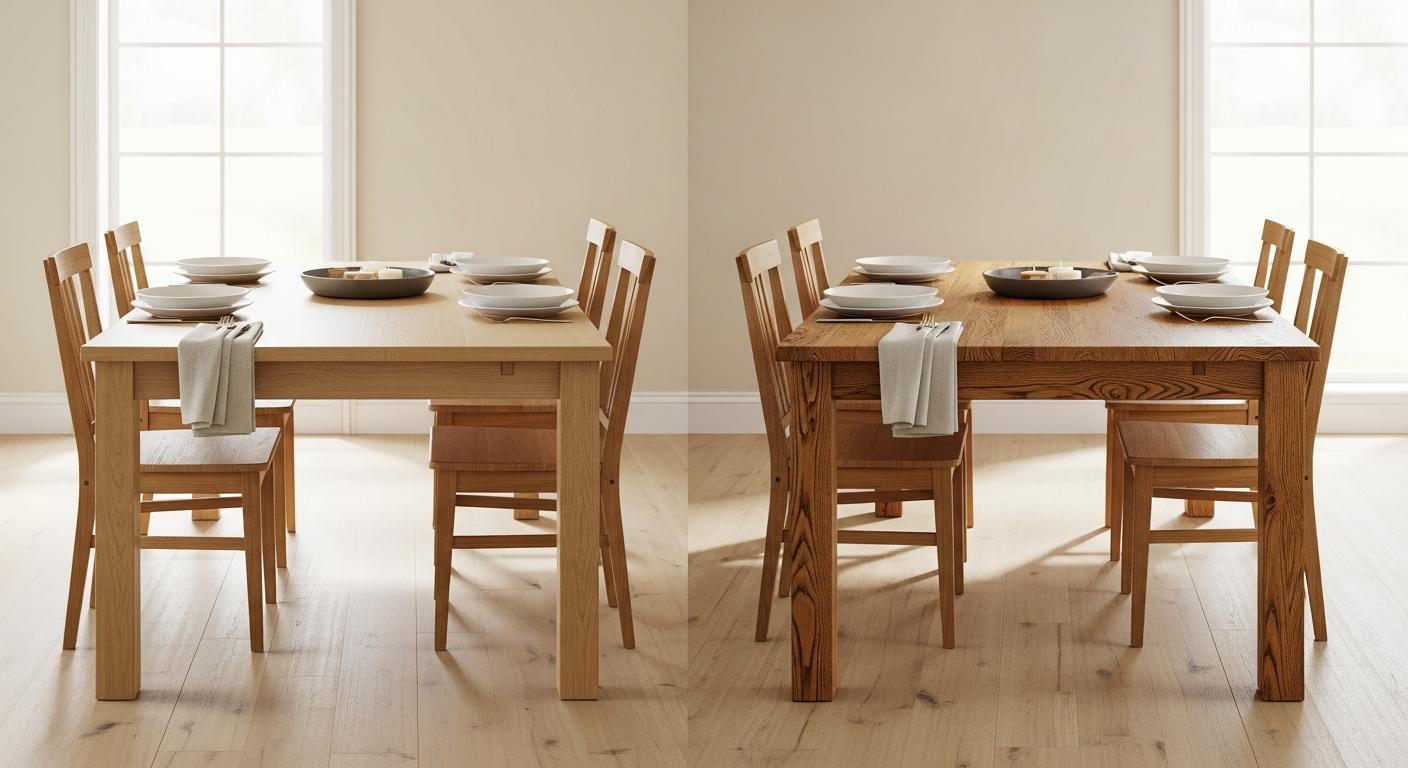
Your lease ends in three months, and you’re calculating whether the IKEA MÖRBYLÅNGA you bought for $490 should move with you or get sold for half that on Facebook Marketplace. The table seats eight without anyone’s elbows touching and survived a year of dinner parties without visible damage, but it weighs 112 pounds and your new place is a fourth-floor walkup. Your coworker’s Article table cost $800 two years ago, moved once already, and photographs like furniture that belongs in a loft, but she warned you about the weight. Which investment was smarter depends entirely on one variable neither of you measured before buying: how long the table needed to last.
The answer isn’t about which brand makes better tables. It’s about matching furniture to your actual life, not the life you think you should have.
IKEA wins when your zip code changes more than your taste
Renters moving every two to three years need tables that survive disassembly without falling apart. IKEA’s flat-pack engineering optimizes for reassembly, and the MÖRBYLÅNGA’s cam lock system holds up through at least two moves before you notice any loosening. At 112 pounds for a table that seats eight, two people can navigate stairs without hiring movers.
Article’s solid oak construction adds weight that renters feel immediately. One furniture analyst who tested both brands notes the Article pieces are “wildly heavy, don’t make the same mistake I did” after attempting a solo carry. The oak doesn’t compress for shipping, so what arrives is what you’re stuck moving forever.
If you’ve signed three leases in four years, IKEA’s move-friendly design saves approximately $300 in moving costs compared to Article’s furniture-that-stays-put weight. That offsets the initial price difference entirely by your third relocation. And you’re not worrying about scratching $800 worth of oak while cramming it through a narrow hallway.
Article wins when you’re willing to trade assembly time for furniture that feels expensive
Article’s instruction manuals assume patience you might not have on a Saturday morning. Design experts who’ve built both brands report Article tables require 90 minutes average assembly time versus IKEA’s 45-minute builds. Article uses traditional wood joinery with dowels, wood glue, and cam bolts through solid lumber, which creates stronger joints but demands precision alignment.
IKEA’s particleboard core forgives minor misalignment during assembly. Article’s hardwood doesn’t forgive rushed work, and one crooked leg means starting over. But that’s the trade for a table that looks like it cost twice what you paid.
The material difference shows up around the 18-month mark, not immediately. IKEA’s oak veneer over particleboard looks identical to Article’s solid oak until someone sets a hot pan directly on the surface without a trivet. The veneer bubbles. The particleboard underneath swells from moisture because there’s nothing solid beneath that thin top layer. Article’s oak absorbs the same heat without visible damage because the material goes all the way through, not just on top.
When veneer stops being enough
Interior design specialists featured in major shelter publications call the MÖRBYLÅNGA “super sturdy for budget-conscious homes,” but qualify that assessment with real limits. This works if you’re not planning to refinish in 2035 and you treat the surface gently. The veneer is typically 0.8mm thick, which sounds like nothing because it practically is nothing.
That thinness makes the table affordable. It also means you can’t sand out scratches or restore the finish after years of use. Layering the table correctly helps protect that vulnerable surface from daily wear.
IKEA’s extendable options beat Article when dinner guests are unpredictable
The IKEA PS 2012 Drop-Leaf extends from 29 inches to 73 inches in about twelve seconds. Unfold the sides, lock the support legs, and you’ve converted a table for two into seating for eight. Article doesn’t manufacture comparable extension mechanisms because solid wood expansion systems add $400 to $600 to manufacturing costs.
For families hosting erratically, that flexibility compensates for material limitations. You’re not storing a massive table in a 150 square foot dining area when you eat alone six nights a week. But Thanksgiving still works without renting folding tables.
Price-per-seat calculations shift depending on how you actually use the space. IKEA MÖRBYLÅNGA at $490 seats eight to fourteen comfortably, which works out to $35 to $61 per seat. Article tables at $800 seat six to eight, putting you at $100 to $133 per seat. But if you host monthly dinners for six, Article’s per-use cost drops while IKEA’s unused extension capacity becomes wasted square footage. Understanding spatial requirements matters before you commit to either size.
Article wins the ten-year game but only if your aesthetic doesn’t shift
Solid oak develops patina over time. Scratches blend into character rather than exposing honeycomb particleboard. Article tables purchased in 2019 show minimal wear after five years according to long-term furniture testing, while equivalent IKEA pieces from the same period show corner chipping and surface bubbling from standard use.
The material science is straightforward. You can refinish Article’s oak in 2035 if your taste holds steady. You cannot refinish IKEA’s veneer without exposing the core, which looks exactly as cheap as it is. Furniture specialists position Article as “four times cheaper than Restoration Hardware with comparable quality,” making it the midpoint between disposable and heirloom.
That’s the real bet. Will you still want this particular table design in a decade? Matched dining sets photograph differently as trends evolve, and solid wood locks you into one look for years.
Your questions about IKEA tables vs Article answered
Can IKEA tables survive a cross-country move?
Yes, if you disassemble properly and keep all original hardware. The MÖRBYLÅNGA’s cam lock system tolerates two full disassembly cycles before thread wear becomes noticeable. After three moves, expect minor wobbling that wood glue stabilizes temporarily, but not permanently.
Article’s dowel-and-bolt joinery survives more moves because solid wood doesn’t compress around metal fasteners the way particleboard does. But you’re still moving that weight, which professional movers price at $150 to $200 extra per floor.
Does Article’s solid wood justify the price premium for renters?
Only if you’re moving fewer than three times in five years. Calculate $150 per move in saved labor costs from IKEA’s lighter construction versus Article’s longer lifespan. For renters staying four-plus years in each location, Article’s durability wins. For annual movers, IKEA’s replaceability beats repair costs because you’re not emotionally attached to $490 the way you are to $800.
Which brand offers better protection for surface damage?
IKEA provides a 10-year limited warranty on MÖRBYLÅNGA covering material defects but not user damage like heat marks or scratches. Article offers a 1-year standard warranty with a 30-day exchange policy for any reason, but their solid wood allows third-party refinishing that effectively extends functional life beyond warranty coverage. IKEA’s smart design solutions show up across categories, but warranties remain limited compared to custom furniture makers.
Late afternoon light hits the dining table’s surface at an angle that shows you exactly what you bought. Your hand rests on wood grain that’s either less than a millimeter deep or goes all the way through. Only one of those surfaces will look the same in 2036, still catching that same light.