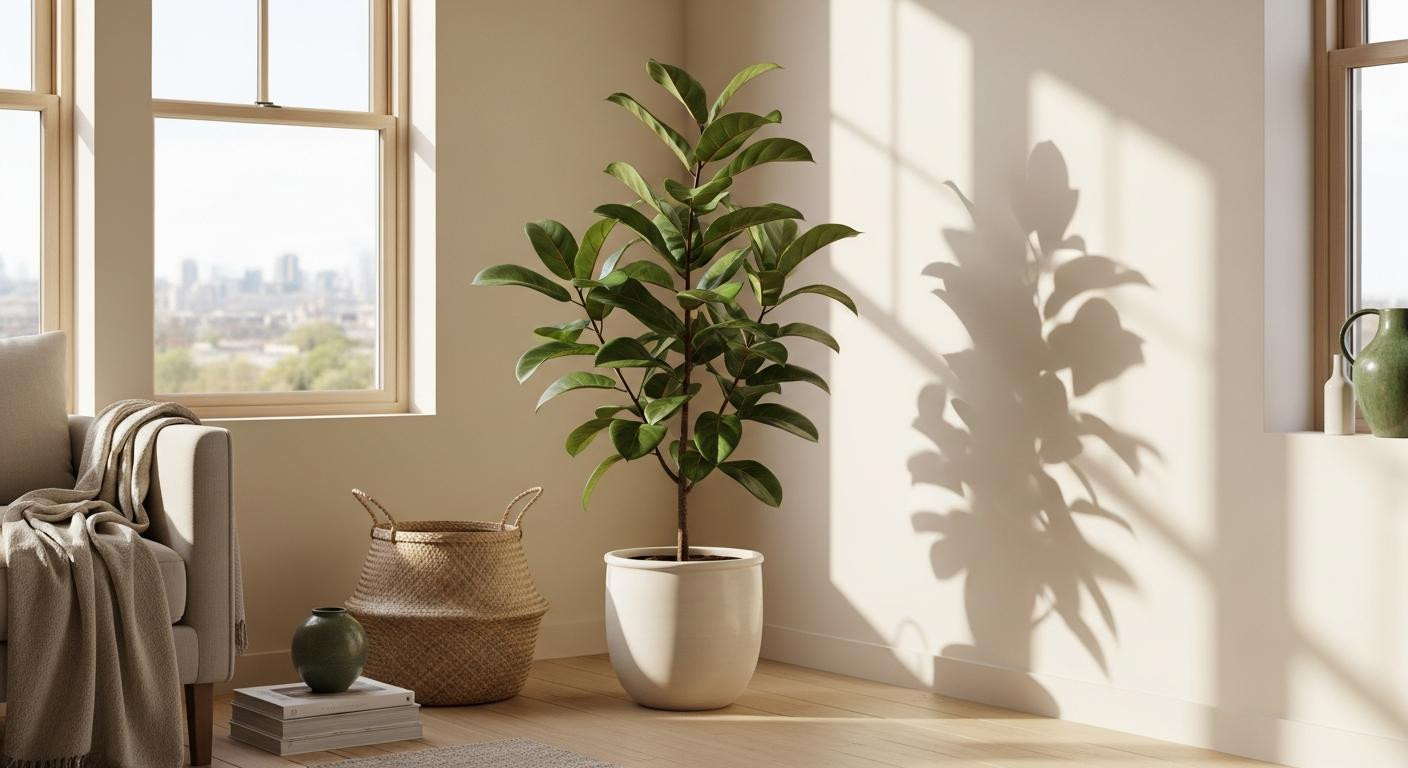
The fiddle leaf fig in your living room corner dropped four leaves last Tuesday. You watered it on schedule, rotated it 90 degrees, checked the soil moisture with your knuckle. But Ficus lyrata evolved in West African rainforests where light filters through triple canopy layers, and your north-facing apartment window delivers 180 lux on a sunny afternoon when the plant needs closer to 400. Four alternative species tolerate your actual conditions without demanding weekly attention and a light meter app. You lose that Instagram-famous paddle silhouette but gain plants that stay alive past June.
Audrey ficus cuts light needs by half but the leaves feel different
Your fingertips on an Audrey ficus leaf feel soft texture, almost suede-like, where a fiddle leaf’s surface is stiff and waxy. That velvety finish collects dust visibly, requiring monthly wipe-downs with a damp cloth instead of quarterly cleaning. But Ficus benghalensis tolerates 200 lux instead of 400, which makes it survivable in corners where fiddle leafs turn brown and drop.
The plant grows to the same 6 to 8 feet indoors but branches naturally, creating a bushier form that reads less “single dramatic statement” and more “collected over time.” The Sill sells 3-foot specimens for $79, while Target’s smaller versions start at $35. Design experts featured in ELLE Decor note that Audrey’s matte leaves lack the architectural punch of fiddle leaf paddles, but they don’t punish you for taking a vacation.
Rubber plants tolerate neglect but variegated varieties need rotation
Ficus elastica ‘Tineke’ grows pink-cream variegation along leaf edges, and those lighter sections contain less chlorophyll. That means the plant leans toward brighter spots, requiring quarterly 180-degree turns to prevent one-sided growth. Standard dark-green rubber plants skip this maintenance entirely and handle the same monthly watering schedule that fiddle leafs can’t survive on.
IKEA’s variegated specimens cost $49 compared to $28 for solid green versions. But rubber plants spread 3 to 4 feet wide at maturity versus a fiddle leaf’s narrow 2-foot profile, which creates problems in corners tighter than 5 feet. Interior designers with residential portfolios warn that you need to measure your floor space before buying, not after the plant arrives and blocks your bookshelf.
The width factor matters in small apartments
And that width comes with compensation in open floor plans. Rubber plant trunks thicken to 1.5 inches versus a fiddle leaf’s 0.75-inch diameter, creating more substantial presence in spaces where spindly stems look unfinished. West Elm’s $120 premium specimens show trunk character immediately, while Amazon’s $42 versions need two years to develop that thickness.
Professional organizers with certification recommend transferring budget rubber plants to ceramic planters within two weeks of purchase. The nursery pot looks institutional, but a $40 to $60 container from CB2 or West Elm makes the glossy leaves read expensive instead of cheap.
Weeping figs shed leaves during transitions but stop after 3 weeks
Ficus benjamina loses 15 to 20 percent of its foliage when you move it from nursery greenhouse conditions to your apartment’s drier air. Botanists featured in Gardeners’ World call this “adjustment drop,” and it stops once the plant adapts to your 180-lux corner. Fiddle leafs do the same initial shed but never quit complaining about imperfect conditions.
HomeGoods sells braided-trunk versions for $65, where three stems were twisted together during early growth to add architectural interest that plain specimens lack. The catch is that branches grow thin and droopy rather than upright, requiring occasional pruning to maintain shape. But weeping figs work well in grouped arrangements where their graceful canopy fills space without demanding solo spotlight.
Monique variety solves the mess problem
Standard weeping figs drop leaves year-round like teenagers drop socks on bedroom floors. The ‘Monique’ cultivar has thicker foliage that holds longer, cutting your vacuuming schedule from weekly to monthly. This variety costs $15 to $20 more than standard benjamina but saves time in the trade-off.
Ficus altissima looks like fiddle leaf’s easier cousin because it basically is
The slim trunk and elongated leaves read as “fiddle leaf that someone stretched vertically” without the paddle drama. Plant experts with 300K+ Instagram followings call it the “dupe that shouldn’t work but does” because it tolerates 220 lux, waters every 10 days, and grows to 7 feet in three years versus a fiddle leaf’s five-year timeline.
Wayfair’s specimens arrive 4 feet tall for $89, while Amazon’s versions start at 2.5 feet for $55. The compromise is that leaves lack the oversized paddle presence, reading more understated in rooms where you wanted a bold focal point. Pottery Barn’s $120 “designer” option adds a terracotta pot but the plant inside is identical to cheaper alternatives.
And if your space gets less than 180 lux even at midday, none of these ficus alternatives will thrive. Download a free lux meter app and measure your corner at 2pm on a sunny day before buying anything taller than snake plants that actually survive darkness.
Your questions about easier fiddle leaf fig alternatives answered
Will my room look cheaper with a rubber plant instead of a fiddle leaf fig?
Only if you leave it in the $28 plastic nursery pot it arrived in. Horticulturists at residential garden centers recommend transferring to a ceramic planter within two weeks, which brings your total investment to around $100 for the same visual weight as an $89 fiddle leaf. The rubber plant’s glossy leaves and thick trunk read expensive when styled properly, not as a budget afterthought.
How do I know if my apartment has enough light for these alternatives?
Download Light Meter by EXO Apps for iOS, which measures lux within 15 percent accuracy for free. Check your corner at 2pm on a sunny day. Below 180 lux, stick with pothos or snake plants. Above 180, all four alternatives survive. Above 300, they thrive instead of just hanging on.
Can I mix a rubber plant with my existing fiddle leaf fig without looking confused?
Yes, but only if they occupy different room zones. Interior designers with ASID certification pair Audrey ficus in living room corners with fiddle leafs in high-light bedroom windows, keeping the species separated so the leaf shape contrast doesn’t create visual competition. Don’t cluster them together on the same wall where their different textures fight for attention.
Your hand on the Audrey ficus leaf at The Sill on Saturday morning, feeling that soft texture against your palm instead of waxy resistance. The $79 plant fits in your trunk. By Sunday afternoon it sits in the north corner where three fiddle leaf figs died, and this time the leaves stay on.