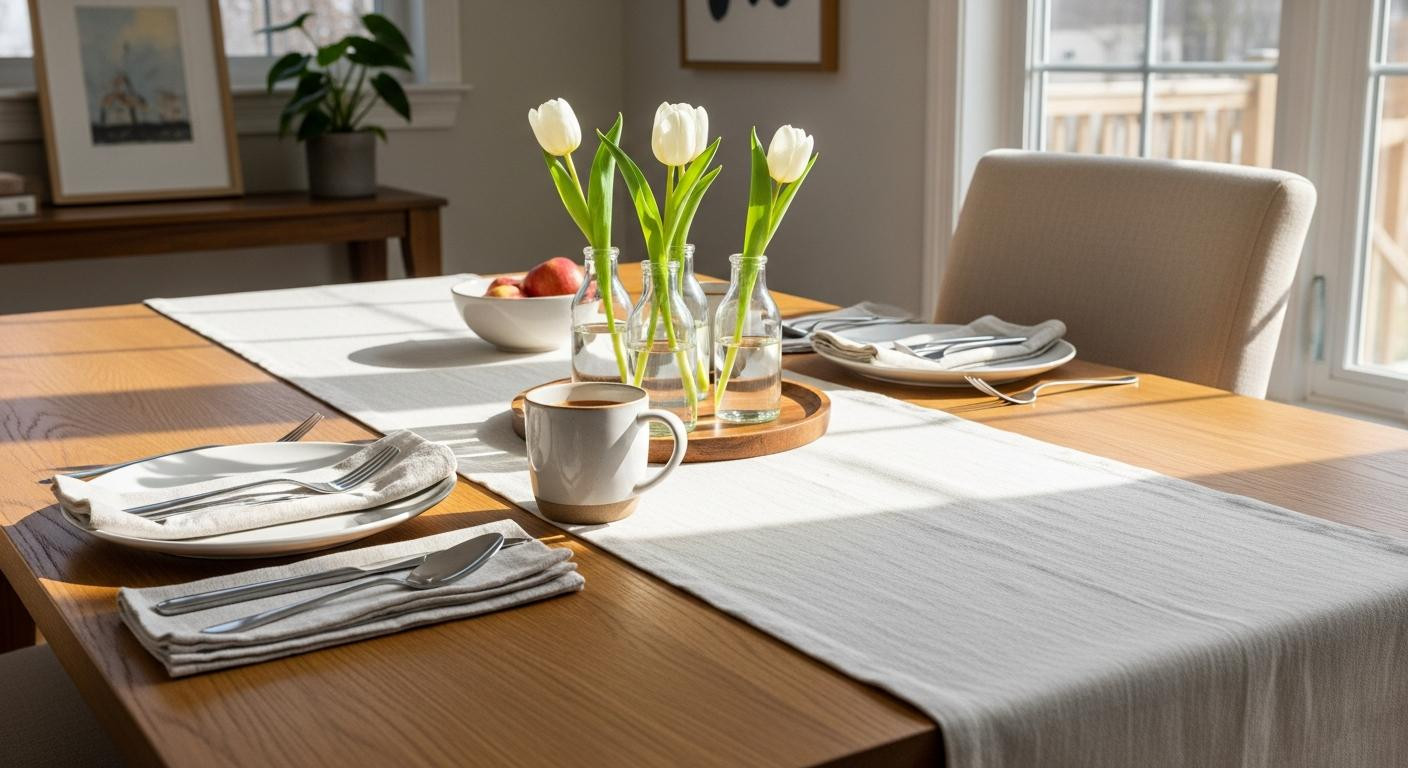
Your dining table on a Tuesday at 6:42pm when you set down the Trader Joe’s rotisserie chicken on the same white plates that have lived in this kitchen since 2019, and your nine-year-old asks if tonight is “a regular dinner or a special dinner” because the table looks identical to breakfast. The room holds $240 worth of chairs and a credenza from Article, but it photographs like a staging photo taken after the crew left. A $20 natural linen runner from Target arrived April 18th. By April 25th, the table felt different enough that your husband asked if you were expecting company.
The whole setup cost $47. That includes the runner, three glass bottles, flowers from Whole Foods, and a wooden tray from Goodwill that still had the West Elm tag attached.
The runner changed how light moved across the table
Natural linen in Target’s Threshold line catches overhead light differently than your polished wood surface did for eight years. The weave texture breaks up glare from the fixture 32 inches above the table, softening the 3000K bulbs you installed last fall. Where smooth wood reflected light in a single bright stripe down the center, linen scatters it.
The space feels less institutional, warmer by perception rather than temperature. The fabric’s natural slubs create micro-shadows that make the whole table feel handmade, less like builder-grade furniture. This only works if your table measures at least 60 inches long. Shorter surfaces make the runner look like a placemat stretched too far.
And the 14-inch width keeps the runner from dominating the visual field. It covers roughly 30% of a standard 6-foot table, leaving space for layering plates without cluttering the full surface.
Grocery store flowers looked expensive in $12 glass bottles
The Amazon Basics recycled glass bottle set ($11.99 for three, 8-inch heights) turned $15 of Whole Foods white tulips into something that photographed like the $140 arrangements in Domino magazine’s April 2026 issue. Splitting 12 stems across three vessels instead of clustering them in your existing ceramic vase changed the visual weight. The table felt curated rather than decorated.
Each bottle held 4 stems in 3 inches of water, enough to keep tulips upright for 6 days before they started drooping. The narrow openings forced stems into natural arrangements without fussing over angles or gaps. But tulips bend toward light, so by day four the stems curved toward your east-facing window in a way that looked intentional rather than sad.
Design experts featured in Architectural Digest recommend splitting florals across multiple small vessels for this exact reason. The distributed weight creates rhythm across the table surface, making even budget stems feel deliberate.
The thrift store tray anchored everything
The 18×12-inch acacia tray from Goodwill ($6.50, original West Elm tag still attached) created a boundary that made the bottles and runner feel intentional. Without the tray, three small bottles looked scattered across linen like you forgot to put them away. The wood’s warm brown played against linen’s cool beige, adding depth your table lacked when everything matched the honey oak finish underneath.
That contrast is what makes mismatched elements feel warm instead of cheap. The tray confined the floral arrangement to a defined zone, which paradoxically made the whole table feel more open. And it solved the practical problem of water rings from glass bottles soaking into raw linen.
What the $47 total actually bought
Four consecutive weeknights showed how the runner and flower setup changed the room’s emotional temperature. Tuesday’s reheated pasta felt less like survival mode when served on linen. Thursday’s salad from a bag didn’t photograph like defeat when centered on fabric texture. The flowers lasted 8 days before petals started falling, which spread the $15 cost across 16 meals at $0.94 per dinner.
But the setup demands your table stays cleared. Leaving mail or your son’s homework on linen makes it look messy faster than bare wood did. The runner needs ironing every 10 days to maintain that crisp boutique look. Crumpled linen reads as laundry, not decor.
Fresh flowers require grocery runs every Sunday, which adds $60 monthly to your budget if you keep this going. Admittedly, that’s easier said than done in February when tulips cost $28 at Whole Foods instead of $15 in spring.
The table doesn’t fix Tuesday itself
Your nine-year-old still asks for screen time during dinner. The chicken still comes from Trader Joe’s. But the space where you eat it stopped feeling like a placeholder, started feeling like a room that knows what it wants to be.
Linen and flowers don’t solve meal planning or work stress. They solve the visual blandness that makes everyday dinners feel temporary, like you’re just passing through your own house. That shift costs $47 and takes 20 minutes to set up. The emotional return lasts as long as you’re willing to buy flowers every 8 days and iron fabric every other week.
Your questions about spring tablescape: fresh flowers and natural linen for under $50 answered
Does this only work on farmhouse tables?
The linen runner reads modern-minimal on glass, warm-traditional on wood, and budget-conscious on laminate. It’s the texture doing the work, not the table material. Your existing surface matters less than clearing it completely before adding fabric.
Tested on a 2015 IKEA Lerhamn ($129 oak veneer) and a friend’s CB2 glass top ($499), the setup shifted both rooms toward expensive-looking without requiring matching furniture. And the neutral beige works with whatever overhead fixture you already own.
What if my table seats 8 and I need the full surface for meals?
The 14×72-inch runner covers roughly 30% of a standard 6-foot table, leaving space for 6 plates. For 8-person setups, remove the runner before serving or use it as a centerpiece strip with place settings on bare wood at each end. The runner becomes decor between meals, not a permanent fixture during them.
Professional organizers with certification confirm this approach mirrors how styled homes actually function. Nothing stays precious when you’re feeding kids mac and cheese on a Wednesday.
Can I skip fresh flowers and use faux stems?
Faux florals from Michaels ($24 for preserved eucalyptus) last 4+ months but photograph flatter than real blooms. The trade-off is longevity versus the depth real petals create in photos. If your table’s primary job is looking good on camera for 10 seconds, real flowers win.
If you need something that survives three kids and daily homework chaos, preserved stems cost more upfront ($38 versus $15) but don’t require weekly replacement. That’s where the maintenance mindset shifts from stressful to practical.
Saturday morning light hits the table at 9:14am, catching linen texture and the white tulips’ waxy petals where they bend toward the east window. The wood underneath still shows a water ring from 2022, but your eye goes to the flowers first now.