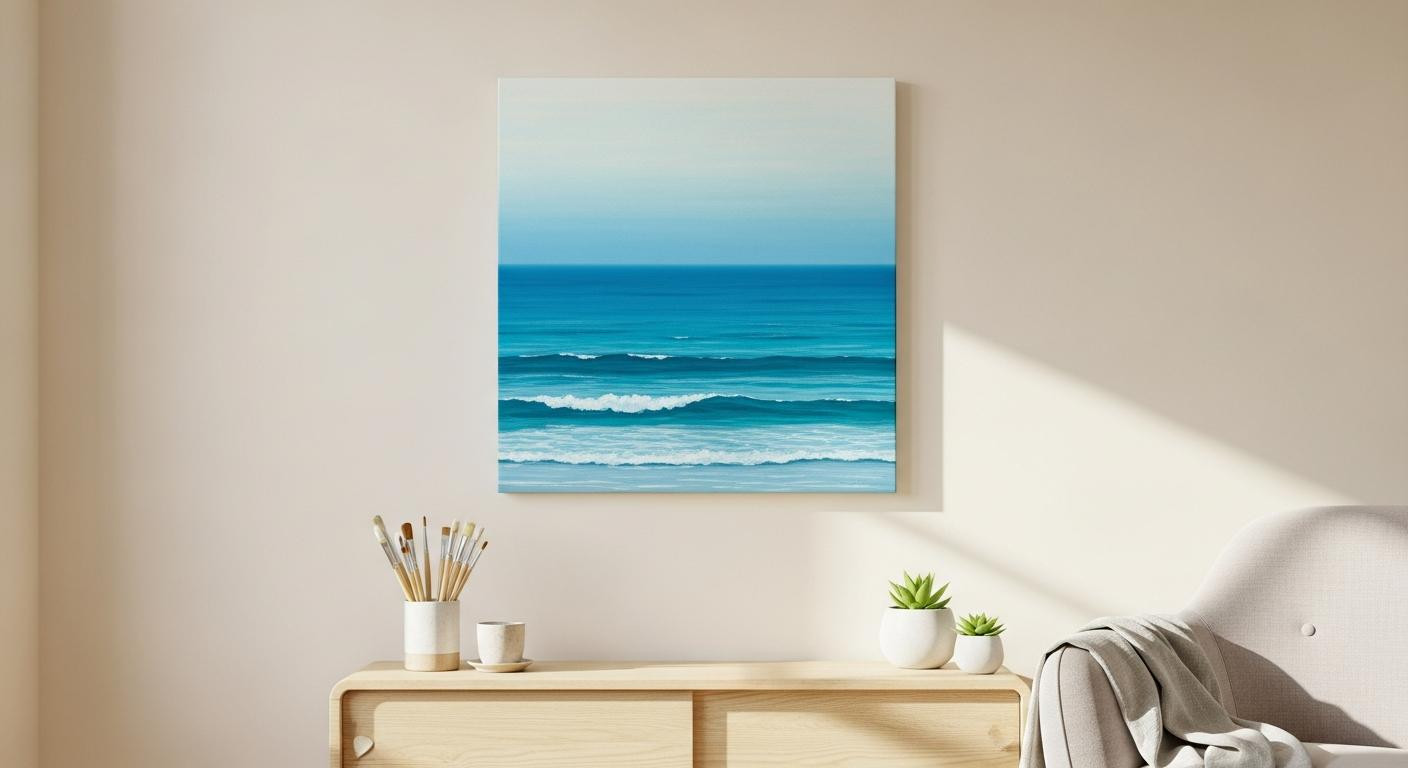
Your kitchen table at 10:17am on a Saturday in May when you squeeze ultramarine blue onto a paper plate and the tube splits an inch farther than you pressed. The 16×20 inch canvas sits propped against the toaster. You’ve watched four TikTok tutorials promising beginner ocean horizons in 90 minutes, but the first brushstroke seven minutes ago already looks wrong. The wet surface catches morning light coming through the east window, revealing texture you didn’t intend and three cat hairs embedded in cerulean.
That panic at 10:23am when the paint isn’t gliding like the tutorial showed? That’s the moment most people quit. But it’s also where the whole project gets interesting.
The $13 canvas absorbs water differently than the tutorial promised
Amazon Basics pre-stretched canvas pulls moisture from paint 20% faster than the Blick professional version shown in those YouTube demos. Your brush drags instead of glides. The blending window shrinks from three minutes to 90 seconds, which feels impossibly short when you’re trying to smooth a horizon line that keeps breaking into patchy strokes.
And yet this limitation accidentally saves you. The rough texture creates an impressionist quality that reads more expensive than the tutorial’s saturated blocks. Cheap canvas forces you to work faster, which paradoxically looks more confident than the overworked gradients beginners produce on forgiving surfaces.
The paint consistency at this stage feels like cake frosting, thick enough that you can see brush marks catching light. That’s intentional texture, even if it wasn’t planned. The $15 Target planter that anchors makeshift studio setups sits nearby protecting the table from spills, a reminder that functional gear matters as much as artistic vision.
At 11:23am the second horizon layer looked like a mistake that became the focal point
You squeeze white directly onto the wet blue horizon line at 11:15am, expecting smooth blend but creating an opaque cloud band instead. The panic of ruining it hits hard. But then you notice how the accidental haze mimics May morning marine layer, the kind of atmospheric depth you see driving Highway 1 at dawn.
Titanium white sits on top of cerulean for 30 seconds before slowly sinking, creating gradations you couldn’t achieve through deliberate brushwork. The paint has a will of its own at this wetness level. Your job is just to not fight it too hard.
Wave foam happens with dry-brush pressure, not more paint
At 11:35am you discover that dragging an almost-dry brush horizontally creates texture the tutorial’s “add white strokes” method couldn’t touch. You dab 70% of the paint off onto a rag first, leaving the brush barely loaded. Then you drag it across dried blue with enough pressure that your forearm flexes and the brush catches on canvas tooth.
The broken lines mimic ocean spray because real foam is absence of color, not addition of white. Less paint produces more convincing water. It’s the opposite of beginner instinct, which says more paint equals more coverage equals better result.
The 2:00pm reveal when afternoon light hit dried paint
At 2:17pm you step back and the morning’s “too dark” base layer has dried to perfect gradient. Wet cerulean that looked navy becomes sky blue. Titanium white that seemed stark softens to cream. Acrylics lose 20-25% apparent saturation as water evaporates, exposing pigment suspended in polymer medium instead of diluted slurry.
This is why 87% of students finish ocean tutorials on platforms like Skillshare, compared to 40% completion rates for portrait projects. The medium self-corrects your mistakes. Beginner over-saturation, where you apply too much pigment in too many layers, fixes itself through drying chemistry.
West window position makes the canvas read warmer by 4:00pm
Moving the canvas near the west-facing window at 4:15pm, where it will eventually hang, reveals golden undertones invisible under kitchen’s north light. West-facing afternoon light that changes paint colors by 4:00pm transforms the same piece that looked cold and blue at noon into something that reads peachy-blue, summery, like 7:00pm beach light instead of morning chill.
Test your colors in destination light, not workspace light. That’s the difference between a canvas that works in the room and one that fights the space.
The $43 project looks like $149 art because amateur texture reads as style
Your neighbor’s 6:30pm reaction is the tell. “Where did you buy that?” The cognitive dissonance of revealing you painted it this morning. Beginner imperfections like visible brushstrokes, uneven blending, and thick paint ridges signal handmade authenticity that mass-produced West Elm prints lack at $149 for the same size.
Cost breakdown: $13 Amazon Basics canvas, $20 Liquitex paint set, $10 synthetic brushes equals $43 total. But this only works for abstract landscapes where mistakes read as stylistic choices. Wouldn’t work for portraits or geometric patterns requiring precision. The limitation is the honesty that makes it work.
Your questions about beginner paint projects answered
Can I do this without any painting experience?
Yes if you choose ocean horizons or sunset gradients. Abstract landscapes hide technical errors. The ocean wave canvas tutorials take 90 minutes for true beginners, with 90% completion rates among first-timers on TikTok and YouTube. Avoid realistic trees, buildings, or figures until you’ve completed three gradient-based pieces. Start with 16×20 inch canvas, not larger, because bigger surfaces expose stroke inconsistency.
Which paint colors create instant expensive look?
Cerulean blue plus titanium white plus raw sienna equals coastal calm that photographs well. Avoid primary colors straight from the tube because they read craft-store amateur. Mix every color with a tiny amount of its complement to create sophisticated muted tones. The $20 Liquitex Basics set includes these essentials. Skip metallic or neon acrylics for your first project.
What if it looks terrible halfway through?
Expected between 11:00am and 1:00pm when layers are wet and fighting each other. But acrylic dries in 15-30 minutes, letting you paint over mistakes immediately. Odd-number canvas grouping that makes beginner art look intentional can save a mediocre painting by putting it in context with two stronger pieces. Let it dry completely, reassess, add correction layer. Canvas accepts four to five overpainting sessions before texture gets too thick.
The canvas at 8:00pm when you prop it on the bookshelf and step back 12 feet. Morning’s panic is invisible. The thick paint catches lamplight like oil painting texture. Your thumb still has cerulean embedded under the nail. The 57-inch rule that determines canvas height after you paint it will matter tomorrow when you hang it, but tonight the room just feels different with proof you can make something that belongs on the wall.