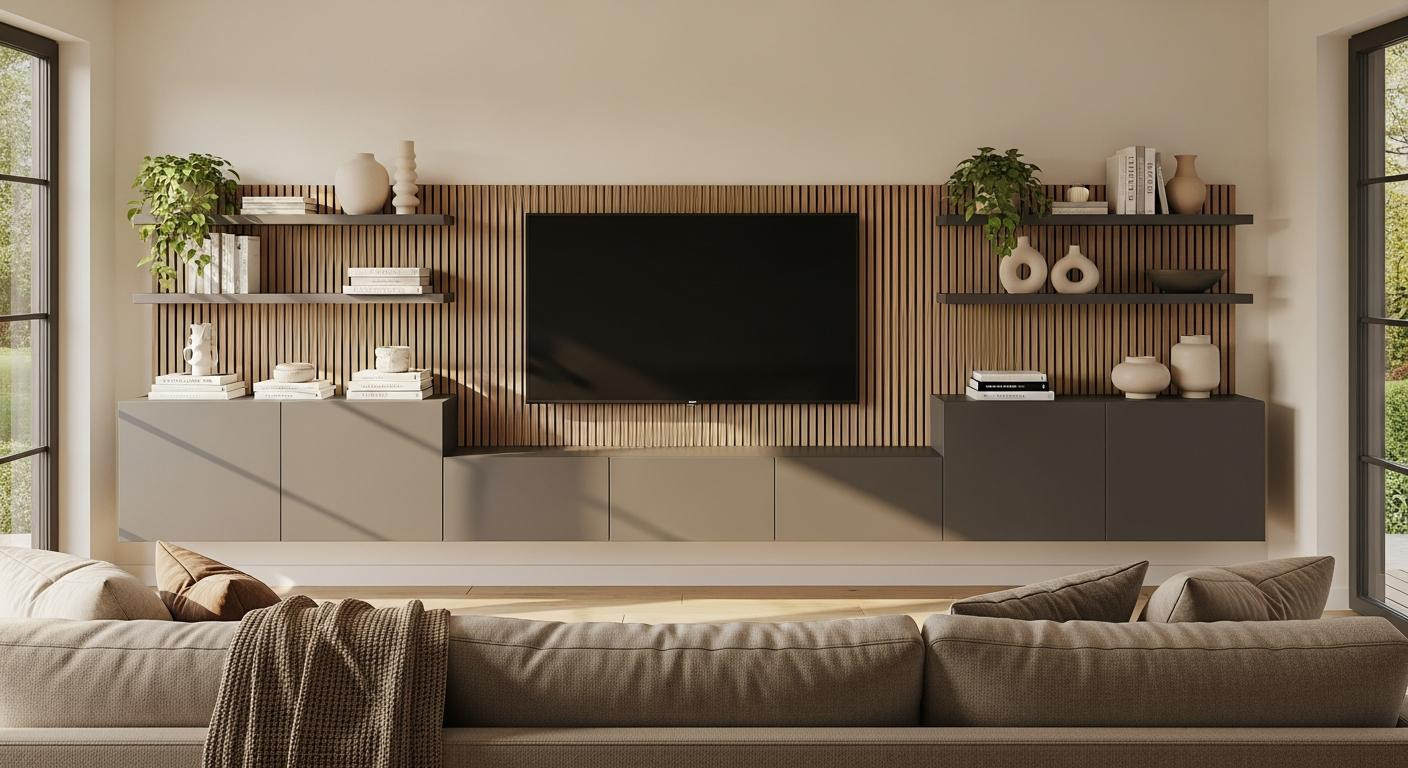
Your 55-inch Samsung TV hangs on the living room wall at 7:23pm Thursday, four feet of blank beige stretching above it where the ceiling starts, three feet of empty space on each side where the sofa doesn’t quite align. The black rectangle floats in a void, cables visible behind the too-small mount you installed in March because YouTube said 16-inch studs meant easy installation. By the time evening light dies at 8:40pm, the TV looks like an afterthought stuck to a wall, not a designed element anchoring 240 square feet of living space.
Designers skip this entirely. They build the wall around the TV instead.
Why basic mounts create visual voids renters can’t fix
A flush mount positions your TV 2.8 inches from the wall, leaving 87 square feet of surrounding surface undefined. Your eye registers the rectangle, then scans for context—shelving, art, architectural detail—and finds nothing. ASID-certified interior designers call this “tech floating in negative space.” The mount solves hanging mechanics but ignores spatial composition.
In 200-300 square foot living rooms, that void makes the entire wall feel unfinished, which contracts perceived room size. Designers avoid mounts in small spaces because they can’t address cable management, proportional balance, or material warmth. A $1,000 Samsung Frame TV on a $79 mount still reads as bare tech unless the surrounding wall provides visual anchoring through integrated elements.
The floating wall strategy that makes 55-inch TVs look intentional
Designers specify IKEA’s Besta system ($299 for 70.8-inch wide configuration) mounted 12 inches left and right of a centered TV. The cabinets float at the same height as the TV mount, creating a horizontal plane your eye reads as one continuous element rather than isolated pieces. Featured in House Beautiful, design experts use this trick in alcove-challenged rentals: “The cabinets frame the TV into an intentional niche without structural changes.”
The visible gap between cabinet and wall—two inches when properly mounted—adds shadow lines that suggest built-in depth. In a March 2026 Brooklyn studio transformation, a renter paired Besta with stick-on wood slat panels behind the TV, creating texture contrast that kept the screen from dominating. Total cost: $487 including panels. The effect photographs like custom millwork.
West Elm panels add warmth basic drywall can’t provide
West Elm’s slatted wood panels ($800 for 8-foot sections, April 2026 pricing) mount with construction adhesive dots renters can remove. The vertical grooves create rhythm that basic flat walls lack, casting micro-shadows that shift as daylight moves. ELLE Decor contributors note backlit LED strips tucked behind slats “add dimension and soft glows” that prevent evening TV walls from reading as black holes.
Admittedly, $800 feels steep for temporary installations. But HomeGoods sells peel-and-stick wood slat wallpaper at $40 per 18-square-foot panel—enough to cover a 6-foot-wide section behind a mounted TV. The texture alone makes screens recede into the composition instead of jutting forward.
How Frame TVs disguise tech as gallery walls
Samsung Frame TVs (starting $1,000 for 55-inch, 2026 models) display artwork when not streaming, transforming “ugly black voids” into rotating galleries. The difference shows at 2pm Saturday when you’re not watching—the screen becomes a framed landscape or abstract print instead of reflective glass. Designers swap Frame bezels for custom Etsy versions ($60-$120) matching room palettes: “It looks like one-of-a-kind art fitting your vibe, not universal Samsung beige.”
In a February 2026 Pinterest analysis, “art TV walls” pins increased 45% because viewers couldn’t distinguish powered-off Frames from actual framed prints. The TV disappears into intentional decor. And that’s the balance that makes small living rooms work—tech that doesn’t announce itself when you’re done watching.
Custom bezels cost $60 but shift entire room perception
Etsy sellers offer walnut, brass, and black oak Frame bezels that replace Samsung’s stock options. A $79 walnut bezel on a $1,599 Frame creates continuity with mid-century consoles, making the TV read as furniture rather than electronics. This only works if your existing room skews warm-toned—pairing oak bezels with cool gray walls creates dissonance.
Interior design leaders at IKEA UK suggest testing bezel finishes against console wood before ordering: “Mismatched tones make expensive TVs look cheaper.” That’s the kind of detail that quietly elevates the whole space.
The 42-inch offset rule that creates dimensional living rooms
Floating media walls work when positioned 42-48 inches from opposing furniture, creating walkable negative space that implies separate zones. A TV wall built flush to the back wall with a sofa 42 inches forward divides the room into “media zone” and “circulation path,” making 240 square feet feel like articulated spaces instead of one rectangle.
This mirrors the sofa-floating principle but applied to vertical surfaces. Design experts featured in Loewe UK confirm wall-mounting “saves floor space and eliminates clutter,” but only when offset distances allow sight lines to register depth layers. Rooms under 200 square feet lose this effect.
Your questions about designer TV walls answered
Do floating shelves work for 65-inch TVs or just smaller screens?
IKEA Besta supports up to 110 pounds when wall-mounted correctly into studs, not drywall anchors. A 65-inch TV averages 55 pounds, leaving capacity for books and decor. The limiting factor is visual proportion: 65-inch screens span 57 inches wide, requiring shelving extensions beyond 70 inches to maintain frame balance.
In living rooms under 12 feet wide, this creates wall-to-wall cabinetry that overwhelms rather than anchors. But if you have the width, it works without tipping into heavy.
Can renters install textured panels without losing deposits?
Command Picture Hanging Strips (rated 16 pounds per set, $14.99 at Target) mount lightweight wood slat panels without nails. Remove within lease terms using dental floss to separate adhesive from wall. Test on inconspicuous areas first—textured rental paint sometimes pulls when strips release.
And if you’re layering lighting, backlit LED accents create the soft glows that prevent TV walls from becoming black holes at night.
What’s the minimum budget for a media wall that doesn’t look cheap?
$300 transforms basic mounts: $50 Target swivel base, $40 HomeGoods faux slat panels, $89 IKEA floating shelf, $79 LED strip kit, $42 for miscellaneous hardware. Focus budget on texture (panels) and light (LEDs) rather than expensive cabinetry—those two elements create perceived luxury mounts alone cannot deliver.
Nothing too precious, but enough warmth to feel intentional. That’s what makes vertical space tricks work in compact rooms where every square foot counts.
By 8pm the textured wall catches lamp glow in horizontal lines where slats meet shadow. The TV powers down into a sepia landscape print, wooden bezel blending with the console grain six feet below. The room holds its composition even when the screen goes dark.