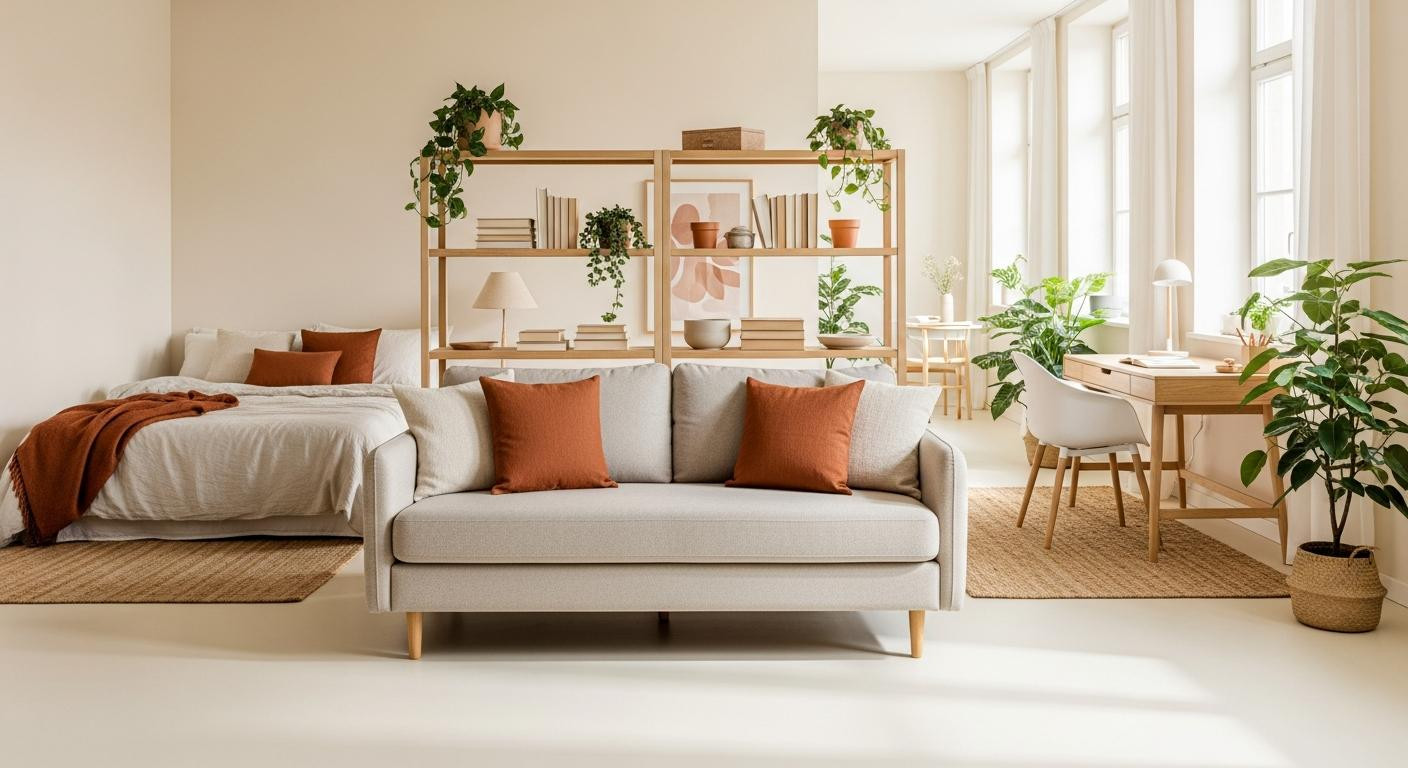
Your 315 square foot studio feels smallest at 6:30pm Wednesday when work papers still cover the coffee table and your unmade bed stares back from 11 feet away. Everything occupies the same visual plane because nothing tells your eye where work ends and life begins. Back-to-back furniture positioning solves this by creating implied walls your brain reads as boundaries, carving three functional zones from one room without blocking your west-facing window or violating your lease.
Why your studio feels chaotic even when it’s clean
Lack of visual separation between functions creates what environmental psychologists call boundary collapse. Your eye constantly scans the entire space looking for edges to rest on, finding none. According to residential designers featured in Architectural Digest, this visual chaos registers as low-grade stress even when surfaces are clear.
That’s the phenomenon behind waking up at 7am and feeling dread before your feet hit the floor. Yesterday’s laptop setup sits visible from bed, collapsing the mental compartment between sleep and work. Furniture positioning that creates soft edges restores those boundaries without permanent construction.
The furniture flip that zones 300 square feet into 3 rooms
Float your sofa 42 inches from the wall, facing your TV zone, with its back creating a boundary to the bed area. This single move transforms the living area from furniture ring to defined lounge. The sofa back acts as a headboard replacement, making the bed feel like separate bedroom space.
Cost is $0 if you already own the sofa, or $89 for a structurally sound used sectional from Craigslist. But this only works if you’ve got at least 9 feet between opposite walls to maintain a 36-inch walking path behind the sofa.
Add a floor-to-ceiling shelf behind the sofa
An IKEA IVAR system at $99 creates visual separation without blocking window light from traveling through open shelves. The walnut-stained wood reaches 79 inches tall, giving each zone its own backdrop. Books face the living area, plants face the bed area, and the whole setup stores twice what a closed cabinet would.
Design experts certified by ASID note that open shelving preserves brightness while dividing space, a balance that closed room dividers can’t match. And the pine accepts stain beautifully, giving you that expensive walnut look for under $15 in materials.
How rugs create zones your brain actually respects
An 8×10 foot rug placed under your desk and chair creates tactile territory that says this is office. The texture shift from hardwood to jute registers subconsciously. When you step onto the rug, your brain enters work mode without conscious thought.
That rug also contains visual clutter from desk supplies, preventing office chaos from bleeding into your living area. Different lighting over each rug zone reinforces the separation further, giving each area its own atmosphere.
Why different textures matter more than matching colors
Your feet tell your brain where you are before your eyes do. Rough jute signals work, soft cotton signals lounge, bare wood signals circulation. This tactile zoning works even when you can see the whole studio at once.
Bare floor between zones creates visual hallways that reinforce separation. IKEA’s Stockholm rug runs $199, while Target’s Threshold version costs $150 for nearly identical jute weave. Both anchor zones without overwhelming small spaces.
The clothing rack divider that costs $50 and looks expensive
A tension rod or floor rack at $30 from Amazon draped with crushed velvet fabric for $20 creates privacy between bed and living areas. The flowing fabric reads as intentional design rather than college dorm desperation. Position it where it won’t block natural light paths, ideally perpendicular to your window wall.
Velvet specifically absorbs sound, reducing echo in hard-surfaced studios in a way that sheer curtains can’t. But this only works if your ceiling height is at least 8 feet, and the fabric needs washing every 6 weeks to avoid dust buildup.
Your questions about studio apartment zoning answered
Will dividers make my studio feel darker?
Back-to-back furniture and open shelving preserve light flow because they’re shorter than ceiling height or have gaps. Professional lighting designers recommend avoiding solid dividers taller than 60 inches. Rugs and fabric screens don’t affect light at all since they operate at floor or mid-wall level.
Can I use this if I move furniture every 6 months?
All these solutions are reversible. IVAR breaks down into flat pieces, rugs roll up, tension rods remove without holes. This flexibility actually saves money because you take everything to your next apartment, unlike permanent dividers that require landlord approval.
What if my studio is smaller than 300 square feet?
Back-to-back sofa positioning requires at least 9 feet between walls to maintain walkways. In studios under 250 square feet, consider single-zone approaches with folding furniture instead of full separation. Organizers with residential portfolios confirm that over-dividing tiny spaces creates more stress than it solves.
Your IVAR shelf stands 79 inches tall at 8pm Thursday, walnut grain catching pendant light from the living side while your bed linens stay shadowed on the sleep side. The studio still measures 315 square feet, but your shoulders drop when you step from work rug to lounge rug.