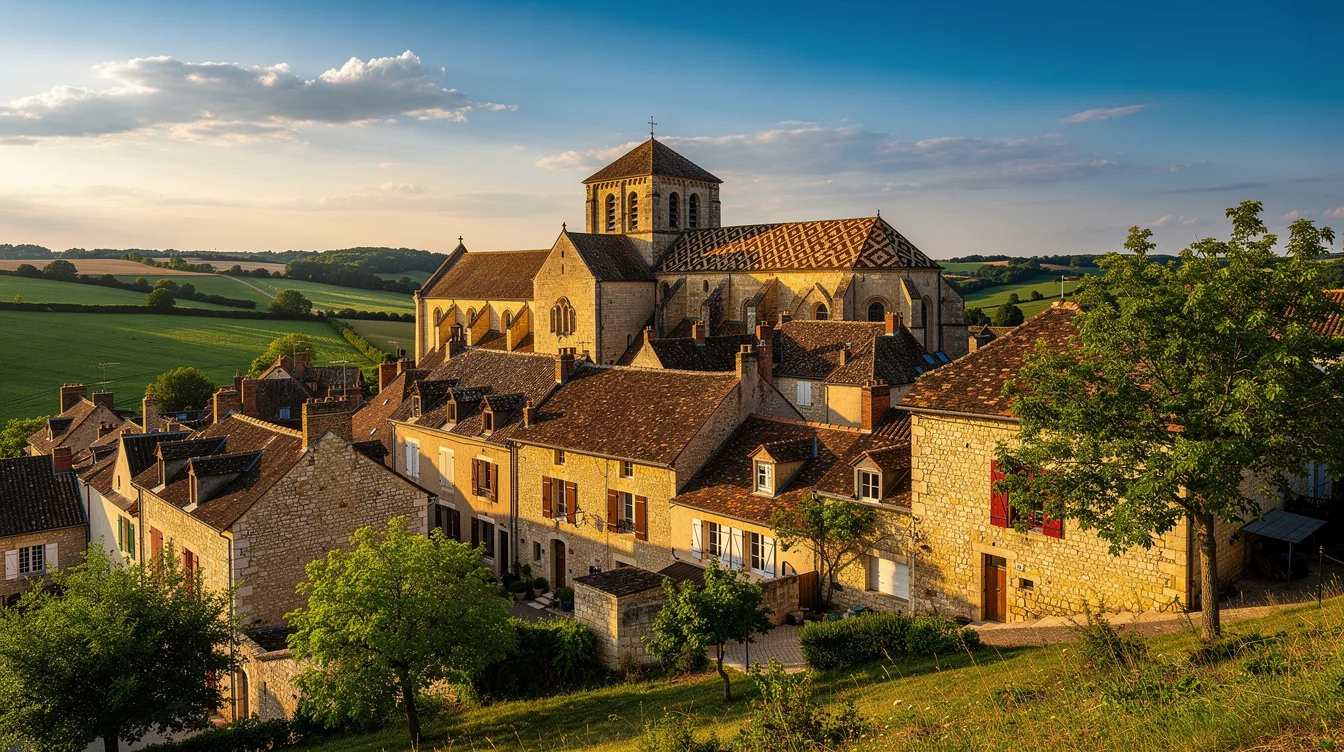
Flavigny-sur-Ozerain is a small medieval village in France’s Côte-d’Or, but its defining scent comes from an abbey. Founded in 719, the former Benedictine abbey now houses the factory behind Anis de Flavigny, the tiny aniseed candies made only here.
That’s the reason to come. The candy isn’t a souvenir tacked onto a pretty village. It’s part of the place’s daily rhythm, and its scent reaches you as you walk its stone lanes.
An abbey that still shapes the village
The old abbey sits at the center of Flavigny, which rises on a rocky spur above the Ozerain valley. You’ll find a village built around it rather than beside it, so nearly every short walk seems to return you to its walls.
And the maker of Anis de Flavigny is still inside the abbey. The village is the candy’s sole producer, which gives this stop more weight than a standard factory visit. You’re seeing a working business inside the building that explains why the town formed here.
Those candies began with the monks, according to the local history. Today the factory employs more than 30 people, a sizable presence in a commune with only a few hundred year-round residents.
Is the candy factory the main reason to visit?
Yes, but don’t rush through the rest of town. The abbey makes the strongest first impression because it joins a founding date, a local product, and a living workplace in one address. But Flavigny works best when you give its streets time to interrupt your plan.
You may come for the anise and stay for the walls. It’s touristy in the warmer season, but it never feels built solely for visitors because the factory and old village fabric remain so closely tied.
Medieval walls, gates, and a slow walk
Flavigny’s fortifications rose during the 12th and 13th centuries, and substantial stretches still ring the village. The walls make the lanes feel contained, then a break in the stone suddenly opens toward the soft folds of the Auxois countryside.
But this isn’t a place for checking sights off quickly. The village has three fortified gates, older houses, paved alleys, and former town residences. Let yourself take wrong turns.
The reward is usually a quiet corner, a worn doorway, or a view beyond the ramparts.
The Porte du Val carries an inner gate from the 13th century and an outer gate from the 16th. The Porte du Bourg dates to the 15th century and includes a statue of the Virgin. These details are easy to miss if you keep looking only at your phone.
Saint-Genest Church is worth a pause for its Gothic stone gallery and its 15th-century Angel of the Annunciation. The village is compact, so you can move between its religious buildings and defensive remains without turning the day into a march.
Why two to four hours feels right
Plan for two to four hours in Flavigny. That gives you enough time for the abbey and candy experience, a loose circuit of the streets, and a pause near the edge of the promontory.
And don’t arrive with an overstuffed itinerary. The village’s appeal is pedestrian and gradual. Its lanes are short, but the uneven stone and small visual distractions make them slower than they look.
The best time to walk the medieval center and its surroundings is in the warmer season. Go in the morning or toward day’s end if you want a calmer mood and better light on the pale stone. Midday can feel busier, especially in the narrow streets.
There’s a useful contrast here: Flavigny is tiny, yet it holds enough history to slow you down. Its population was listed at 274 residents in 2023, so this is not a town that can absorb crowds without changing character.
Pair it with Alésia and Semur-en-Auxois
Flavigny lies in the Auxois area of Burgundy-Franche-Comté, near Alésia and Semur-en-Auxois. That makes it an easy cultural stop on a wider route, particularly if you want Roman history before medieval streets and sweets.
MuséoParc Alésia adds the site associated with the siege of 52 B.C. Between Julius Caesar and Vercingetorix. The pairing works because the two places offer different scales of history: one is tied to a major conflict, while the other is best understood at walking speed.
But don’t let the film connection become the whole story. Flavigny appeared in Chocolat (2000), and visitors still mention it. The real pull is more specific: an abbey from 719, fortified lanes, and an anise maker that never left town.
By late afternoon, the candy scent hangs lightly near the abbey, the stone lanes quiet down, and Flavigny feels less like a film set than a village still doing the work that made it known.