Small front porch flooring can stay low-maintenance with painted concrete, running-bond brick, porcelain planks, or sealed aggregate. The best surface manages muddy footprints while giving a narrow entry real character. A few choices fail in rain, so every idea below includes a practical finish and a clear limit.
- Paint a checkerboard pattern on concrete (The Two-Tone Grid Rule)
- Lay narrow brick pavers in running bond
- Stencil delicate farmhouse motifs over gray concrete
- Install wood-look porcelain planks lengthwise
- Border stamped concrete with contrasting edges (Stamped Concrete over Plain Slab)
- Tuck a pebble mosaic beneath the entry (The Pebble Landing Principle)
- Whitewash brick pavers for weathered farmhouse charm
- Create diagonal stripes with porch floor paint (Painted Stripes over Bare Slab)
- Frame concrete slabs with cedar trim (The Cedar Frame Method)
- Use terracotta tiles for warm farmhouse color
- Set black slate squares beneath the doorway (Is Slate Worth the Upkeep?)
- Scatter geometric inlays across a concrete floor
- Float removable deck tiles over worn concrete
- Paint a deep charcoal threshold strip (A Dark Band over Full Coverage)
- Blend siding color into the porch flooring (The Siding-to-Slab Blend)
- Lay small hex tiles around the steps
- Add a faux rug with painted borders
- Seal exposed aggregate for natural texture
1Paint a checkerboard pattern on concrete (The Two-Tone Grid Rule)
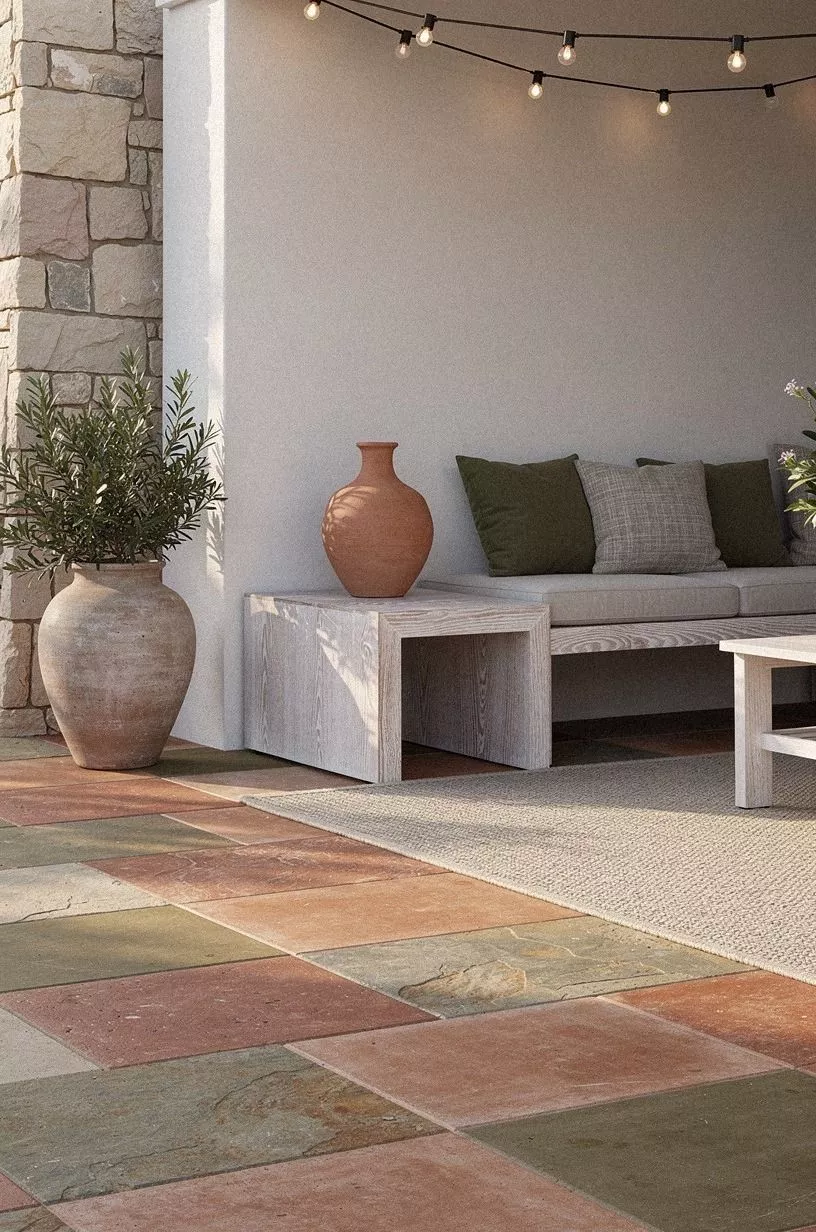
Painted concrete is one of the quickest ways to give a small porch a defined floor without raising the threshold. A warm terracotta square beside an olive square creates a checkerboard pattern that feels rustic, earthy, and intentional. You’ll want crisp painter’s tape, a clean slab, and an exterior coating with enough grip for wet shoes.
Use Benjamin Moore Aura Exterior in two compatible colors, then keep the furniture quiet. A cerused white oak stool, a narrow planter, and a woven doormat won’t overwhelm the entry. Don’t use glossy indoor paint, because it can become slippery and show every scuff!
For a small entry, large squares usually read better than tiny ones. Your eye needs a calm rhythm from the sidewalk to the door. Pair the floor with small front porch topiary planting ideas for height, but keep the planter outside the main walking path.
Typical cost by tier (US averages):
2Lay narrow brick pavers in running bond
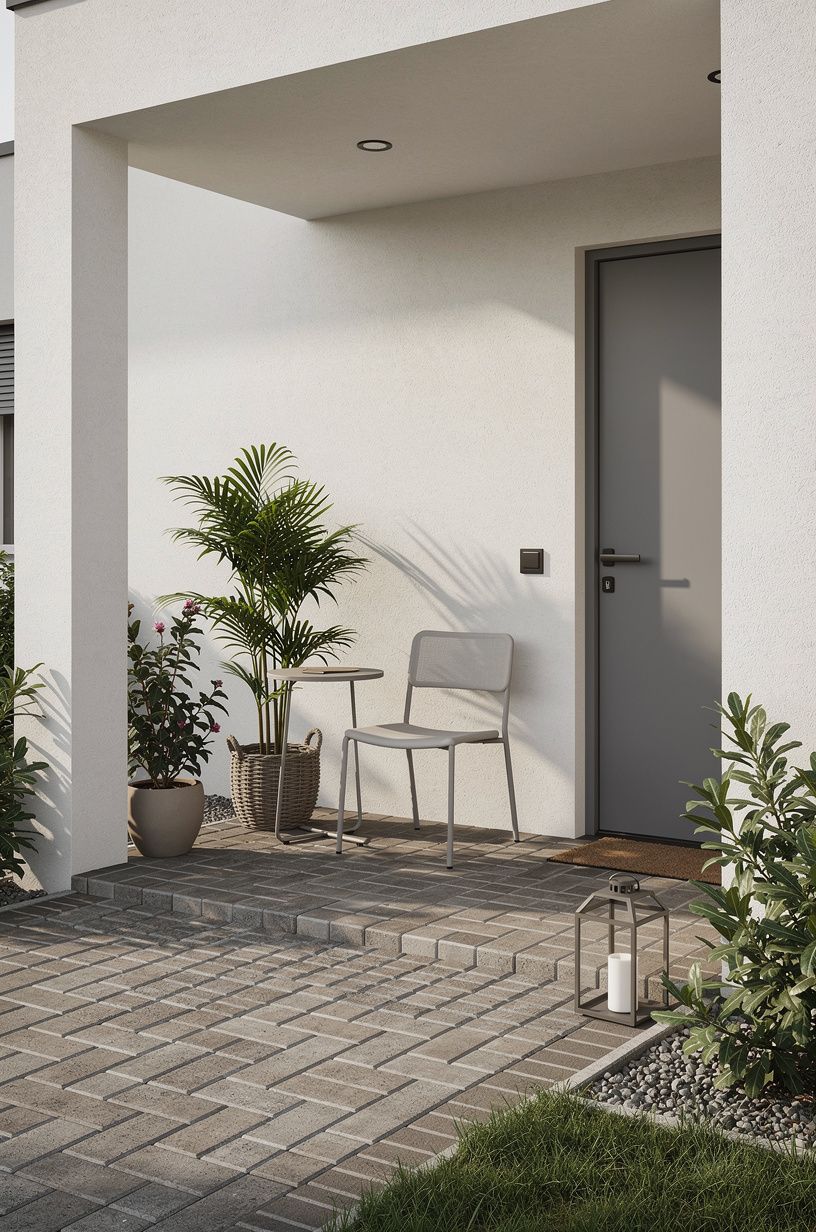
Narrow brick pavers in a running bond make a compact porch feel longer, especially when the rows follow the direction of the front door.
3Stencil delicate farmhouse motifs over gray concrete
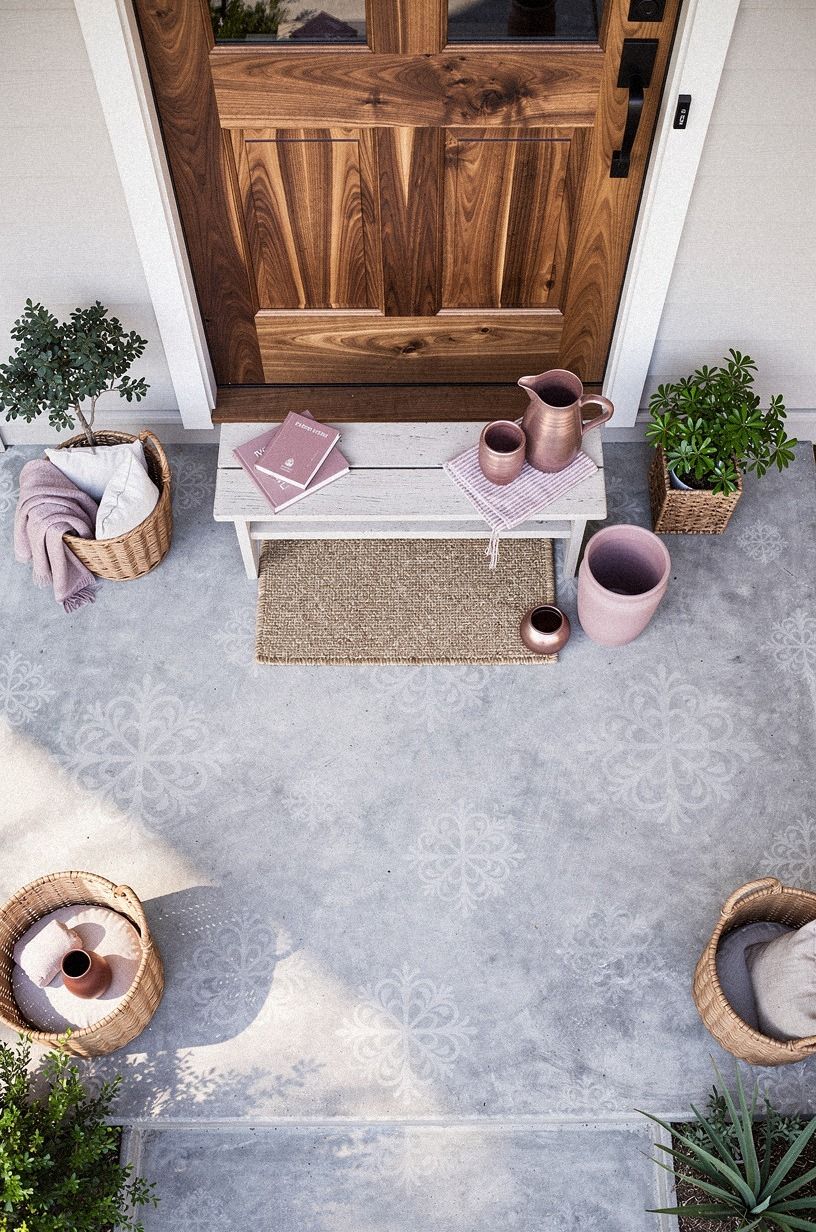
A delicate stencil gives plain gray concrete the character of a farmhouse tile floor without the added height or weight of real tile. Choose a small motif with generous negative space, because dense pattern can make a small porch feel cramped. Plum, gray, and rose gold create a refined palette against book-matched walnut accents.
Use Sherwin-Williams Emerald Exterior for the painted design, with a matte or low-sheen topcoat rated for foot traffic. You’ll want a stencil brush rather than a loaded roller, since excess paint can blur the edges. Test the motif near the door before covering the full slab.
The best stencil designs look slightly handmade. Don’t chase factory-level perfection, especially on an older porch where small variations feel fitting.
Your eye will read the repeated pattern from a distance, while soft irregularity keeps the floor welcoming. Add small front porch summer decor only after the paint has fully cured.
4Install wood-look porcelain planks lengthwise
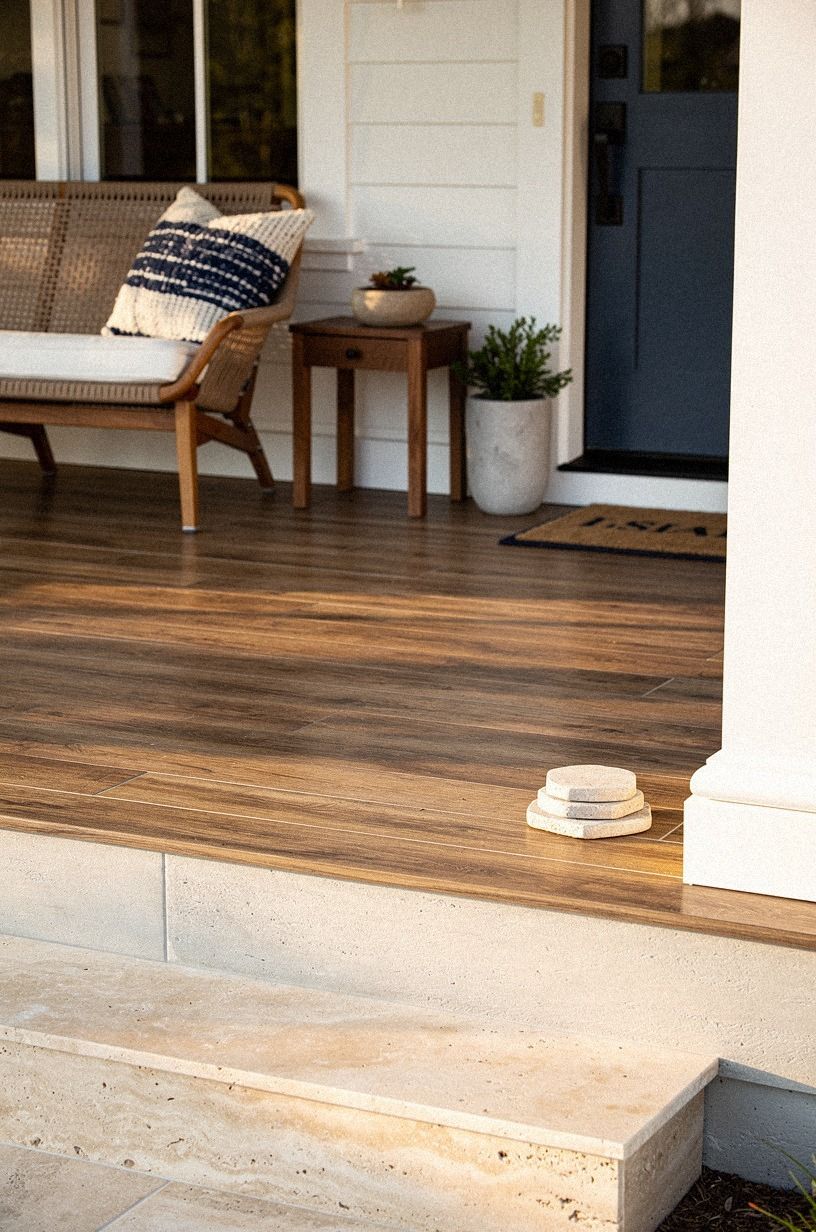
Wood-look porcelain planks give you the visual warmth of timber with a surface that handles rain, grit, and regular sweeping.
5Border stamped concrete with contrasting edges (Stamped Concrete over Plain Slab)
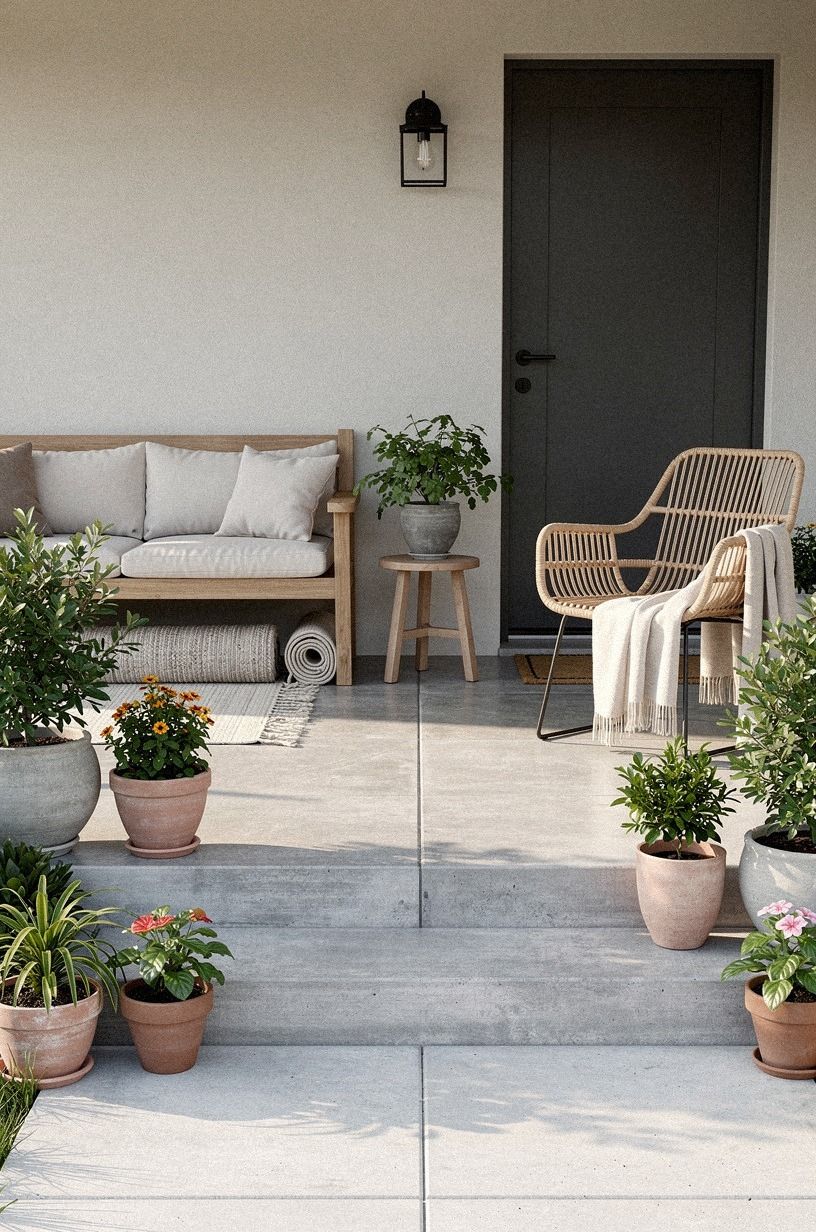
Stamped concrete becomes more convincing when the border changes the scale of the slab. Use an emerald or muted cream center with a narrow gold-toned edge, then repeat one color in the door hardware. The contrast gives a small porch a framed appearance without adding separate materials.
A stamped concrete border needs careful planning around door clearance and drainage. You’ll want a texture that resembles subtle stone rather than deep cobbles, because deep impressions collect leaves and grit. Unlacquered brass developing soft patina can warm the emerald palette without making the entry feel formal.
Don’t stamp every inch with the strongest pattern available. Your porch will look more composed when the center stays quiet and the edge carries the detail.
Add a slim welcome mat, but leave enough exposed surface for the border to remain visible. A simple small front porch welcome sign detail can echo the frame.
6Tuck a pebble mosaic beneath the entry (The Pebble Landing Principle)
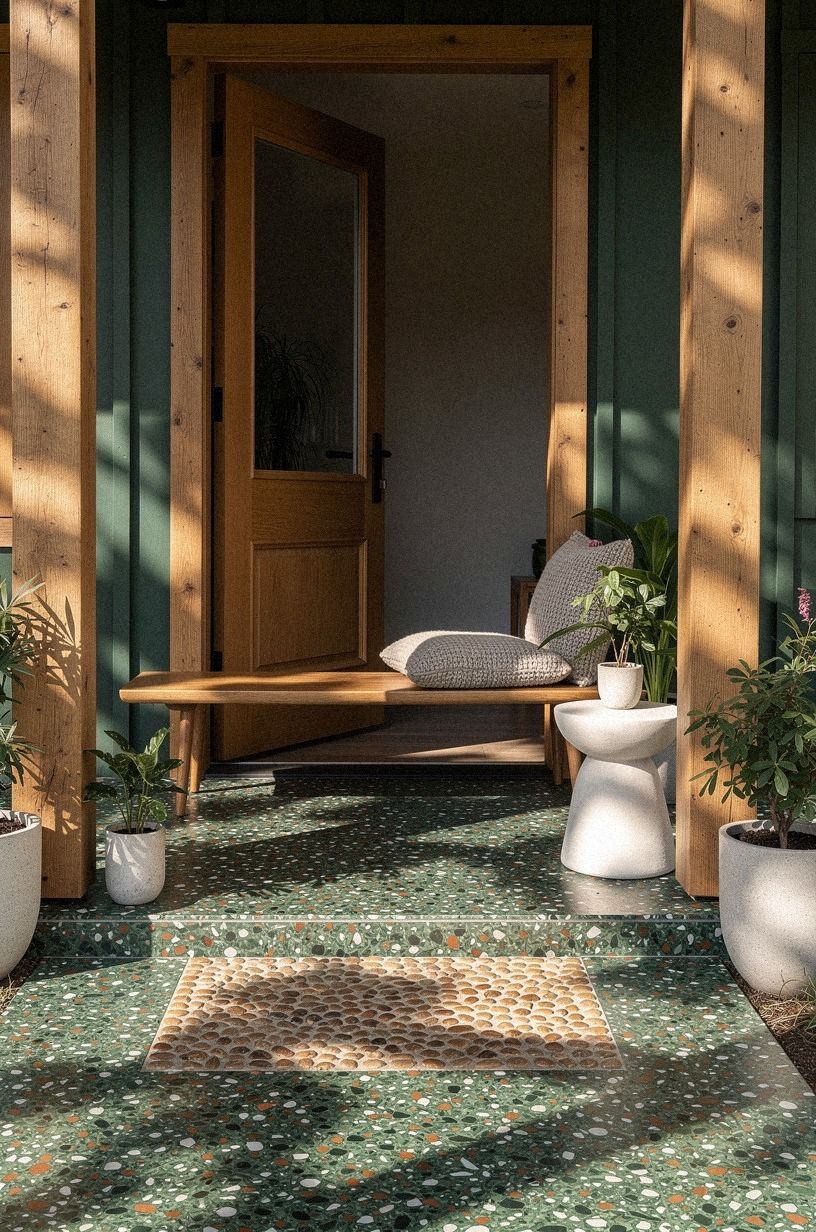
A pebble mosaic works best as a small landing beneath the doorway rather than as a full-porch treatment. Forest green, rust, and natural oak create an organic transition from the path to the threshold. The texture catches water and gives the entry a grounded, tactile quality.
Use river pebble mosaic sheets with rounded stones set tightly enough to keep heels stable. Oversized-chip terrazzo can work around the outer edge, but it shouldn’t compete with the pebble field. You’ll want an exterior grout that resists staining and a surface sealer that doesn’t create a slick film.
Keep the mosaic zone visually contained. Your porch will feel more spacious when the pattern stops before the seating area.
A natural oak stool, a rust-colored pot, and one simple lantern are enough. Don’t use loose decorative gravel, because it migrates toward the doorway and creates a maintenance problem!
7Whitewash brick pavers for weathered farmhouse charm
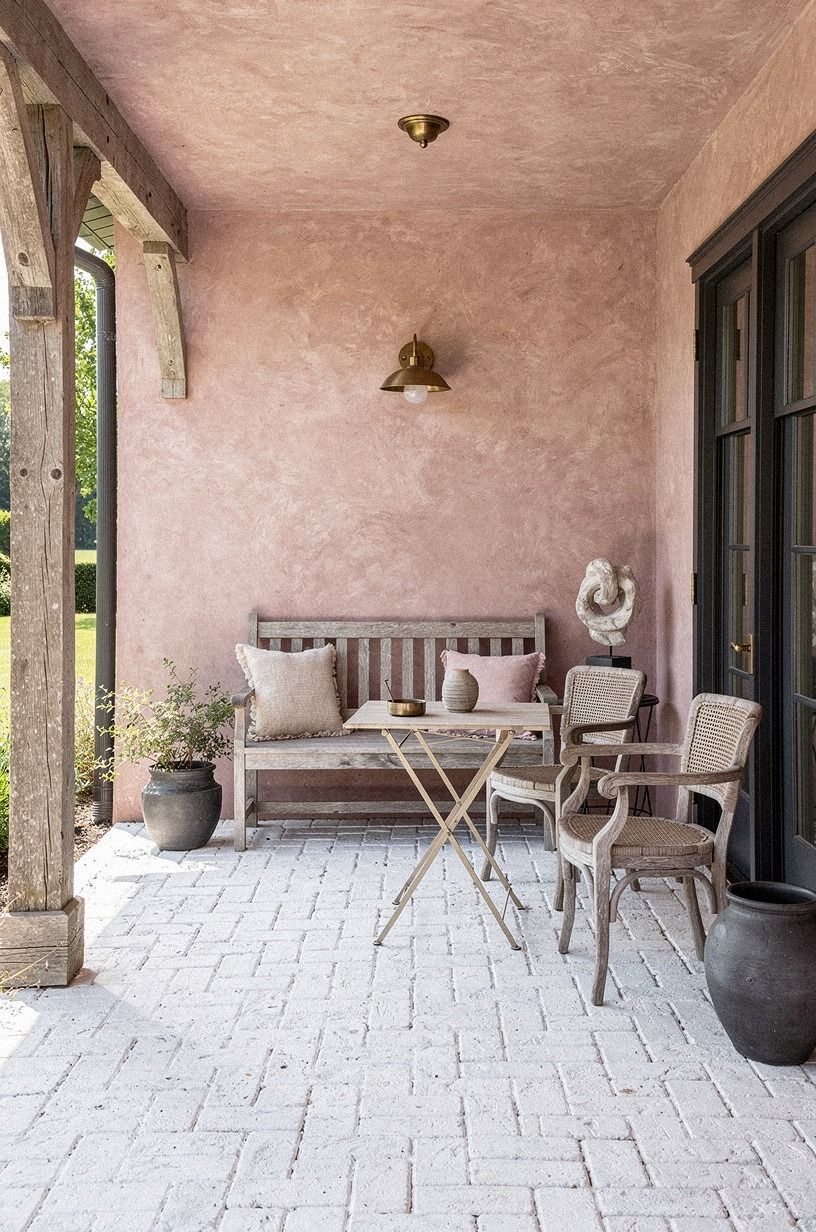
Whitewashing brick softens the strong red of old pavers while allowing the masonry texture to remain visible.
8Create diagonal stripes with porch floor paint (Painted Stripes over Bare Slab)
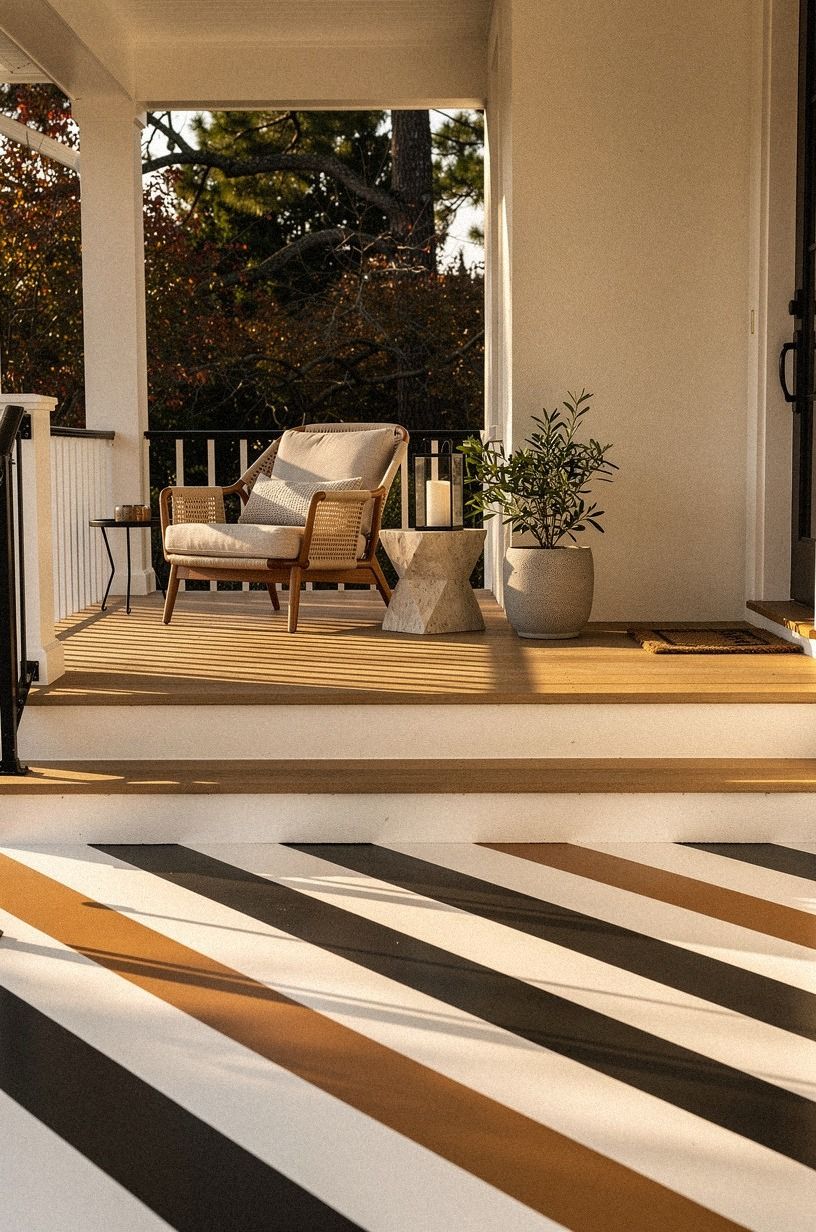
Diagonal stripes can make a square porch feel wider, but the spacing needs discipline. Use warm white and camel with thin black accents, then stop the pattern before the threshold. The result feels modern, bold, and graphic without requiring tile installation.
Choose exterior porch floor paint with a slip-resistant additive, especially if your entry faces a wet walkway. You’ll need a long straightedge, painter’s tape, and a dry weather window. Don’t make the stripes too narrow, because small repeating bands can resemble visual noise from the street.
The strongest version uses one dominant stripe color and one supporting color. Your furniture should stay quiet, perhaps with a black metal chair and a shagreen accent on the cushion. If you’re working around an existing crack, align the pattern so the repair sits beneath a stripe rather than at a high-contrast intersection.
9Frame concrete slabs with cedar trim (The Cedar Frame Method)
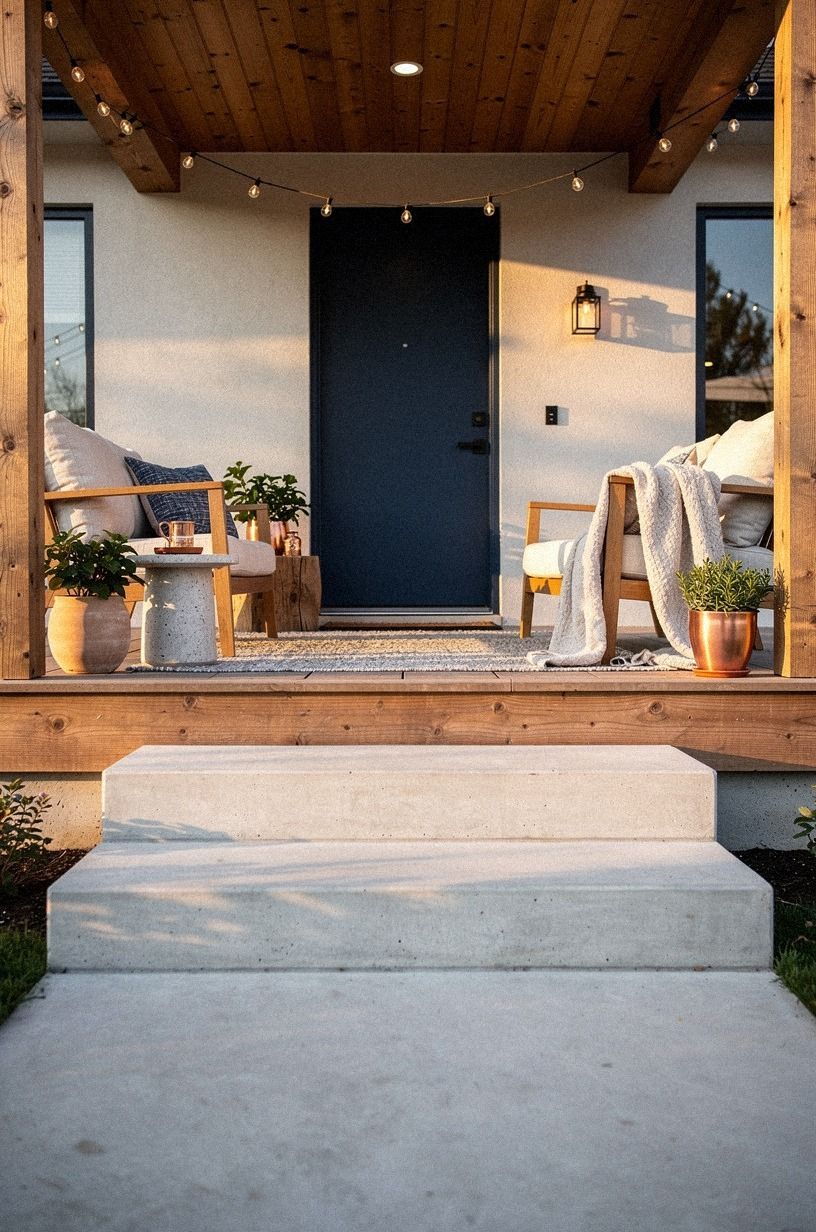
A cedar border gives a plain concrete slab a deliberate architectural edge.
10Use terracotta tiles for warm farmhouse color
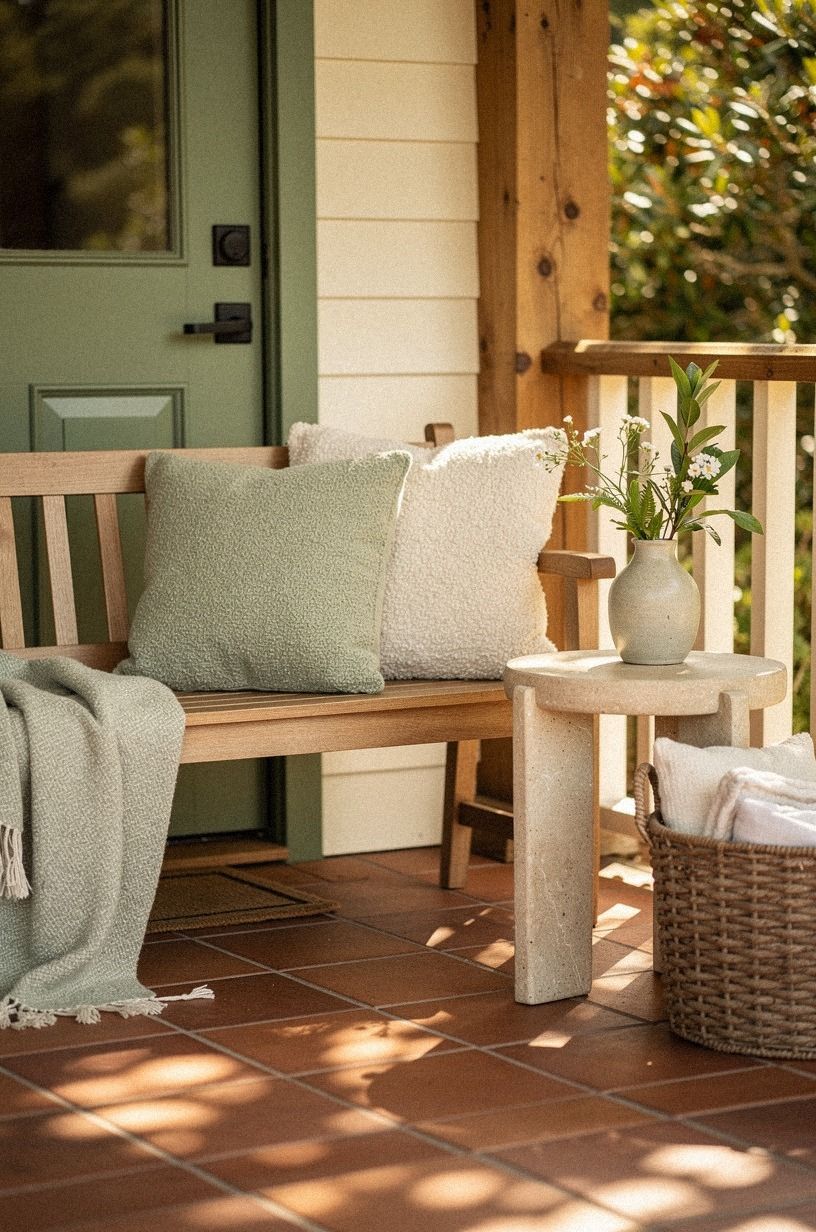
Terracotta tiles bring a naturally warm floor color that works especially well with sage green, warm cream, and natural wood. Their tonal variation hides dust better than a flat pale surface, making them a practical choice for a sheltered entry.
Choose hand-finished terracotta tile with a textured face and an exterior-rated sealer. You’ll want to check the tile’s frost suitability before installation, because traditional terracotta can be vulnerable in harsh climates. A soft organic bouclé cushion and a simple oak stool will keep the porch inviting.
Avoid placing the strongest color directly against a bright white door if the entry is very small. Your eye needs a buffer, such as a cream threshold mat or pale trim. Add a few restrained plants, then connect the floor to small front porch topiary arrangements without crowding the tile field.
11Set black slate squares beneath the doorway (Is Slate Worth the Upkeep?)
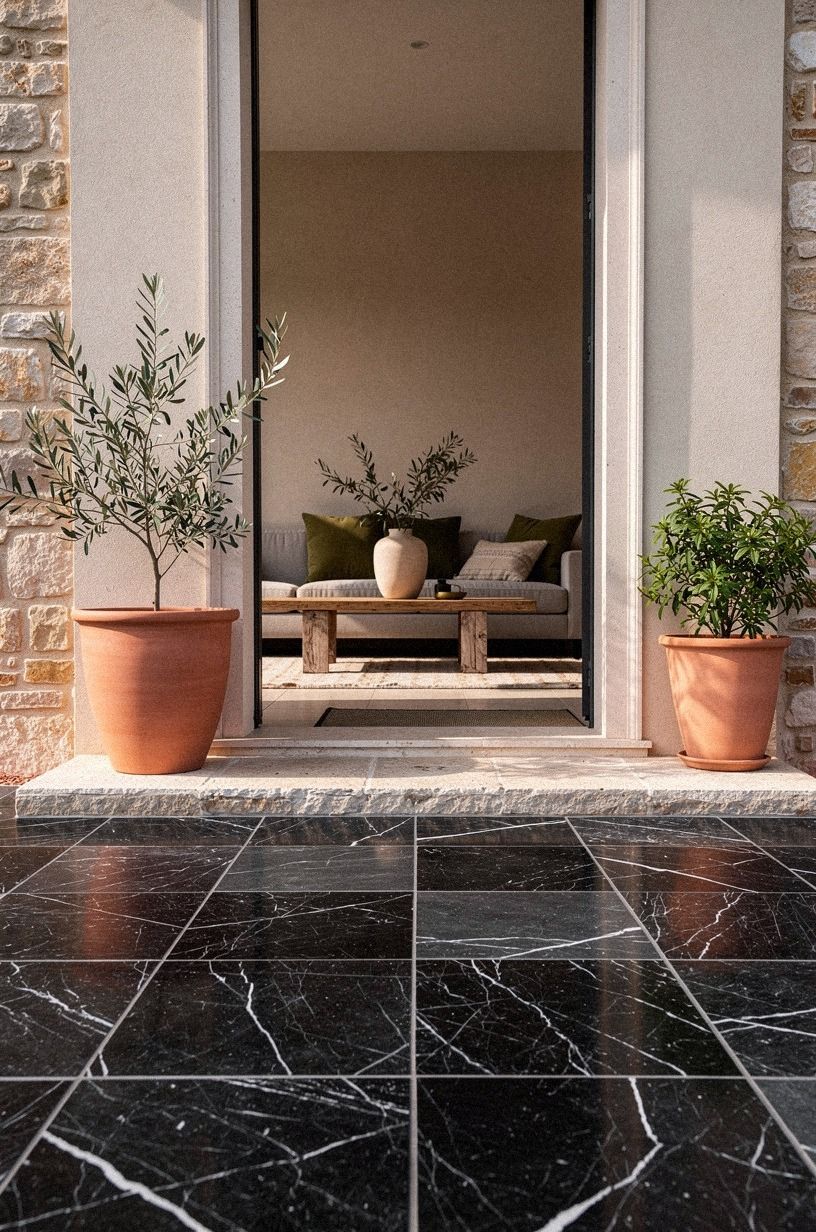
Black slate squares create a strong threshold and make lighter siding appear cleaner.
12Scatter geometric inlays across a concrete floor
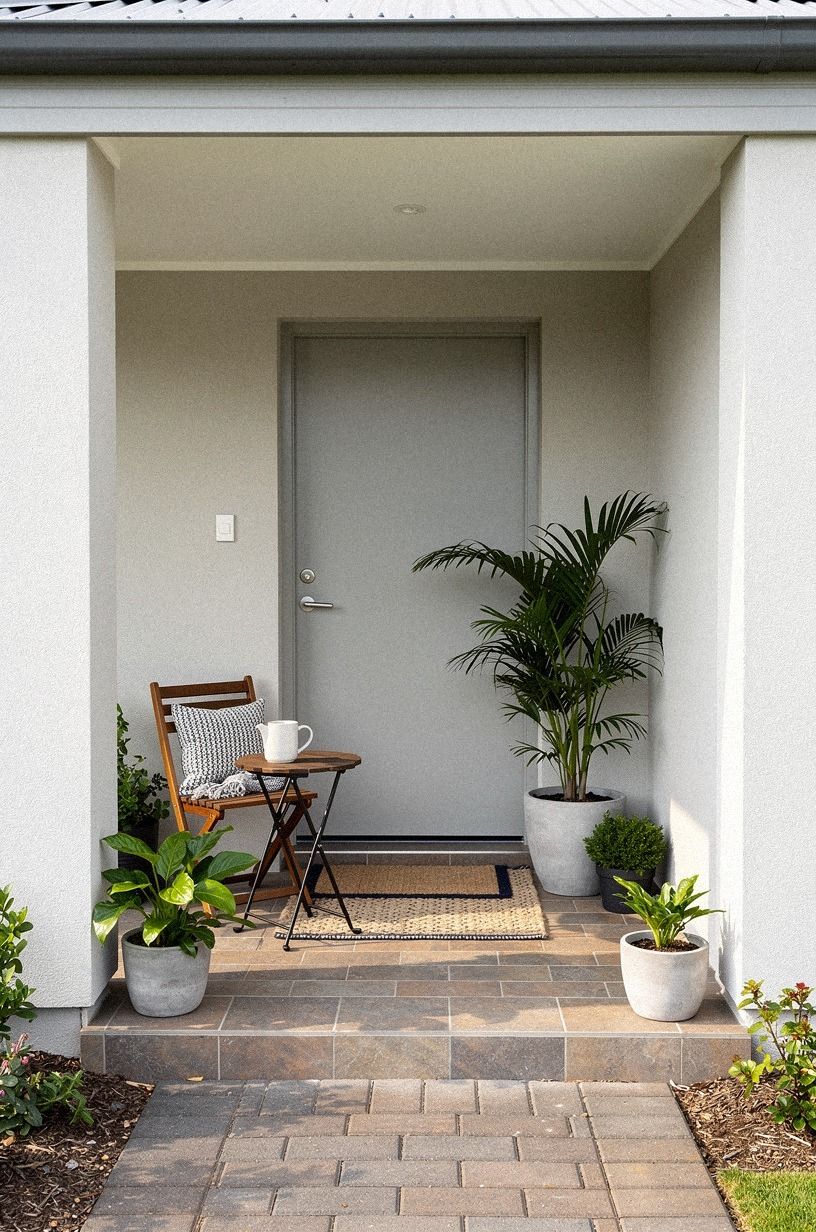
Geometric inlays add detail without demanding a full patterned surface. Set clay, linen, and aged brass colors into a restrained concrete base, with each shape positioned far enough apart to remain readable. The effect is refined rather than fussy, especially beside mohair velvet on a nearby seat.
Use inlaid exterior tile strips or painted geometric blocks with consistent spacing. You’ll want to map the design before installation so the shapes don’t end abruptly at the threshold. A repeating diamond or rectangle is easier to maintain than a complicated medallion.
Your porch should have one clear visual event. If the floor carries geometric movement, keep the doormat plain and choose furniture with simple legs.
Don’t place several patterned textiles over the inlays, because the surface can lose its calm rhythm. A narrow brass light will reinforce the palette at night!
13Float removable deck tiles over worn concrete
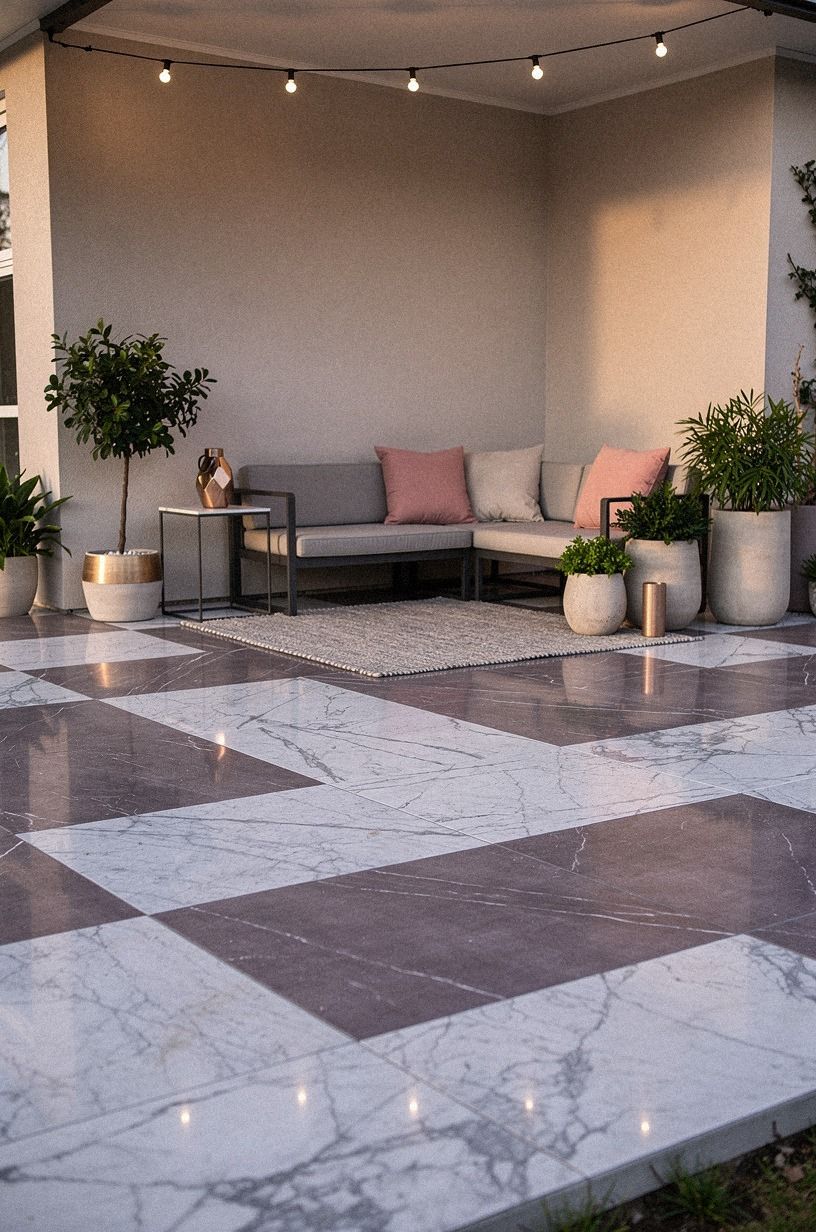
Removable deck tiles are useful when the existing slab looks tired but a permanent installation isn’t practical. Plum, gray, and rose gold can make worn concrete feel more intentional, especially when the porch includes Carrara marble with subtle gray veining in a small accent piece.
Choose interlocking composite deck tiles with drainage channels beneath the surface. You’ll want to inspect the slab for major height changes before laying them, because floating pieces can rock over uneven areas. Removable flooring works best on a relatively stable base with clear edges.
This option suits renters and homeowners who want a reversible update. Your door must still open freely, and the new surface shouldn’t create a lip that catches shoes. Place a slim mat near the threshold, then use small front porch swing seating to finish the seating zone.
14Paint a deep charcoal threshold strip (A Dark Band over Full Coverage)
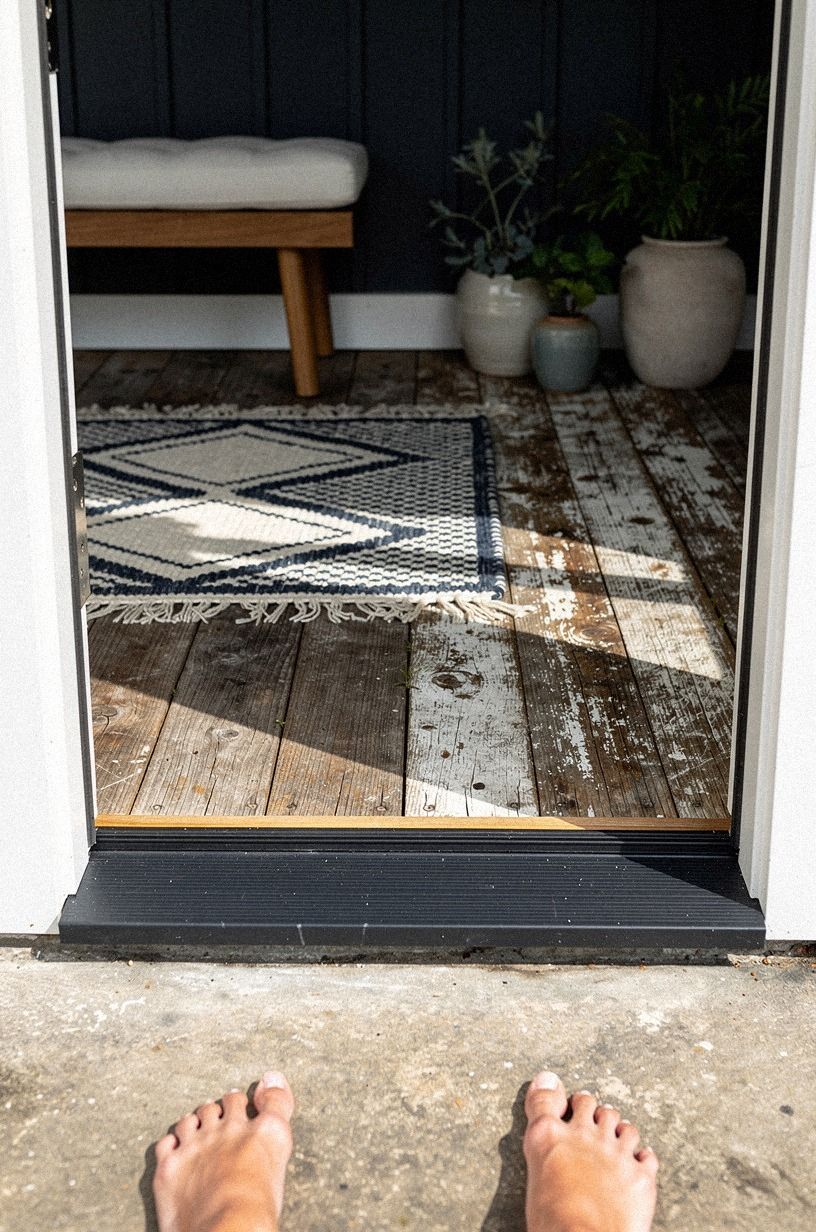
A deep charcoal strip beneath the doorway gives a small porch a clean visual anchor without requiring a full repaint.
15Blend siding color into the porch flooring (The Siding-to-Slab Blend)
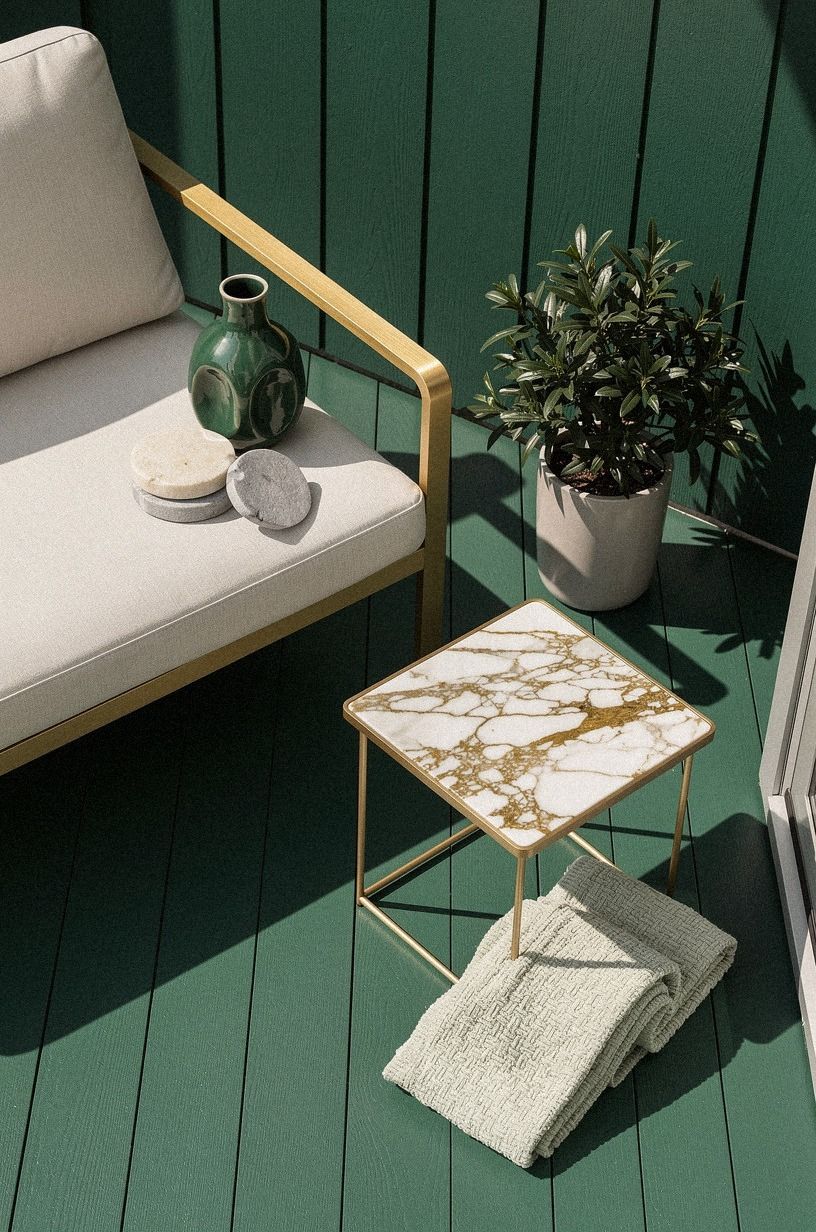
Matching one flooring color to the siding creates a quiet connection between the house and the porch. Emerald, gold, and cream can feel sophisticated when the floor borrows only one shade from the wall. Calacatta marble with gold veining adds a polished note, but the main surface should stay practical.
Use Sherwin-Williams Evergreen Fog SW 9130 as a color reference if the siding has a muted green cast. You’ll want the floor tone to be slightly darker or duller than the wall, so the porch doesn’t look flat. A simple test board can reveal how the color changes in morning and evening light.
Your entry will feel more spacious when the transition is gentle. Don’t force an exact match if the siding receives different light, because near-matches can look accidental. Repeat the color in a planter or cushion, then keep the door hardware warm and restrained.
16Lay small hex tiles around the steps
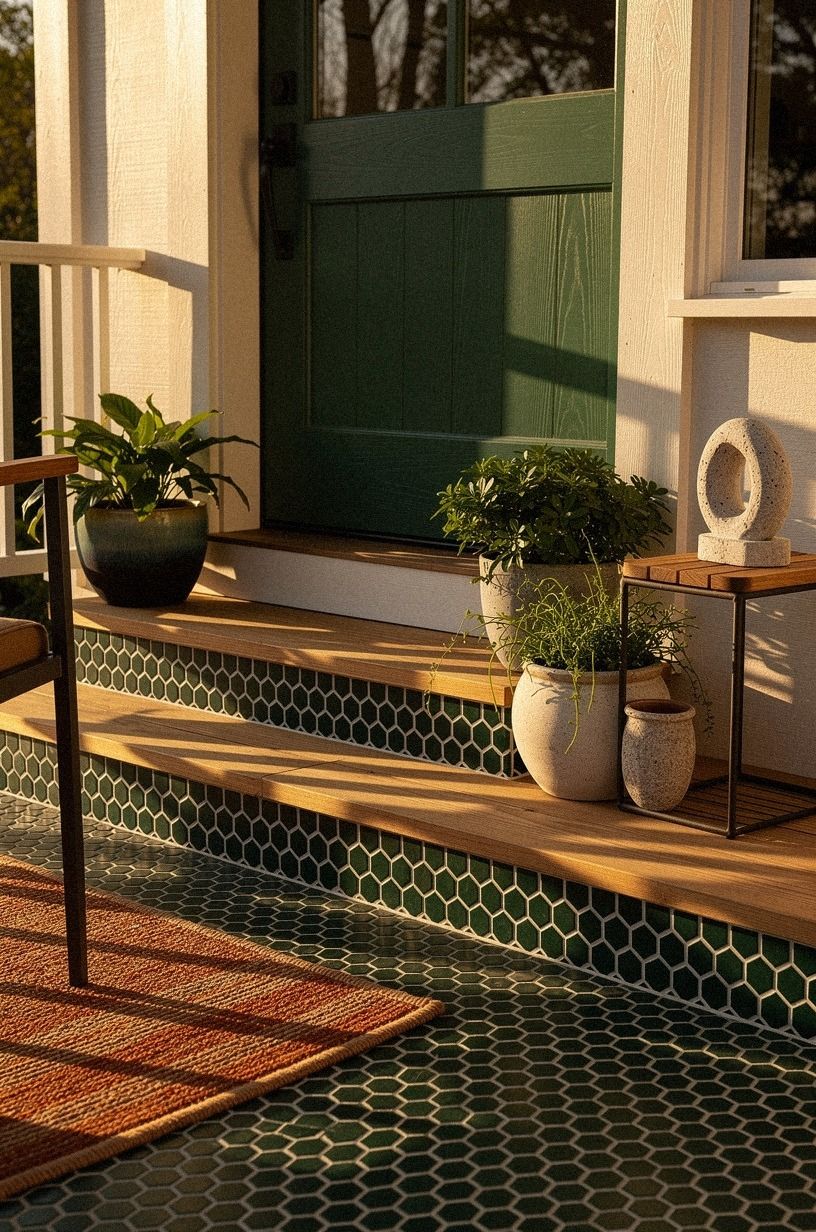
Small hex tiles can outline the steps and give a farmhouse porch a crisp border. Forest green, rust, and natural oak create an earthy palette, while cerused white oak furniture keeps the entry light. The shape works particularly well around corners where straight planks may feel rigid.
Choose exterior porcelain hex tile with a textured surface and a frost-rated body. You’ll want grout lines that contrast gently rather than sharply, because strong outlines can make a small area look busier. Lay the hexes around the step zone, then use a quieter surface near the door.
Your walkway should retain at least 36 in of clear passage. Don’t let the tile border become a trip edge, especially where the porch meets the steps. A narrow planter can repeat the rust tone, while small front porch step layouts can help coordinate the approach.
17Add a faux rug with painted borders
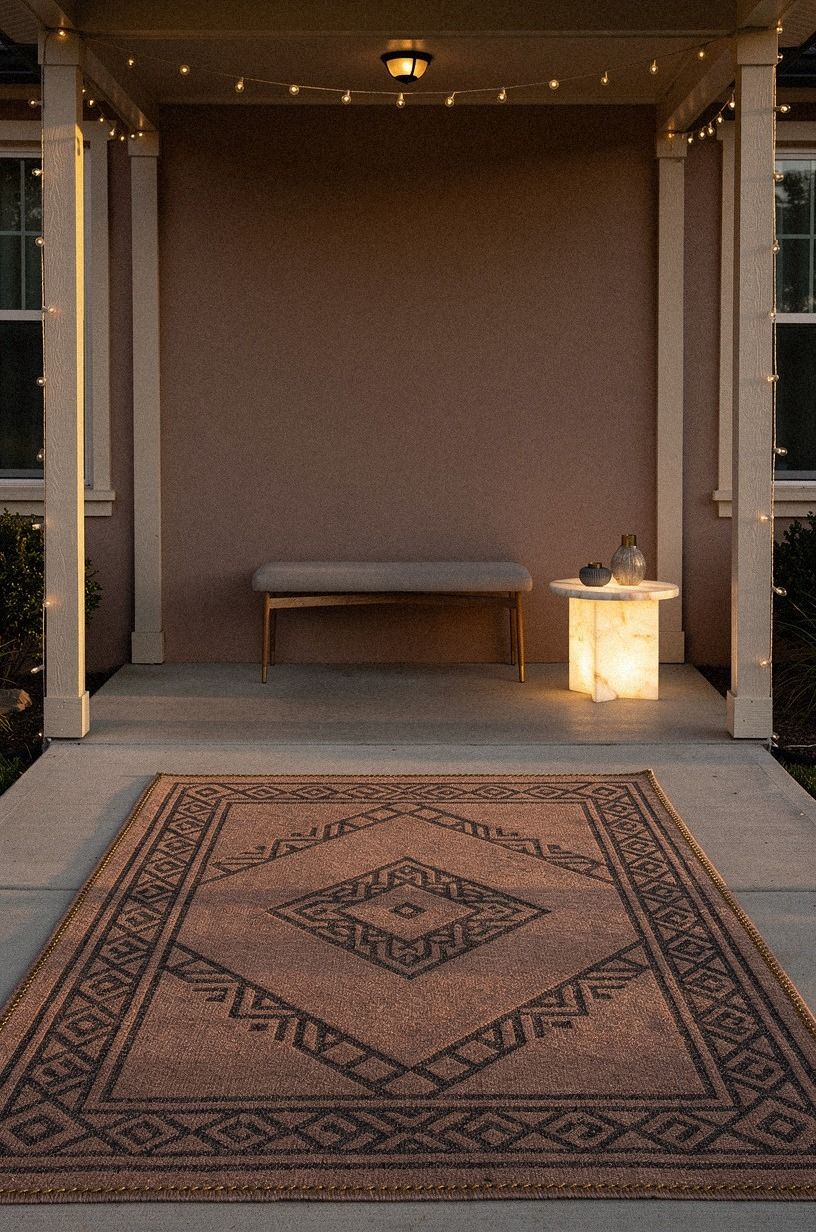
A painted faux rug gives the porch a soft decorative center without adding fabric that can trap moisture. Dusty rose, charcoal, and brass create a welcoming pattern, while backlit translucent onyx can inspire a pale accent near the door.
Use exterior floor paint to draw a border, then fill the center with a quiet neutral. You’ll want rounded corners or a simple rectangular frame, depending on the porch shape. A busy faux rug can feel dated quickly, so keep the motif restrained and let the border do most of the work.
Your floor should still look convincing from the sidewalk. Use a real outdoor mat at the threshold and keep the painted rug slightly away from the door swing. Add one brass lantern and a charcoal planter, then leave the center visible rather than covering it with furniture.
18Seal exposed aggregate for natural texture
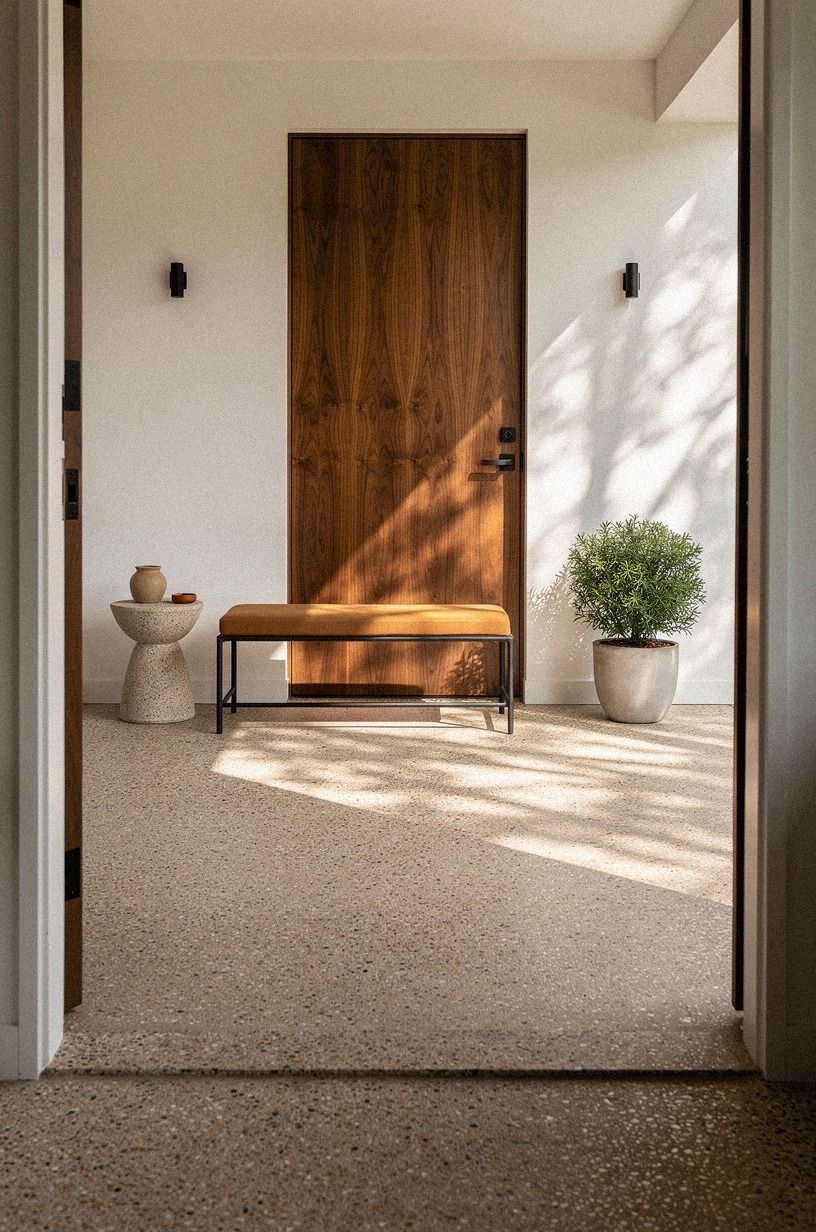
Exposed aggregate can be one of the most practical small porch finishes because the texture disguises small marks and adds visual depth without a printed pattern.
The Practical Case for Low-Maintenance Porch Floors
Small porches reward restraint. A large patio can absorb several materials, furniture groups, and lighting layers, but a compact entry has nowhere for visual noise to hide. The strongest floors usually make one firm decision, such as a painted grid, a brick direction, or a dark threshold, then allow the door and plants to support it.
Weather matters more than trend cycles. A surface exposed to rain needs texture, drainage, and a finish that can be renewed without dismantling the entire porch.
That’s why painted concrete, sealed aggregate, and properly rated porcelain often outperform delicate indoor materials. You’ll get better results when the floor responds to the way your entry is used, whether shoes arrive muddy, packages land near the door, or snow sits against the threshold.
A small porch also benefits from visual continuation. When your floor color repeats in the siding, planter, railing, or door hardware, the entry feels connected to the house.
The repetition doesn’t need to be exact. Slight variation gives the materials room to look natural, while a matching tone can make the porch seem wider.
Cost deserves an honest reading. A budget floor refresh may fit inside a broader outdoor spending range of $200-$900, while larger paving projects belong to a very different investment level.
You don’t need the most expensive surface to create a strong first impression. You need a finish that suits the climate, leaves 36 in of comfortable passage, and still looks good after ordinary dirt arrives.
The practical test is simple: can you sweep it, rinse it, repair it, and live with its texture? If the answer is yes, the floor is doing its job. Your porch should welcome daily use, not demand museum-level care!
The Questions Worth Answering First
What is the best small front porch flooring for a small front porch?
Painted concrete and running-bond brick are strong choices because they offer durable visual structure without consuming much space. You’ll get the best result when the surface follows the entry direction and furniture stays outside the main walking line. A slim wooden stool can add function without crowding the floor.
Where can you buy small front porch flooring pieces on a budget?
Look at Wayfair, Target, local tile outlets, salvage yards, and neighborhood marketplaces for leftover pavers or unopened boxes. Second-hand materials can lower project cost when enough matching pieces are available. You’ll want to inspect every piece for cracks, moisture damage, and inconsistent thickness before installation.
How much does a small front porch flooring makeover cost?
A modest cosmetic update may fit within the broader $200-$900 budget tier when paint, outdoor textiles, plants, and lighting are included. Existing concrete keeps the floor portion lower because demolition is avoided. Your cost rises when the project requires new paving, structural repairs, or extensive drainage work.
Can you create a small front porch flooring look on a budget?
Yes, and painted concrete is the most accessible starting point. Sweep the slab, test two exterior colors, and use a simple border or checkerboard.
Free layout planning saves money before materials arrive. You can also reuse planters, shop surplus tile, and choose one strong accent instead of several small purchases.
Is small front porch flooring worth it in a small space?
Yes, because a compact floor can change the entry’s visual proportion quickly. A clear directional pattern makes the porch feel more intentional without adding furniture. You’ll want to preserve the 36 in walkway clearance and keep the strongest pattern near the threshold rather than beneath every object.
Is small front porch flooring a good idea for a rental?
Yes, when the surface is reversible and the door clearance remains safe. Removable deck tiles, outdoor mats, and painted-look textiles can create a finished appearance without permanent work. You’ll need landlord approval before painting, while freestanding planters and tension-mounted lighting can usually move with you.
Where to Start First
Start with painted checkerboard concrete. It gives a tired slab pattern, color, and a washable exterior finish without raising the threshold. Pin the idea for later, then compare it with these front porch step layouts.