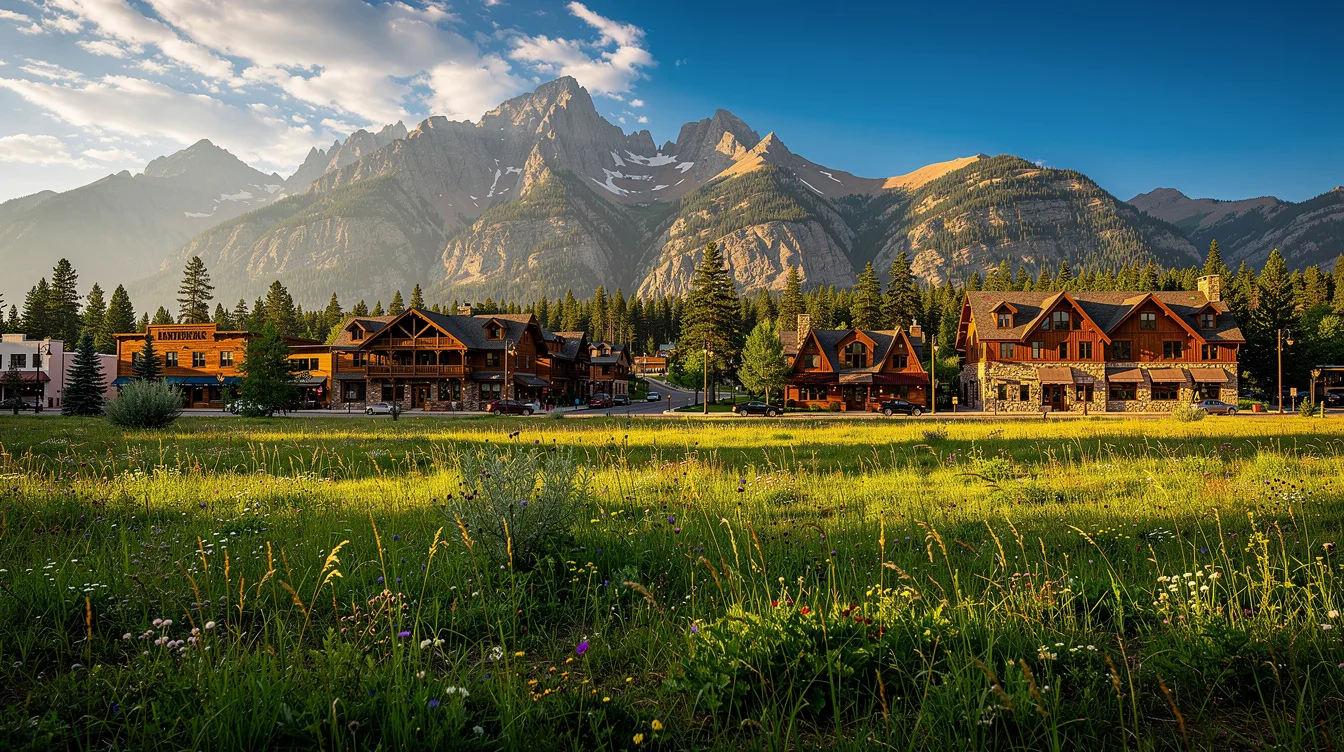
Estes Park dates to 1859, and it sits at the east entrance of Rocky Mountain National Park. The town also holds the park’s headquarters, while the park itself was created in 1915. That combination gives Estes Park a particular pull: you’re in a working gateway town, not simply a place to sleep before the mountains.
And the setting changes the rhythm of a summer visit. The town lies along the Big Thompson River, with the sound of moving water threading through streets lined with shops, cafes, and hotels. But Estes Park isn’t remote in the difficult sense.
It occupies the southwest corner of Larimer County, where roads lead directly toward the park’s eastern entrance.
The park begins where the town gets busy
Rocky Mountain National Park is the main reason travelers come, and the headquarters makes that connection impossible to miss. You can use Estes Park as your base, then move toward the park from town when the day is still cool. That practical arrangement is the town’s strongest advantage.
And summer brings energy to the streets because visitors are moving in both directions. Some are heading toward the park, while others are returning to town with dust on their shoes and a day’s worth of mountain air in their clothes. You can read more about the park’s east entrance before deciding how much time to leave for town.
The trade-off is clear. Estes Park is convenient, but it won’t feel sleepy in summer. If you prefer quiet streets and empty viewpoints, the town’s busiest season may test your patience.
1859 still shapes the town’s identity
The community was founded in 1859, when the valley belonged to the Territory of Nebraska. That date gives Estes Park more than a decorative historical detail. It explains why the town feels older than a typical park gateway, with a long relationship between visitors, lodging, guiding, and the surrounding valley.
And tourism arrived early. Travelers came for hunting, fishing, mountaineering, and the promise of cooler mountain air. Early roads were rough trails for pack horses, but an improved route later connected the valley with Lyons and became today’s U.S.
Highway 36.
You can still see that old travel logic in the town’s layout. People arrive through a gateway, pause for supplies or a meal, then continue toward the park. But the route works in reverse too, because a day in the mountains often ends with a walk beside the river.
Lake Estes gives the gateway town room to breathe
Lake Estes sits below town and was created when Olympus Dam was completed in 1949. The water gives Estes Park a different pace from the park entrance, where visitors often focus on roads, trails, and high country. Here, the views open across the lake toward the surrounding mountains.
And the Big Thompson River runs through the town with a steady, audible presence. A river walk connects downtown’s main street, Elkhorn Avenue, with the water. You can make that walk when the afternoon crowds have thickened, then let the sound of the river provide a little distance from the traffic.
The town’s scale helps. Estes Park had 5,904 residents in the 2020 census, so it isn’t a large resort city pretending to be a mountain village. But summer visitors change the feel of the streets, especially around the central shopping areas.
Lumpy Ridge keeps the view from feeling ordinary
Lumpy Ridge rises immediately north of Estes Park, while Roosevelt National Forest borders the town to the north, south, and east. Those boundaries make the gateway feel physically connected to public mountain country. You don’t need to leave town before the terrain starts shaping the day.
And the town sits at about 7,743 feet, high enough for the altitude to affect how quickly you move. You should take the first morning slowly, especially if you’ve arrived from lower ground. The climb may be worth it, but the elevation is a real part of the experience.
Beyond the park entrance, you can orient yourself around landmarks such as the Stanley Hotel, the Baldpate Inn, and the historic MacGregor Ranch. These places give the valley texture, while the mountains keep the setting from becoming merely architectural. That balance is why Estes Park works better as a destination than as a quick overnight stop.
Should you spend more than one night?
Yes, if you want the town and the park to feel like separate experiences. One day can point you toward the national park, while another lets you explore Lake Estes, the river walk, and the older parts of the community without watching the clock.
And summer is the obvious season because the town functions as a mountain resort then. The days can be warm, while the surrounding high country keeps the setting distinctly alpine. You can plan around the park, but leave room for a slower afternoon in town.
There are limits. Estes Park is a gateway, so summer brings crowds, traffic, and busy lodging. But that liveliness is also useful: restaurants, hotels, historic attractions, and the park headquarters are concentrated close together.
By evening, the Big Thompson River is still moving beside downtown, and the mountains darken beyond Lake Estes. The park is the reason most people arrive, but the town is what gives the visit a place to land.