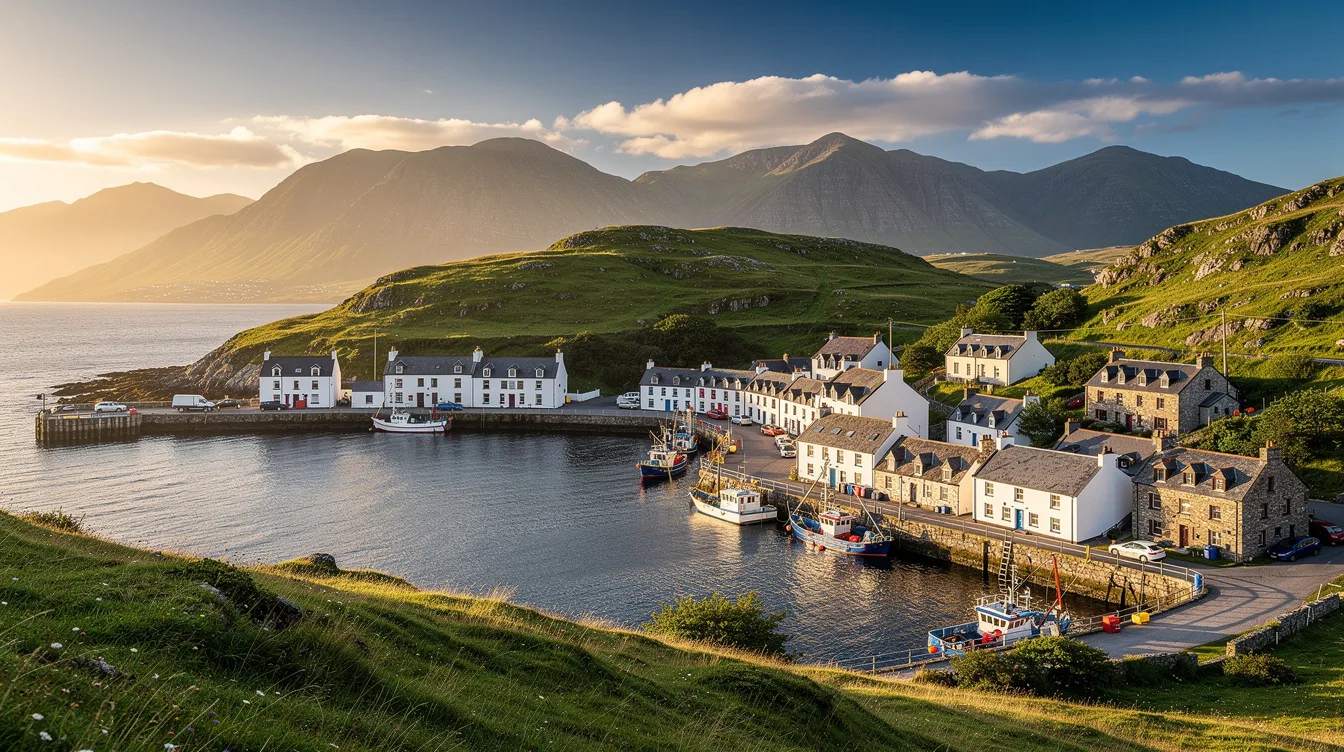
Ullapool was founded in 1788 for one practical reason: herring. The British Fisheries Society established the village as a fishing port on Loch Broom, using a formal plan that gave the waterfront a clear purpose. And that purpose still explains Ullapool better than any postcard does.
But today, ferries, fishing boats, yachts, and cruise ships share the same water.
Why a herring port appeared here in 1788
Before 1788, Ullapool was only a small hamlet of just over 20 households. The British Fisheries Society saw a useful harbor on the east shore of Loch Broom and built around the herring trade. This wasn’t an accidental village that slowly drifted toward the water.
The water came first.
And if you walk along the harbor, that original logic remains easy to read. The settlement faces a deep sea loch with room for working vessels and larger boats. But it isn’t only a historical backdrop.
The harbor still carries the practical, working character that made the town worth founding.
Loch Broom made the location work
Ullapool sits on the eastern shore of Loch Broom, a substantial natural harbor in the Scottish Highlands. The loch gives the port shelter and access to open water, which is why the village could support fishing before it became a stop for travelers. You notice the geography first, then the history starts making sense.
And the town is far enough to feel remote without being cut off. The road approaches through mountain country, while the water opens toward the west. But Ullapool isn’t difficult to place on a map.
It is a small port with a direct relationship to both the loch and the road.
The harbor still works for more than fishing
What is the harbor used for now?
The harbor now serves fishing vessels, leisure craft, cruise ships, and ferries to Stornoway on the Isle of Lewis. That mix changes the feel of the waterfront from hour to hour. You might see the traces of a working port, then watch a ferry turn the same water into a route across the Minch.
And the ferry connection gives Ullapool a role far beyond its size. The village is also on the A835, the road from Inverness toward Durness and part of the North Coast 500 route. But road traffic and sea traffic don’t erase the older identity.
They build on the reason the settlement exists.
A small hamlet became Wester Ross’s largest settlement
According to 2016 Scottish Government figures, Ullapool had 1,520 people, making it the largest settlement in Wester Ross. That number helps explain the town’s balance. It has enough residents for shops, accommodation, pubs, restaurants, arts spaces, and a swimming pool, yet the water remains close at hand.
And the connection inland began early. A road linking Ullapool with Dingwall was started in 1792, only four years after the port was founded. Permission for a railway to connect the village with the Highland network came in the 1890s, although the railway never became part of the town’s everyday story.
But the ambition was clear: this harbor was meant to connect outward.
Music gives the port a second life
Ullapool’s cultural life keeps the village from feeling like a place built only for transport. The Ceilidh Place combines accommodation, food, and music, while the Macphail Centre includes a small theater. An talla solais adds an arts center, and local halls and hotels host music events throughout the year.
And if you visit in early October, the annual Ullapool Guitar Festival brings performers to several venues around the village. You don’t need a grand event to understand the appeal. A small room, a tune carrying through the evening, and the dark water outside can tell you more about Ullapool than a crowded itinerary.
What Ullapool asks you to notice
Ullapool rewards travelers who look for function beneath the scenery. Its mountains and loch draw the eye, but its strongest story is more specific: a planned herring port that grew into a ferry town, fishing harbor, and cultural stop. You can admire the views, but the harbor explains the place.
And when a ferry moves away from the waterfront, the original idea becomes visible again. Ullapool was founded because the water could carry work outward, and it still does. The loch holds the village at its edge, gray, open, and busy enough to remember why the town began.