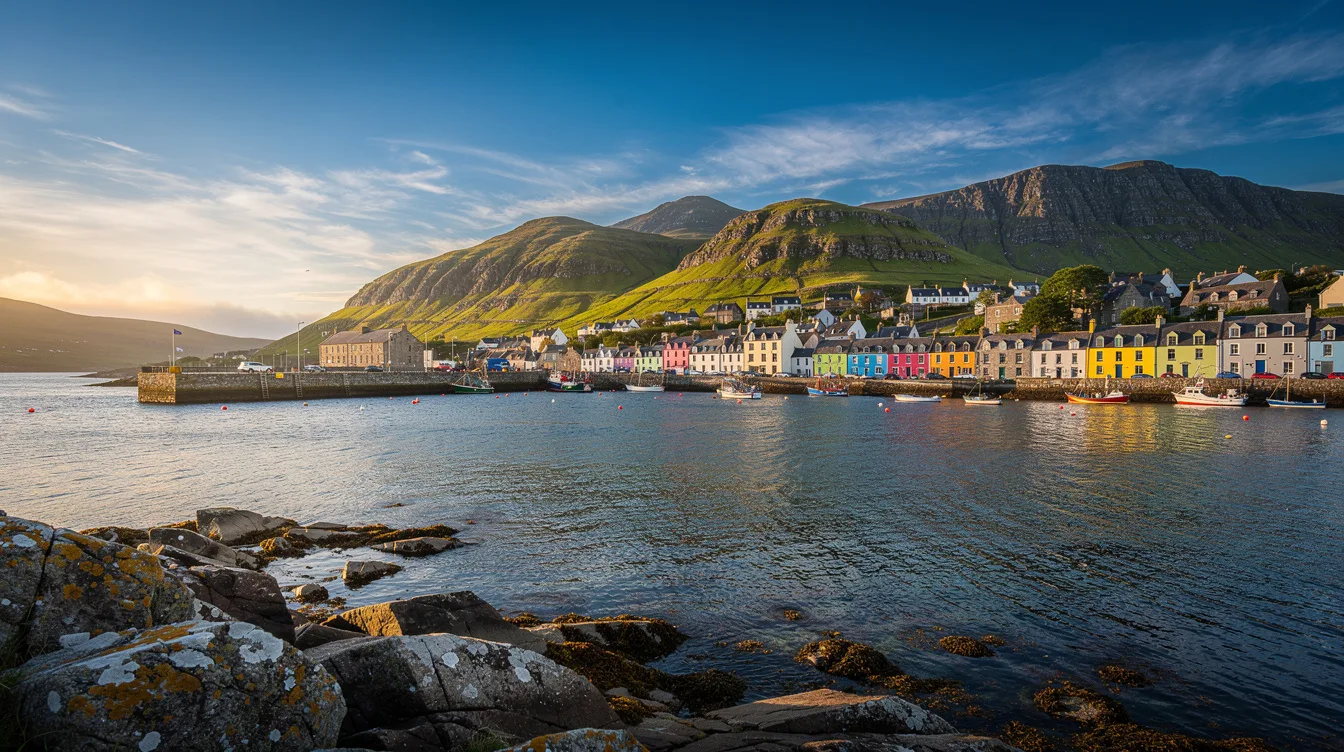
Portree relied on the United Kingdom’s last manual telephone exchange until 1976. An operator connected calls by hand, a detail that gives this small Isle of Skye town a surprisingly modern story. And today, the harbor still feels more working town than postcard stop.
Portree sits at the end of a sheltered bay on Skye’s east coast. But the town’s appeal isn’t only its history. Pastel façades face the water, and boats shift against the pier.
The last manual exchange gives Portree its sharpest story
Before the switch to a modern system, Portree depended on a manual exchange to connect telephone calls. And because it closed in 1976, the town became the final place in the UK where that older system remained in service.
The fact works because it feels so close to everyday life. This wasn’t an ancient relic behind glass. It was part of how people reached one another in a town that had only 2,281 residents in 2022.
But Portree isn’t frozen around that fact. You can walk from the harbor to Somerled Square, where shops and services keep the town useful after visitors leave the waterfront. That balance is the point: historic, but still practical.
Pastel houses make the harbor worth a slow walk
Start at the pier and look back toward the row of colorful houses. And take your time here, because the view changes as boats move across the bay and the light reaches different façades.
The pier was designed by an engineer, though Portree’s version feels modest and close to the water. You’ll hear gulls, footsteps, and the small sounds of a harbor town rather than the rush of a city.
From there, climb toward The Lump, the small rise above the harbor. But don’t expect a long hike or a wilderness expedition. The reward is a broader view across the bay, with a tower and rooftops below.
Scorrybreac gives you a longer coastal walk, with views toward Raasay. It’s a better choice when you want salt air and open water under your feet. And the route makes Portree feel larger than its population suggests.
Portree’s oldest story reaches back 4,500 years
Archaeological work found evidence of occupation around Portree from the Early Bronze Age through the medieval period. The earliest radiocarbon date was 2570 BC, which places people here long before the manual exchange ever connected a call.
And the discoveries included timber roundhouses, stone tools, pottery, and features linked to earlier settlement. You won’t see all of that on a casual walk through town, but it changes how the harbor reads. The modern streets sit above a much older human record.
Beyond the square, Portree works as a base for Skye’s northern sights. The roads lead toward Trotternish, the Old Man of Storr, Kilt Rock, and the Quiraing. But this is where a car becomes useful, since local buses are infrequent.
Can you reach Portree without a car?
Yes, but you’ll need patience. Buses connect Portree with other parts of Skye, and the trip from Inverness takes about three hours by coach, depending on the service.
There’s no train on Skye, so the nearest station is at Kyle of Lochalsh on the mainland. And from the Skye Bridge near Kyle, Portree is about 34.8 miles north along the A87.
Glasgow takes about six hours by coach, while driving from Edinburgh takes roughly 5 hours 30 minutes to 6 hours 30 minutes, depending on traffic and stops. But once you arrive, you can walk between the harbor, Somerled Square, and The Lump.
Use Portree as a base, not your whole Skye itinerary
Portree has hotels, guesthouses, independent rentals, cafés, restaurants, supermarkets, and other basic services. And that makes it a sensible place to sleep before heading toward the island’s larger sights.
The town is livelier than a remote village, but it never feels like a city. You’ll find more convenience than solitude, which is the trade-off. Stay here for access, then walk the waterfront when the day’s visitors have moved on.
By evening, the pastel houses darken against the bay and the boats settle beside the pier. But Portree’s strongest detail remains the simplest one: until 1976, someone in this town still connected calls by hand.