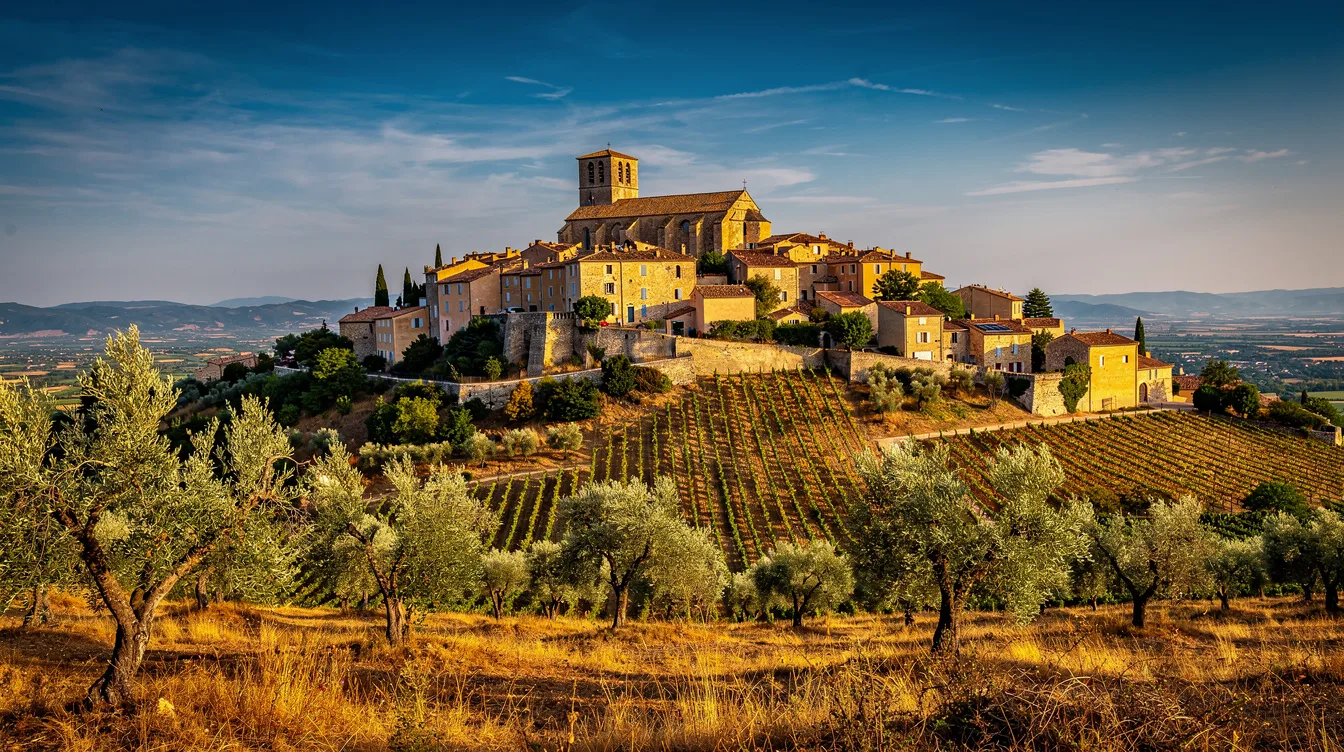
And when you reach Mirmande, look up. The village rises through stone lanes toward Sainte-Foy, a 12th-century Romanesque church perched at the summit.
But the church is only half the pleasure. Mirmande belongs to Les Plus Beaux Villages de France, yet it feels more intimate than the heavily visited Provençal towns farther south. You can wander without a strict route, following paved lanes upward until the Rhône Valley opens below.
Sainte-Foy gives the village its reason to climb
And Sainte-Foy rewards the effort because its forecourt has an open view toward the Rhône Valley and the Ardèche mountains. The former castral chapel is now desacralized, used for exhibitions and concerts, so the building feels connected to village life rather than sealed away as a monument.
But the climb is real. The streets are steep and paved, and you’ll want sturdy shoes before leaving the lower village. Start slowly, pause in a small square, and let the stone walls do their quiet work.
The route takes about 1.5 to 3 hours if you include the church, lanes, galleries, and a drink.
And you should resist rushing straight to the top. The best details appear along the way: vaulted passages, uneven calades, old stone façades, and sudden glimpses across the valley. The Drôme feels especially appealing here because the village gives you history without demanding a full day.
Stone lanes, artists, and a slower kind of visit
And Mirmande’s artistic character is easy to notice. Workshops and galleries occupy the old streets, continuing a connection that grew around a summer academy in the 1920s. You can browse quietly, then step outside into air scented by gardens and fruit trees.
But this isn’t a place built around constant activity. The village is lively in season, but never loud, and the pleasure comes from moving at walking speed. If you’re used to Provence’s busier stops, Mirmande feels like a useful change of tempo.
And the lower church, Saint-Pierre, explains how the village once served people living below the hill. Built in 1845 for easier access from the valley hamlets, it gives the visit a practical counterpoint to Sainte-Foy’s high position.
On a practical note, you can connect Mirmande with Montélimar or nearby Cliousclat, known for pottery. The setting also appeared in a 2017 film, but you don’t need to know the movie to understand why these streets work on camera.
Spring and autumn show Mirmande at its best
And spring is the season I’d choose first. The orchards flower, the lanes feel fresh, and the climb toward Sainte-Foy has a softer rhythm. Local fruit production includes cherries, apricots, peaches, plums, and kiwis, with availability changing through the year.
But autumn may be even better for photographers and slow walkers. The light grows gentler, the stone takes on warmer tones, and the views toward the valley become easier to linger over. Summer can work too, especially early in the morning or late in the day.
And you can arrive before 10 a. M. Or around 5 p.
M. To avoid the hardest heat. The village is free to enter year-round.
Sit with a coffee, listen for footsteps on the paving, and leave space for the place to unfold.
How do you reach Mirmande without overplanning?
And Mirmande sits in the Drôme, about 12.4 miles north of Montélimar and 18.6 miles south of Valence. That makes it an easy stop along the Rhône Valley and a sensible detour for a Drôme-Ardèche itinerary.
But you’ll need to park below the village and continue on foot. The slope becomes part of the experience.
And if you visit on Saturday morning, the weekly market usually runs from 9 a. M. To 1 p.
M. That’s a good time to pair the climb with local produce before heading upward. You can also find a nearby route for a more active outing, including a roughly 14.9-mile mountain-bike course intended for experienced riders.
By the time you reach Sainte-Foy, the village has narrowed to stone, sky, and the valley beyond. The last sound may be your shoes on the calades, with the orchards below catching the late light.