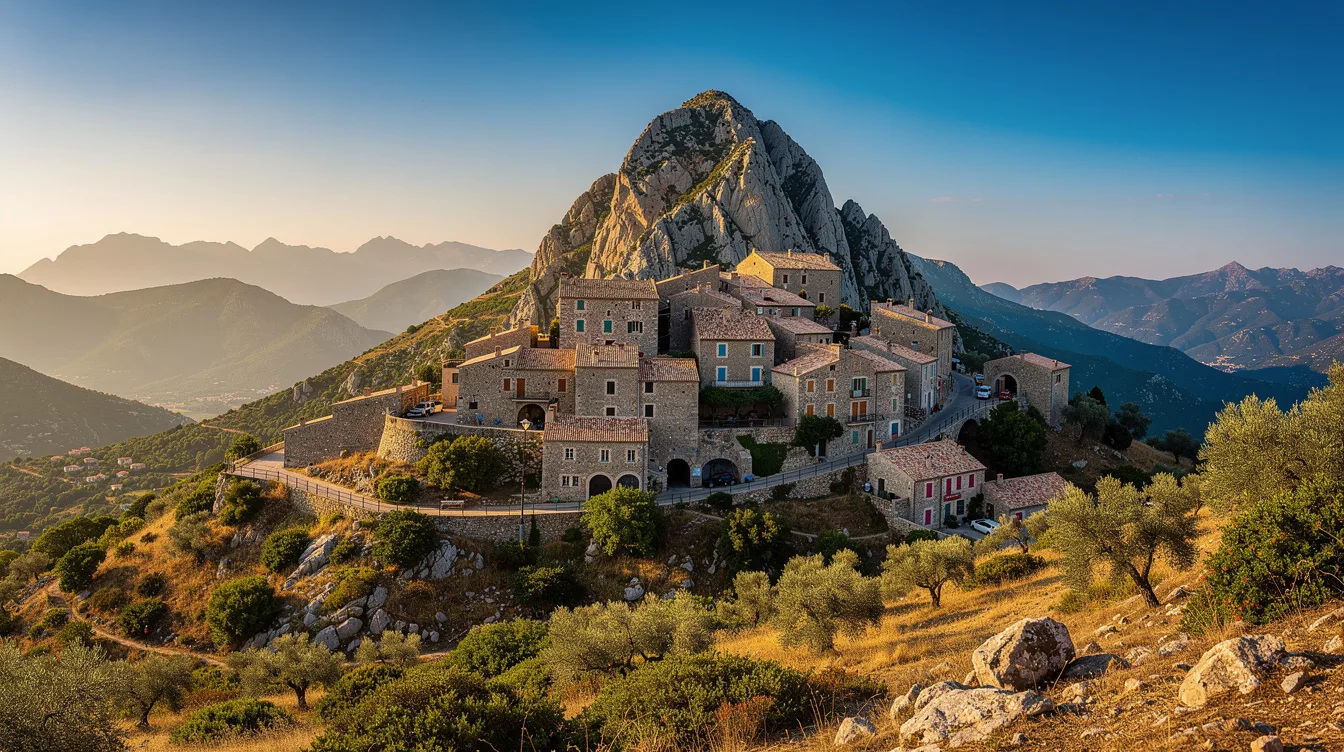
In Sant’Antonino, about 75 stone houses gather around a granite peak high above Balagne. The village sits at roughly 1,640 feet, with narrow lanes, vaulted passages, steep stairs, and tunnels folding into the rock.
But the real pleasure is getting slightly lost. You’ll turn through a shaded passage, find a sudden patch of blue sky, then hear your shoes strike old stone. Traditionally founded in the early 9th century, Sant’Antonino still feels built for defense rather than convenience.
A granite peak gives the village its shape
But Sant’Antonino isn’t a village with a scenic overlook added afterward. The rock is the organizing idea, so the houses cling tightly to it and the streets twist instead of running straight.
And you should walk without chasing a fixed route. The lanes open into covered passages, abrupt stairways, and small tunnels before climbing toward the highest point. That maze is the village’s strongest feature, especially when the morning light reaches only the upper walls.
The summit near the old fortification remains are your reward. From there, you may see the Balagne countryside, olive groves, mountains, Calvi Bay, L’Île-Rousse, and the Mediterranean when visibility is good. Read more about exploring Balagne’s hill villages before you plan your route.
Why the early morning changes everything
But this is a place where timing matters more than speed. Visit early or late in the afternoon, and the heat feels manageable while the lanes remain quieter. Come during the busiest summer hours, and the same narrow paths can feel crowded.
And you’ll notice the difference in the stone. In softer light, old façades and archways show their uneven surfaces, while the high point catches the sun above the rooftops. The best visit lasts 45 minutes to 1 hour 30 minutes, though you’ll need longer if you add lunch or a walk beyond the village.
Sant’Antonino is lively, but never sprawling. Because the village is compact, you can see its essential character in a short stop, then continue toward another corner of northwestern Corsica.
The climb is short, but the footing matters
But don’t treat the visit as a flat village stroll. Some lanes and stairs are very steep, and the stone underfoot can make each turn feel more deliberate than the distance suggests.
And you’ll park at the entrance or below the village before continuing on foot. Wear stable shoes, especially if you want to reach the highest viewpoint. There’s no reason to rush the climb, because the best details are close to eye level: arcades, old façades, a former bread oven, and a traditional press.
Can you combine Sant’Antonino with other villages?
Yes, you can make it part of a half-day or full-day loop. But keep the order flexible, since heat and summer crowds may decide how long you stay.
And a practical route runs from Calvi through Pigna and Sant’Antonino, then toward Aregno and L’Île-Rousse. Pigna is about 15 minutes away by car, while Calvi and L’Île-Rousse are each roughly 30 minutes from Sant’Antonino.
What to see beyond the lanes
But the village deserves more than a quick photograph from the road. At the entrance or lower edge, the Church of the Annunciation dates from the 17th century and holds an 18th-century organ along with older works.
And nearby, the confraternity chapel is known for its wall paintings. You can also look for the small signs of traditional Corsican life built into the houses, including old work spaces and façades shaped around the rock. The architecture is the attraction, not a single grand monument.
When you’re ready to widen the day, follow the road toward L’Île-Rousse. The coast gives the visit a different rhythm, but Sant’Antonino is where the journey feels most concentrated.
A village worth seeing before the heat arrives
But Sant’Antonino works best when you give it a little quiet. Arrive early, climb slowly, and let the changing views pull you through the passages instead of treating the village as a checklist.
And you should accept the trade-off: the elevation brings broad views, but the stairs demand steady footing. At 1,640 feet, the village sits high enough to feel removed, even though the drive from Calvi or L’Île-Rousse takes only about 30 minutes.
By late afternoon, the granite walls hold the last warmth of the day. Below them, the lanes grow quiet again, and a single patch of Mediterranean blue appears between the roofs.