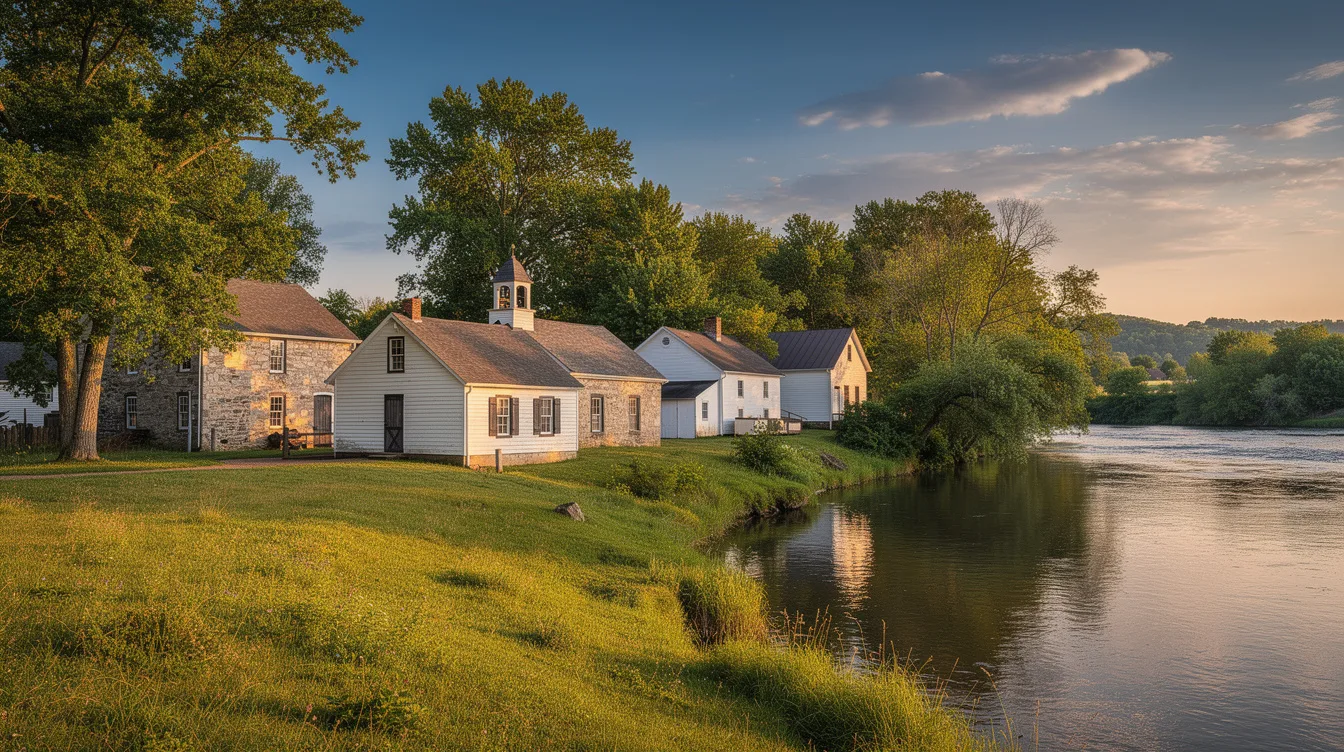
Overlooked by tourists, Zoar was founded in 1817 by about 200 German religious dissenters. They left Württemberg to escape persecution, then built a communal village in Ohio’s Tuscarawas County. The arrangement lasted until 1898, when the society dissolved and its shared property became private.
Today, Zoar remains inhabited, with 172 residents recorded in 2020. The historic district is small enough to explore slowly, but its story is unusually large. I think that’s the appeal: you aren’t visiting a stage set, but a living village shaped by an experiment that actually lasted.
Why Zoar’s 1817 experiment still feels unusual
But the founders weren’t simply forming another German settlement. In 1819, they created the Society of Separatists of Zoar, with collective ownership, shared work, and community support for daily needs.
And the system reached far beyond farming. The community ran mills, textile workshops, a forge, foundries, stores, a cooperage, and wagon-making operations. The Ohio & Erie Canal also brought business through the settlement, helping it grow beyond a small agricultural outpost.
A village built around shared work
But Zoar’s communal economy eventually covered more than 10,000 acres. That figure helps explain why the settlement could support so many trades and maintain a degree of independence in rural Ohio.
And the buildings still make that organization easier to imagine. Restored homes, shops, gardens, and work buildings line the historic area, with brick and sandstone giving the village a sturdy, workmanlike character. You can sense the practical priorities here, even when the streets are quiet.
What you’ll see at 198 Main St
But don’t expect a sprawling attraction with a full day’s worth of diversions. The main historic area is concentrated around 198 Main St, where guided visits generally include museums and about a dozen restored buildings.
And that compact scale works in Zoar’s favor. The site has roughly 12 restored buildings, so you can pay attention to details instead of rushing between distant stops. I prefer that pace, especially if you’re interested in how ordinary rooms supported an unusual social system.
Can you visit without a guide?
Yes, you can take a self-guided visit on certain days from May through September. The published adult price is $10 for self-guided access, while guided visits cost $12 per adult and $6 per child.
When to go, and what to check first
But opening hours aren’t identical throughout the year. In October, the historic site usually opens on Saturdays from 11 a. M.
To 4 p. M., while the May-to-September schedule varies by day.
And you should check the official schedule before setting out, because events can change those hours. Zoar is remote in feel, but not difficult to locate, sitting between Cleveland and Columbus in eastern Ohio’s countryside.
Zoar is quiet, but it isn’t empty history
But the village’s strongest detail is its continued life beyond the historic district. The 2020 count of 172 residents means modern households still share space with restored buildings and preserved gardens.
And that makes the visit more interesting than a polished reconstruction. You can walk through a place where communal property ended in 1898, yet the village itself never disappeared. By late afternoon, the old brick and sandstone buildings sit quietly along Main Street, with the day’s history still close to the surface.