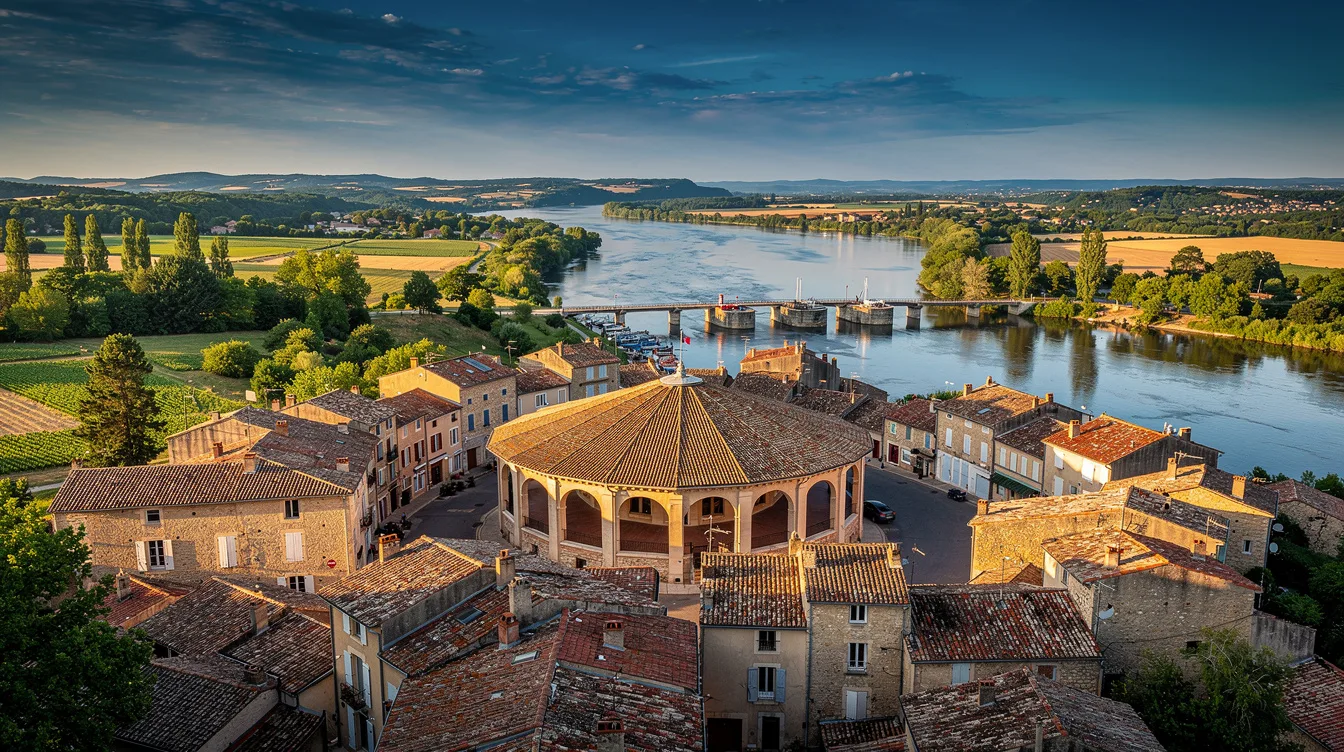
Auvillar sits above the Garonne in France’s Tarn-et-Garonne, and its old port once handled 3,000 boats a year. That traffic helped turn a hilltop settlement into a trading village, even though the river now feels much quieter.
And that contrast is the reason to come. You can walk from the historic center toward the port, then look back at the village rising above the water and understand why this location mattered.
A port built on river traffic
At the beginning of the 19th century, boats carried trade along the Garonne below Auvillar. The village prospered because its position above the river connected commerce with a defensible, walkable center.
But the old port is only part of the story. You’ll also find the local history of pottery, goose-feather pens, and river navigation at the museum of Old Auvillar, which gives the village’s quiet streets a more practical past.
And the descent toward the water changes the mood. The high village opens toward views of the Garonne and the Quercy hills, while the port area recalls the working river that once brought regular movement below the houses.
The circular hall gives the center its shape
The village’s clearest landmark is the circular market hall, built in 1824 at the center of a triangular square. Its unusual form makes the heart of Auvillar easy to recognize, even before you’ve learned the street plan.
And this is where I’d begin your visit. The hall feels less like a grand monument than a piece of civic furniture, built for ordinary market life and still strong enough to organize the square around it.
But look closely at the setting before moving on. Pink brick, pale stone, and Garonne pebbles give the center a restrained palette, while the surrounding arcades and old streets keep the place lively without making it loud.
Walk through the old gate, then look down
The Clock Tower marks the entrance to the historic village through a former fortified gate dating from the late 16th century. Pass beneath it and the streets narrow into an easy walk through galleries, workshops, and older buildings.
And you should save time for the Church of Saint Peter and the Chapel of Saint Catherine of the Port. Their connection to the village’s religious and river history adds depth to a center that could otherwise seem designed only for photographs.
But the strongest view comes at the Place du Château. The village sits on a rocky outcrop above the river, so the height gives you a wider sense of the Garonne and the countryside beyond the immediate streets.
Can you see Auvillar without rushing?
Yes. Plan on 2 to 3 hours for the center, the hall, the church, the Clock Tower, the viewpoint, and the walk down toward the port.
And that pace suits Auvillar better than a quick photograph from the roadside. You can pause beneath the hall, browse the artisan workshops, and let the village reveal how its trading past shaped the present.
But there’s a limit: the sources don’t specify a best season, so don’t build your trip around a particular month. If you visit on a Sunday morning, a producers’ market is usually held on the square, giving the center a more immediate purpose.
How do you get there from the highway?
Auvillar lies between Agen and Montauban in the Tarn-et-Garonne. From the A62, take exit 8 for Valence-d’Agen, then continue about 3.1 miles to the village.
And Valence-d’Agen is also the closest railway station, about 3.4 miles away. Agen-La Garenne Airport is approximately 21.1 miles from Auvillar, while Toulouse-Blagnac is about 55.9 miles away.
But the village works best as a deliberate stop, not a rushed detour. Check the [official Auvillar site](https://www. Auvillar.
Fr/) before leaving, then allow enough time to park, climb into the center, and walk back toward the river.
The quiet payoff is below the square
Auvillar belongs to the Plus Beaux Villages de France and sits on the GR65 route to Santiago de Compostela. Those labels bring visitors, but the village’s appeal comes from the connection between its elevated center and its working-port history.
And that connection is easy to feel as you leave the hall behind. The square grows quieter, the view opens, and the old river route becomes more legible from above.
But don’t expect a full-day attraction packed with diversions. Auvillar is better for a measured half-day, when the stones, galleries, and river views have time to settle.
By the time you look down from the village toward the Garonne, the number becomes tangible: 3,000 boats once passed through the port each year, far below the same quiet hillside.